A washerman owned a donkey so thin you could count every rib through
its hide. Each night the donkey brayed with hunger, and each night
the washerman lay awake feeling guilty, because he had no money for
extra feed.
One morning, walking through the forest, the washerman stumbled upon
a dead tiger. An idea sparked in his mind. He skinned the tiger
carefully, rolled up the heavy striped hide, and carried it home.
That night, he draped the tiger skin over his donkey and set it loose
in the neighbouring fields.
It worked beautifully. The farmers saw the "tiger" prowling through
their crops in the moonlight and ran screaming into their houses,
bolting every door. The donkey ate all night long — rice, wheat,
sugarcane, mustard greens — and grew fat and happy.
Night after night, the same trick. The donkey wore the tiger skin
and feasted while the whole village trembled behind locked doors.
But one night, standing in the middle of a moonlit cornfield with
stalks rustling all around it, the donkey heard another donkey
braying in the distance. The sound was sweet and familiar. And
without thinking — without remembering the tiger skin on its
back — it opened its mouth and brayed back.
"HEE-HAW! HEE-HAW!"
The farmers heard that sound and knew instantly. "That is no tiger!
That is the washerman's donkey!" They came running with sticks
and lanterns.
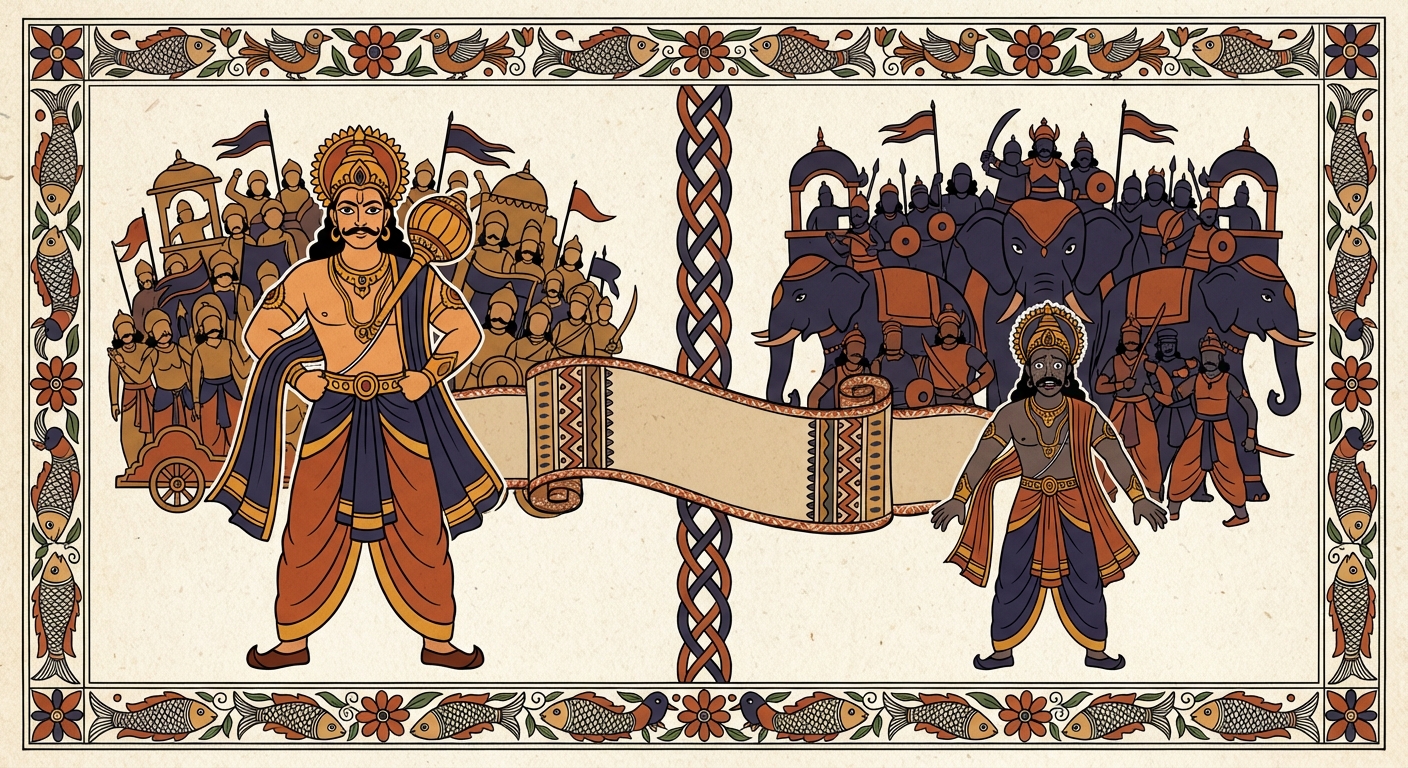
Duryodhana's words in this verse are like that tiger skin. On the
surface, he roars: "Our army is unlimited! Theirs is small!" He is
puffing up his chest, trying to look like a tiger before his teacher.
But the Sanskrit word "aparyaptam" has two opposite meanings: both
"unlimited" AND "insufficient." So his boast accidentally brays out
his real feeling: our army is not enough.
The great poet Vyasa wrote it this way on purpose. He let Duryodhana
wear a tiger skin of words while underneath, the frightened donkey
was braying. Sanskrit poets called this "shlesha" — a pun where one
word carries two truths at once.
Sometimes the bravest-sounding words are the most frightened ones.