Nisha had never been to a fireworks show before.
Her grandmother had told her stories about the Diwali celebrations in
the big city — "Louder than thunder, brighter than a hundred suns" —
but Nisha had rolled her eyes. How loud could it really be? She had
heard thunder plenty of times from the safety of her bedroom, rain
tapping the glass, distant rumbles rolling across the sky like
furniture being dragged across a floor. Thunder was fine. Thunder was
manageable.
Her father drove them to the riverbank at dusk. Hundreds of families
were already gathered on the sandy shore, sitting on blankets and
plastic sheets, children running between the legs of adults like
excited puppies. The air smelled of roasted peanuts from a vendor's
cart and the faint sulfur-sweetness of sparklers that some children
were already waving in looping circles of gold.
"It starts at eight," her father said.
At 7:59, Nisha was licking the last of a mango ice cream bar,
perfectly calm.
At 8:00, the world exploded.
The first rocket screamed upward from a barge in the middle of the
river and burst into a chrysanthemum of red and gold. The boom hit
Nisha's chest like a fist. Before she could catch her breath, three
more went up — green, silver, violet — each one detonating with a
crack that rattled her teeth. Then ten more. Then twenty. Then too
many to count.
The sound was not like thunder at all. Thunder rolled and faded.
This sound did not fade. It stacked. Each explosion layered on top
of the last — booms, crackles, whistles, hisses — until the air
itself seemed to vibrate like a drumhead. Nisha felt the sound in
her feet, in her stomach, in the bones of her skull. The river
reflected the fire back in wobbly pillars of color, doubling
everything, so the sky and the water were both on fire at once.
Nisha pressed her hands over her ears, but the sound came through
anyway. It was not just loud. It was everywhere. It was inside
her. Her heart was beating in time with the explosions, or maybe
the explosions were beating in time with her heart. She could not
tell the difference.
When it finally stopped, ten minutes later, a silence settled over
the riverbank that felt just as enormous as the noise had been.
Smoke drifted across the water, smelling of gunpowder and burnt
cardboard. Nisha's ears rang. Her hands were shaking.
"Well?" her father asked, grinning.
Nisha opened her mouth. Closed it. Opened it again. "I think," she
said quietly, "the sky just cracked open."
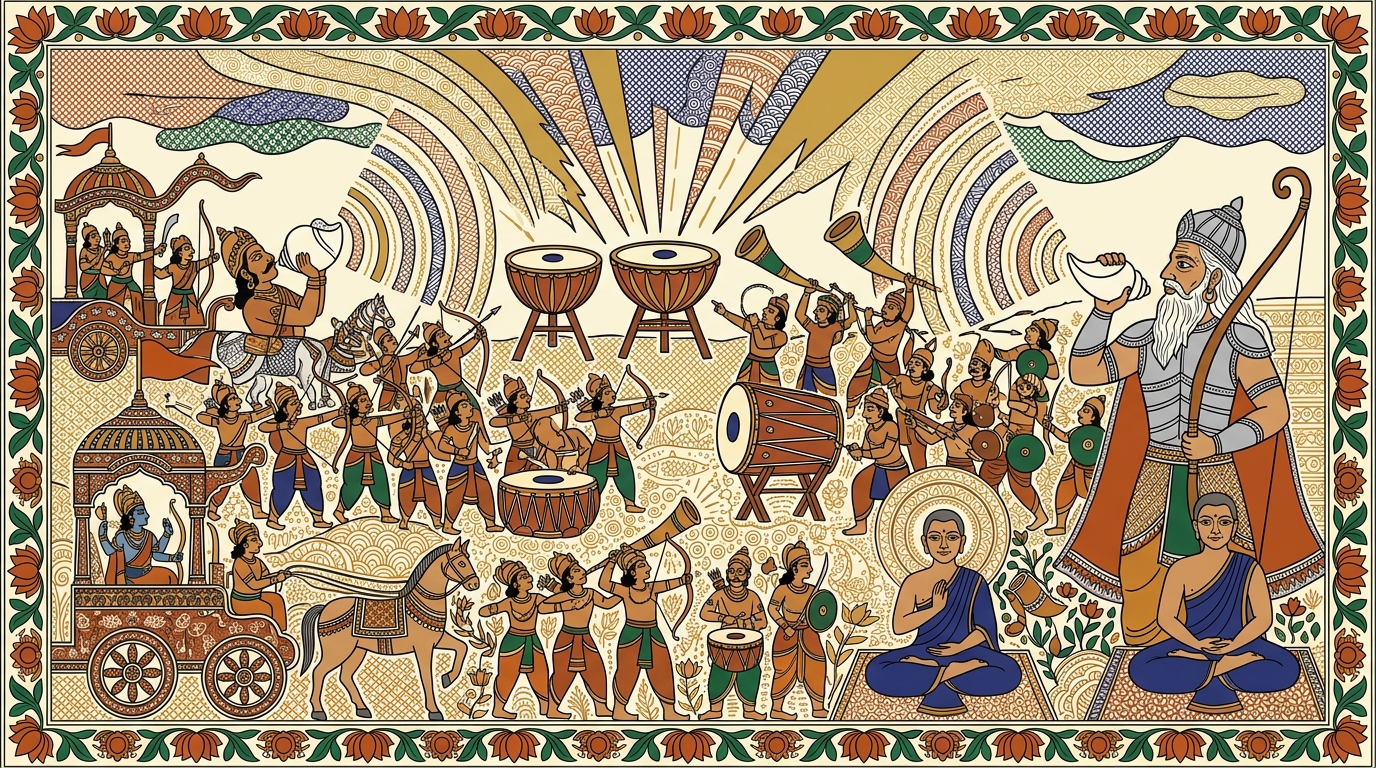
That is what the Kaurava war drums sounded like on the field of
Kurukshetra — not one sound but a hundred instruments erupting
together, so loud that the earth shook and the sky seemed to split.
The word the Gita uses is "tumula" — tumultuous, overwhelming. A
sound that does not just enter your ears but takes over your body.