Mira's older brother Kartik had a trick he used on her every single
time they played chess.
The trick was not a move on the board. It was a sound. Whenever Mira
was thinking hard — her chin resting on her fist, her eyes narrowed,
her fingers hovering over a piece — Kartik would start drumming his
fingers on the table. Not loudly. Just a soft, steady tap-tap-tap-tap
against the wood, like rain on a windowsill.
It drove her crazy.
She would lose her train of thought. The brilliant three-move
combination she had been building in her head would dissolve like
sugar in water. She would grab a piece in frustration, make a bad
move, and Kartik would pounce.
"Stop drumming!" she said one evening, after losing her third game
in a row. They were sitting at the kitchen table, the chess board
between them, the overhead light casting sharp shadows across the
black and white squares.
Kartik grinned. "I'm not doing anything. Just tapping."
"It's not just tapping. You do it on purpose. You do it every time
I'm about to find a good move."
He shrugged, still grinning. "Sound is a strategy, Mira. Every
general in history knew that. War drums, trumpets, battle cries —
they were not for entertainment. They were weapons. The Romans
marched in sync so the ground shook and their enemies felt it in
their bones. The Zulu warriors sang before battle to turn their
own fear into the enemy's fear. Sound gets inside your head before
an arrow can get anywhere near you."
Mira stared at the board. She hated that he was right.
The next day at school, she went to the library and read about
something called "psychological warfare." She learned that armies
throughout history used noise to break their enemy's concentration
before a single weapon was raised. The Mongols tied branches to
their horses' tails so the dust cloud made their army look ten
times bigger, and the thundering hooves sounded like the end of
the world. Scottish Highland warriors screamed as they charged,
and the scream often won the battle before the swords touched.
That evening, she sat down across from Kartik and set up the
pieces. He made his first move. She made hers. Then she began
to hum — a soft, steady tune, barely above a whisper, the same
three notes over and over.
Kartik's grin faded. His fingers paused above a knight. "What
are you doing?"
"Nothing," Mira said sweetly. "Just humming."
She won in twenty-two moves.
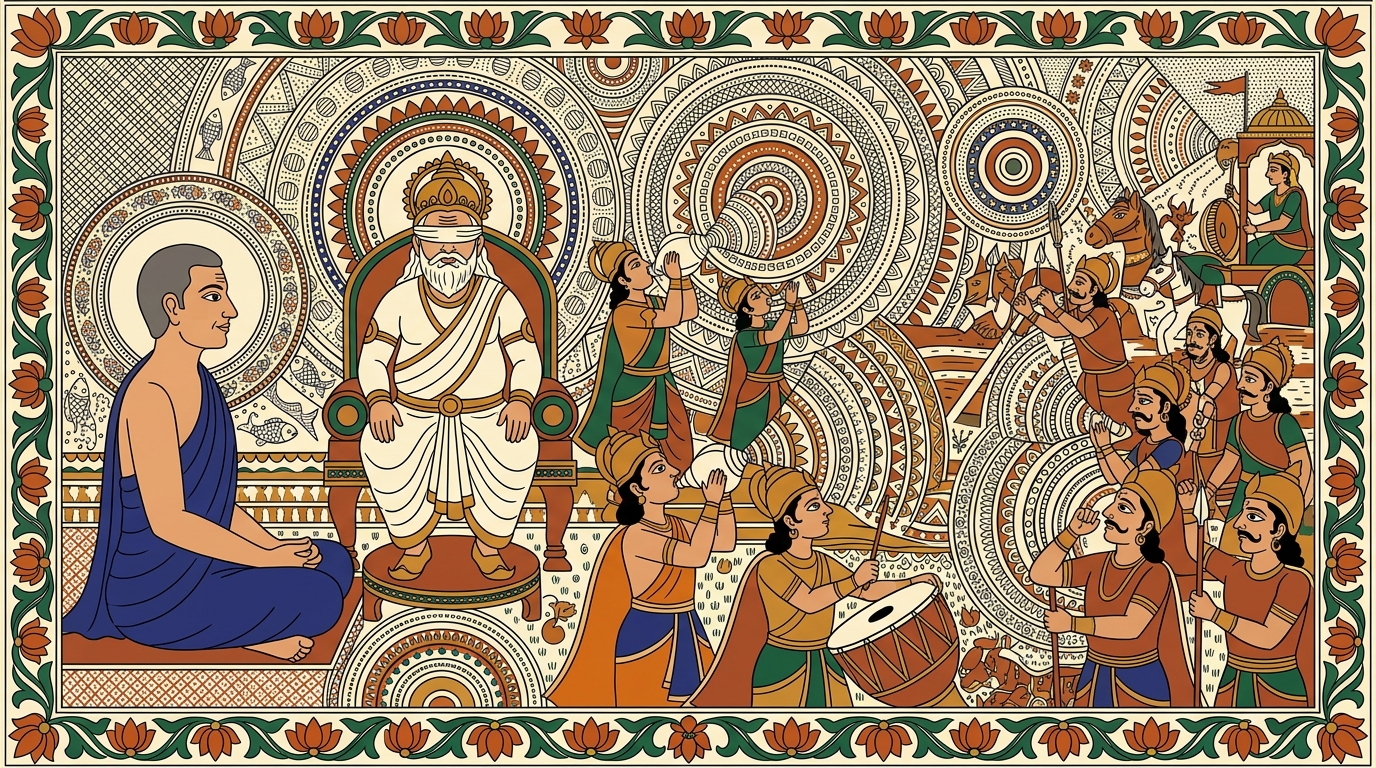
On the field of Kurukshetra, the Pandava conches did what Mira's
humming did to Kartik: they broke the Kauravas' concentration.
The Gita says the sound "tore their hearts apart." Not with
blades. With vibration. With the terrifying realization that the
people on the other side were not afraid.