The school bus had broken down, and now Meera was walking home through
the old market road when she heard the shouting.
Two groups of boys stood on opposite sides of the narrow lane. On the
left were boys from her school — she recognized Ravi and Karthik and
a few others from the cricket team. On the right were boys from the
Gujarati-medium school, their white shirts untucked, faces tight with
anger. A bicycle lay twisted between them, its front wheel bent at a
wrong angle. Someone had crashed into someone. Words had become
accusations, accusations had become threats, and now both groups were
picking up stones from the gravel shoulder.
Meera's stomach tightened. She knew what was about to happen. She had
seen it before — a small argument that swelled like a river in monsoon
until it swallowed everything around it.
She could have walked past. The lane curved ahead, and her house was
only three minutes away. Nobody would have blamed her. But something
made her stop. Not bravery — she did not feel brave. It was more like
a stubborn need to understand.
"Wait," she said, stepping into the lane. Not loudly, not with her
hands raised like some hero in a film. Just firmly, the way you close
a book when you have finished reading.
The boys turned. A few laughed. "Move, Meera. This isn't your problem."
"I know," she said. "I just want to see."
She walked into the space between them — the empty lane where the
broken bicycle lay, and stood there. From the left, she could see
Ravi's clenched jaw and the red scrape on his elbow where he had
fallen. From the right, she could see a smaller boy, maybe eight
years old, clutching the bent bicycle wheel with tears running down
his face. His older brother stood in front of him, fists balled.
"Oh," Meera said quietly. She had not understood any of it from the
outside. The shouting had made it sound like two angry groups. From
the middle, she could see that one side had a hurt boy and the other
side had a crying child, and neither side could see the other clearly
because they were too busy shouting.
"His wheel is bent," Meera said to Ravi, pointing at the younger boy.
Then she turned to the older brother. "Ravi didn't mean to crash. He
swerved to avoid a dog." She had not seen the crash, but Ravi always
swerved for dogs.
Standing between two sides does not make a fight disappear. But it
does something else: it lets you see both sides for what they
are. And sometimes, that is how a fight ends. Not with a winner, but
with understanding.
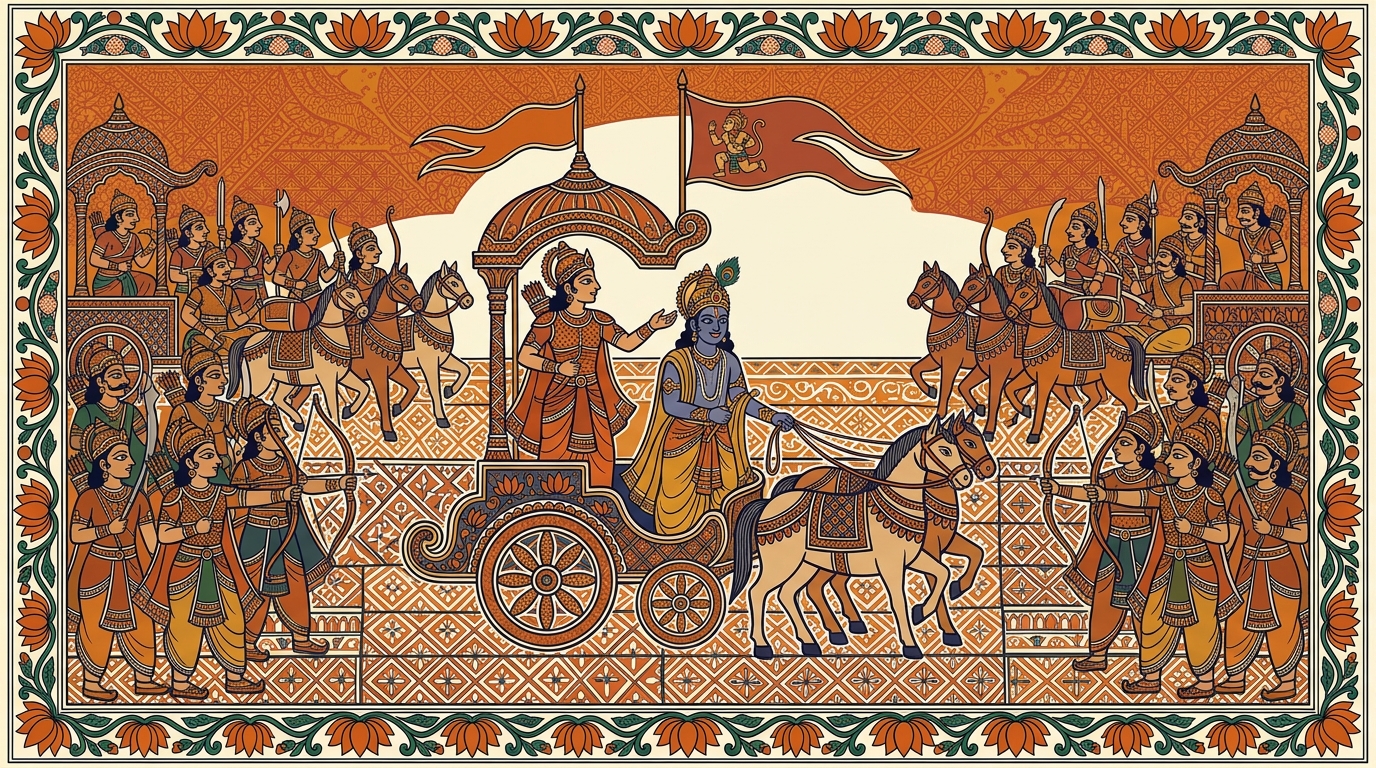
Arjuna asked Krishna to drive the chariot into the middle. He did not
ask for an advantage. He asked for a view.