Appa never argued with Amma. Not once. Not in the way the neighbours
did, with raised voices and doors slamming and the whole apartment
block pretending not to hear. When Amma was upset, Appa simply did
whatever needed to be done, quietly, without being asked twice.
Tara noticed it first when she was nine.
One Thursday evening, Amma came home from work and dropped her bag
on the kitchen counter with a thud that said everything. Her face
was drawn tight, the skin around her eyes pinched. "They cancelled
the project," she said flatly. "Six months of work. Gone." She
stood at the counter, staring at the wall, her hands gripping the
edge of the granite.
Tara looked at Appa. He was reading the newspaper at the dining
table, a cup of chai going cold beside him. He folded the paper,
set it down, and stood up. He did not say "I'm sorry" or "That's
terrible" or "What happened?" He walked to the kitchen, filled the
steel kadhai with oil, turned on the gas, and began making Amma's
favourite — crispy onion pakoras. The kitchen filled with the hiss
and crackle of batter hitting hot oil, the warm smell of gram flour
and cumin and green chillies. He stacked the pakoras on a plate
lined with newspaper and set them on the counter beside her without
a word.
Amma ate three before she spoke again. Her shoulders dropped. Her
jaw unclenched. "They cancelled the project," she said, but this
time the words were softer, like she was telling a story instead of
announcing a disaster.
Tara saw this happen again and again over the years. When Thatha
was in the hospital, Appa drove Amma there every morning at five,
without being asked — just the car keys jingling in the dark hallway,
the front door clicking shut, the engine turning over in the
pre-dawn quiet. When Tara failed her maths exam and cried at the
dining table, Appa sat beside her and opened the textbook to
Chapter 1 and said, "Show me where it stopped making sense."
He never said "I'm here for you." He just was.
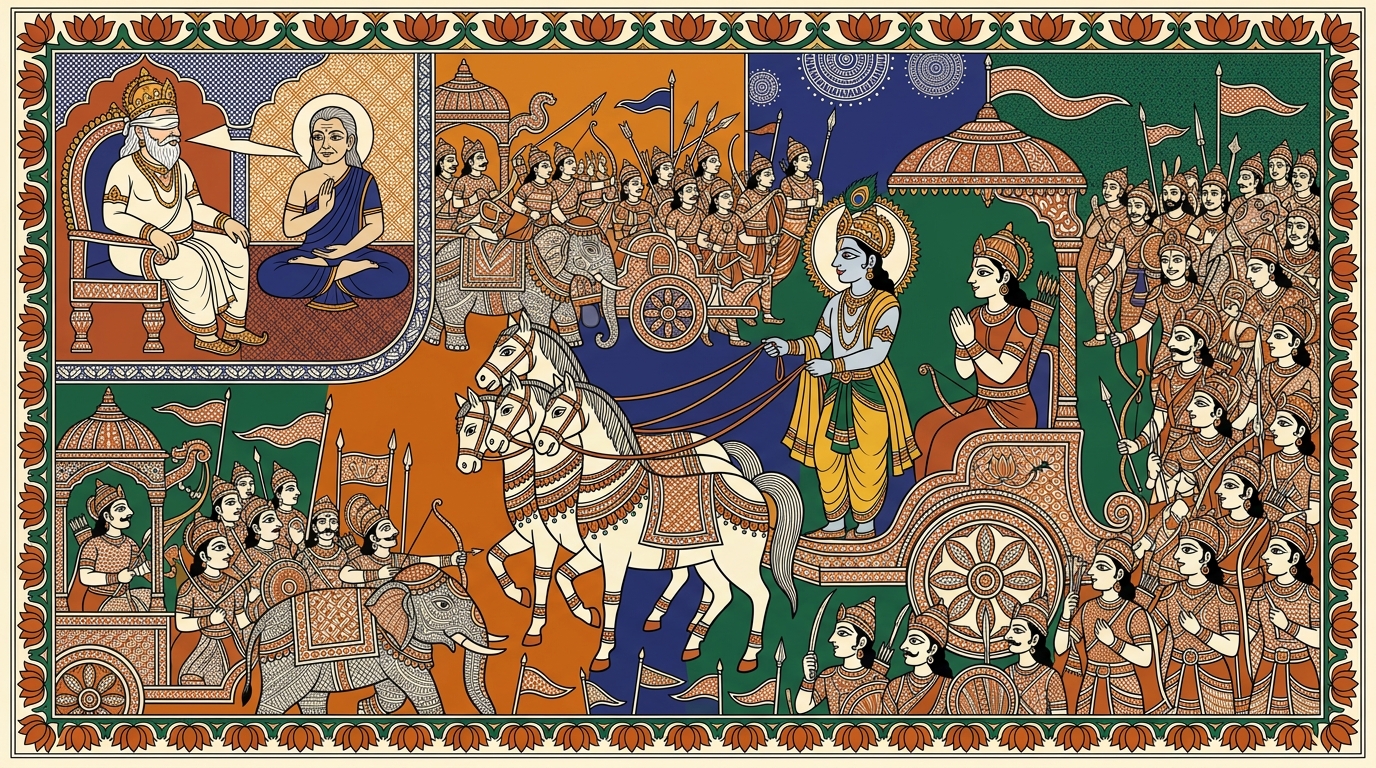
That is what Krishna does in this verse. Arjuna asks, and Krishna
does not question, does not advise, does not lecture. He simply
takes the reins and drives the chariot to exactly where Arjuna
needs it to be. Later, Krishna will have a great deal to say — the
entire Bhagavad Gita, in fact. But right now, Arjuna needs to see,
and Krishna's only job is to drive.
Sometimes the wisest thing looks like silence, and the kindest
looks like a plate of pakoras set down without a word.