The annual cricket match between Mohalla A and Mohalla B had been a
tradition in their small town for as long as anyone could remember.
Every Dussehra, the two neighbourhoods faced off on the dusty maidan
near the bus stand, and the whole town came to watch.
This year, thirteen-year-old Aarav was opening batsman for Mohalla A.
He had practiced all month — batting against tennis balls thrown by
his father on the terrace, shadow-batting in front of the bathroom
mirror until his mother told him to stop scaring the cat. He was
ready.
The two teams lined up for the toss. Aarav stood at one end, bat
resting on his shoulder, and looked across at the other team.
His stomach dropped.
Ankit Mama was standing at mid-off, stretching his bowling arm.
Ankit was Aarav's maternal uncle — not some distant relative, but
the uncle who brought him comics every time he visited, the one who
had taught him to ride a bicycle by running beside him on the road
outside their house, holding the seat and then letting go without
telling him.
Behind the wicket, adjusting his keeping gloves, was Rohit — Aarav's
cousin. They had shared a room every summer at Nani's house. Rohit
snored like a tractor and stole all the blankets and always let
Aarav have the last gulab jamun.
At first slip stood old Pandey Sir, Aarav's maths teacher from
Class 5. The man who had stayed after school for an entire month
to help Aarav understand fractions, who drew little smiley faces
on correct answers and never, not once, used a red pen for mistakes.
And at fine leg, hands on his knees, grinning at Aarav across the
dusty field — Kabir. Best friend since Class 2. The boy who had
shared his lunch every single day when Aarav's mother was in the
hospital and his father forgot to pack tiffin.
Aarav lowered his bat. The field, which moments ago had been an
abstract arrangement of positions — mid-off, slip, fine leg — had
become a constellation of people he loved. Every fielding position
had a face. Every face had a name. Every name had a story that was
tangled up with his own.
The bowler ran in. The ball left his hand. But Aarav just stood
there, bat at his side, because something had shifted inside him
that he could not shift back.
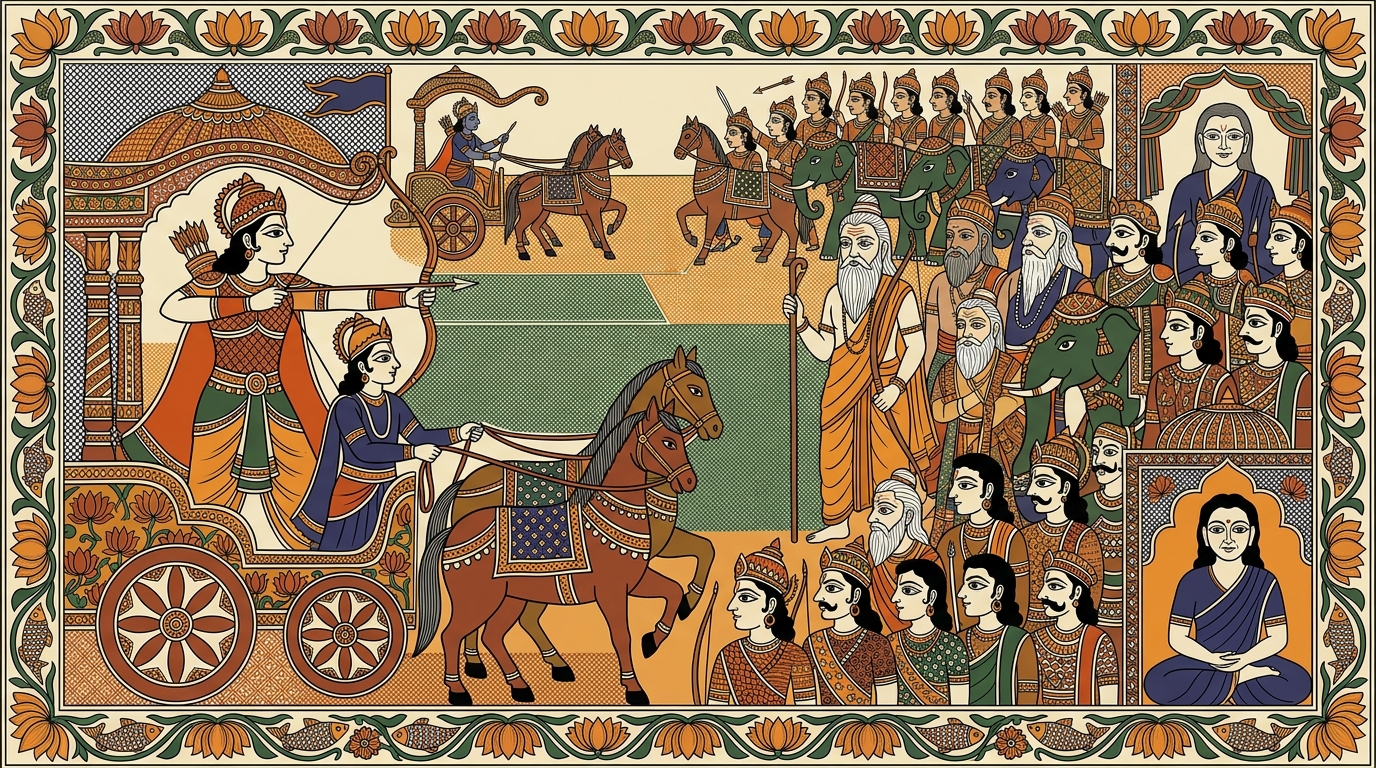
This is what happened to Arjuna. He looked across the battlefield
and saw not soldiers, not enemies, not an opposing army — but
fathers, grandfathers, teachers, uncles, brothers, sons, grandsons,
and friends. The people who had made him who he was. And every name
hit harder than any arrow ever could.
But here is what Aarav did not yet understand, standing frozen on
that dusty maidan: the shifting inside him was not the start of
breaking down but the start of seeing clearly: that the people across
from you are real, that competition and love can live in the same heart.
What felt like paralysis was actually the first step toward a deeper
kind of courage, the kind that plays the game honestly and still
walks across the field afterward to share a cold drink with the
other side.