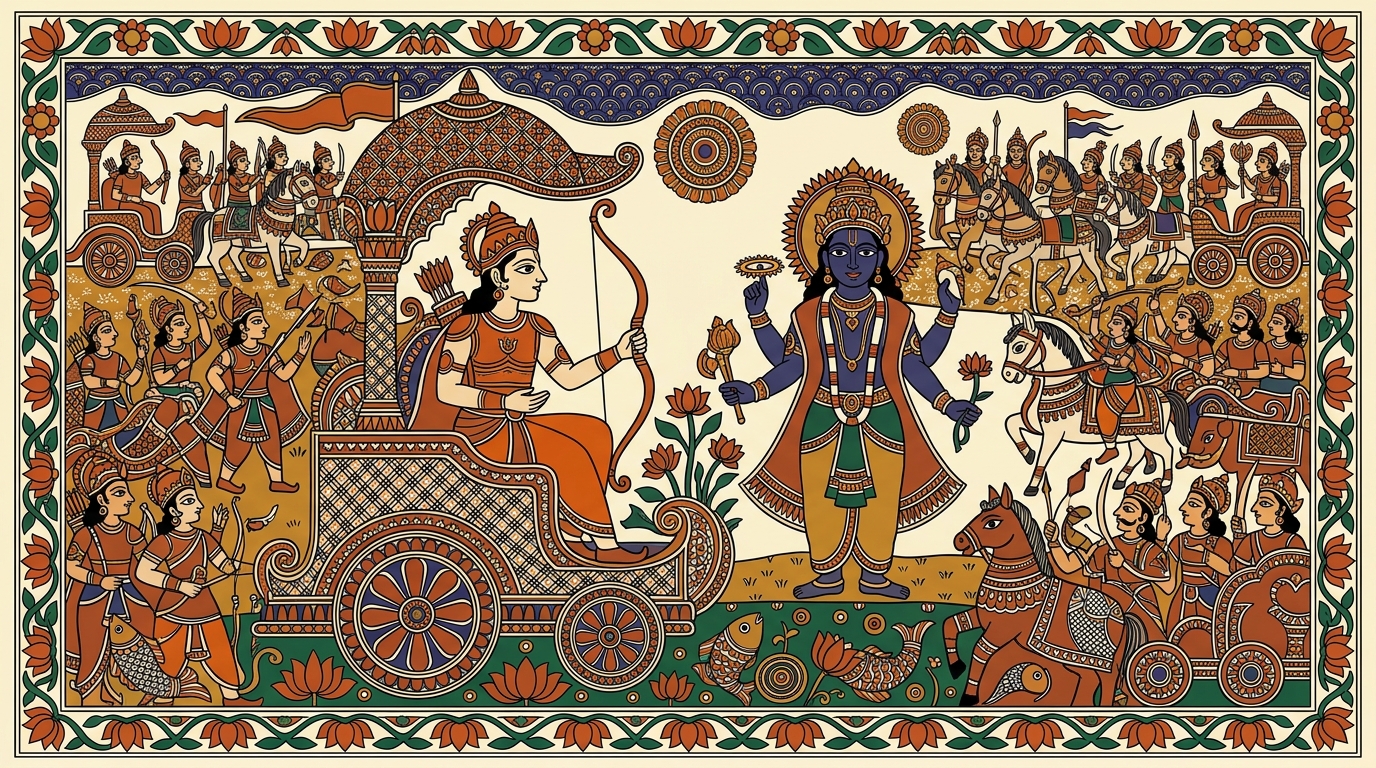
Ajji sang while she cooked.
Not the songs from the radio, not film songs or devotional tracks
from the Bluetooth speaker that Rithvik's father had installed in
the kitchen. Ajji's songs were older than all of that. They were
Halakki Vokkaliga songs from the coast of Karnataka — harvesting
songs, wedding songs, lullabies that had been passed from mother
to daughter for so many generations that nobody could say where they
began. The words were not in Kannada or Konkani or any language
Rithvik could find on the internet. They were in Halakki, a tongue
spoken by fewer people each year, a language that lived mostly in
the mouths of old women who remembered.
Ajji was one of the last.
Every morning, while the oil heated in the iron kadhai and the
mustard seeds began to pop, Ajji would start a song. Her voice was
thin and cracked — she was eighty-three — but the melody was sure.
It wound through the kitchen like smoke, curling around the steel
vessels and the tamarind jar and the framed photo of Ajja, who had
died before Rithvik was born. The song was about planting rice in
the monsoon, about feet sinking into warm mud, about the egrets
that stood like white priests in the flooded fields. Rithvik did
not understand every word, but he understood the feeling. The song
was a thread connecting his grandmother to her mother, and her
mother to her mother, all the way back to a time when the fields
were new and the world was green and the songs were all the history
a family needed.
"Teach me," Rithvik said one morning, sitting on the kitchen
counter, swinging his legs.
Ajji smiled and shook her head. "You won't remember. Your tongue
is made for English and Kannada. These sounds are different."
"Try me."
She tried. She sang a line — slow, deliberate, each syllable placed
like a seed in a furrow — and Rithvik repeated it. His tongue
stumbled. The sounds were not like anything in his school textbooks.
There were clicks and hums and vowels that seemed to come from the
back of the throat, from a place that modern languages had
forgotten. He tried again. Closer, but not right. Ajji corrected
him gently, the way you straighten a plant that is leaning.
They practised for a week. Then exams came, and Rithvik stopped.
Then summer holidays, and he went to his other grandparents' house
in Bengaluru. Then school again. Then another year. Then another.
Ajji died on a Tuesday in April. The kitchen was quiet. The kadhai
sat on the stove, empty and cold. Rithvik stood in the doorway
and tried to sing the rice-planting song. He remembered the first
line — or thought he did. The melody came, but the words were
smoke. He could feel them just beyond his reach, dissolving as he
grabbed for them. He hummed the tune. He got the rhythm right. But
the words — the ancient, irreplaceable, never-written-down words —
were gone.
Arjuna calls them "sanātana kula-dharma" — eternal family traditions.
The word sanātana means something so old it has no beginning. These
are not rules written in a book. They are living things — songs,
rituals, recipes, prayers, ways of greeting the morning and saying
goodbye to the night — passed from one generation to the next like
a flame passed from lamp to lamp. When a family is destroyed, the
chain breaks. And when the chain breaks, what is lost is not just
people. It is everything those people carried in their memories,
their hands, their voices. It is the song no one else knows.
But here is what Rithvik discovered, years later, humming to his own
daughter while she fell asleep: the words were gone, but the melody
was not. He hummed the rice-planting song, and his daughter hummed it
back, and she hummed it to her children. The tune changed a little
with each generation — a note shifted here, a rhythm softened there —
but it did not die. It only changed form. And the loss of those exact
words did something else too: it lit a small fire in Rithvik. He
began visiting the last Halakki elders in the coastal villages,
notebook in hand, recording what he could. He could not bring Ajji
back. But he could make sure the chain, though thin, did not break
entirely.