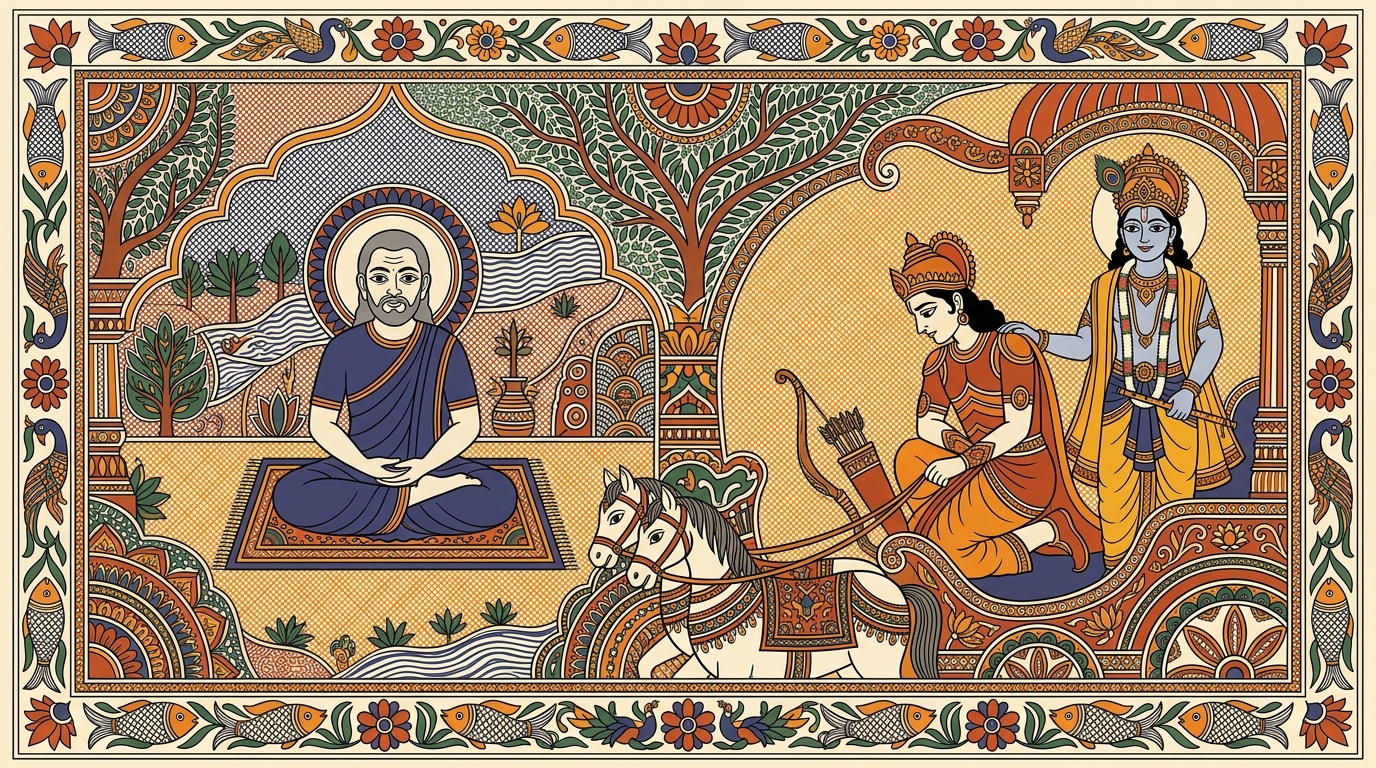
Sanjaya paused.
In the dark palace at Hastinapura, far from the battlefield, the
blind king Dhritarashtra sat on his cold marble throne and waited.
He could hear Sanjaya breathing — the slightly unsteady breath of
a man who has been speaking for a long time about things that are
difficult to say. The incense had burned down to ash. Outside the
tall windows, night birds called to each other across the palace
gardens.
"And then?" the king asked.
"And then nothing, Your Majesty. He sat. He would not fight."
Dhritarashtra let the words settle. In the silence, he could hear
the distant rumble of the war drums, carried on the wind from
Kurukshetra, still beating. Always beating.
"The conqueror of sleep," the king said softly. "The scorcher of
foes. And he sat down on the floor of his chariot."
"Yes."
"And Krishna?"
"Krishna waited."
Sanjaya's voice was careful. He was a narrator, a witness — blessed
by the sage Vyasa with divine sight so that he could see every moment
of the distant battle and describe it to the blind king. He had
watched Arjuna's face as the bow fell. He had seen the way the
warrior's shoulders dropped, as if someone had removed the iron rod
that had been holding them straight. He had seen the grief move
through Arjuna's body like a wave: first the hands going limp,
then the arms, then the chest caving inward, then the legs folding
until the great hero sat on the rough wooden floor of his chariot
like a man sitting by the ashes of his own house.
And Sanjaya had seen Krishna's face too. That was the part he did
not tell the king — not yet. Krishna's expression as he watched
Arjuna break. It was not pity. It was not disappointment. It was
something closer to patience, the kind of patience that a river
has with the stones in its path, knowing that the water will find
its way through.
"This is where the first chapter ends, Your Majesty," Sanjaya said.
"Ends? It has barely begun."
"Yes. That is the nature of beginnings. They look like endings."
Dhritarashtra shifted on his throne. He wanted to ask more — what
would Krishna say? Would Arjuna pick up his bow? Would the war
still happen? He wanted to know the end of the story the way a
sick man wants to know if the medicine will work. But Sanjaya had
fallen silent, and in that silence was a lesson: some stories
cannot be rushed.
Chapter One of the Bhagavad Gita is called "Arjuna Vishada Yoga"
— the Yoga of Arjuna's Sorrow. Not the "chapter about sorrow."
The yoga of sorrow. Yoga means union, discipline, a path. The
ancient teachers who gave this chapter its name were saying
something extraordinary: that Arjuna's grief was not a failure.
It was a practice. It was the first step on the path.
Before Krishna can teach, Arjuna must break. Before wisdom can
enter, the old certainties must shatter. Before the Gita can begin,
the bow must hit the floor.
The chapter closes here, in the stillness between the question and
the answer, in the pause between one breath and the next. Arjuna
is sitting in his chariot, refusing to fight, his mind drowning in
sorrow. Krishna stands beside him, silent, holding the reins. The
great armies of the Kauravas and Pandavas face each other across
the field, waiting.
Everything that follows — every verse of wisdom, every teaching
about duty and devotion and the nature of the self — begins in
this silence. In this refusal. In this grief.
The first chapter is over. The conversation is about to begin.