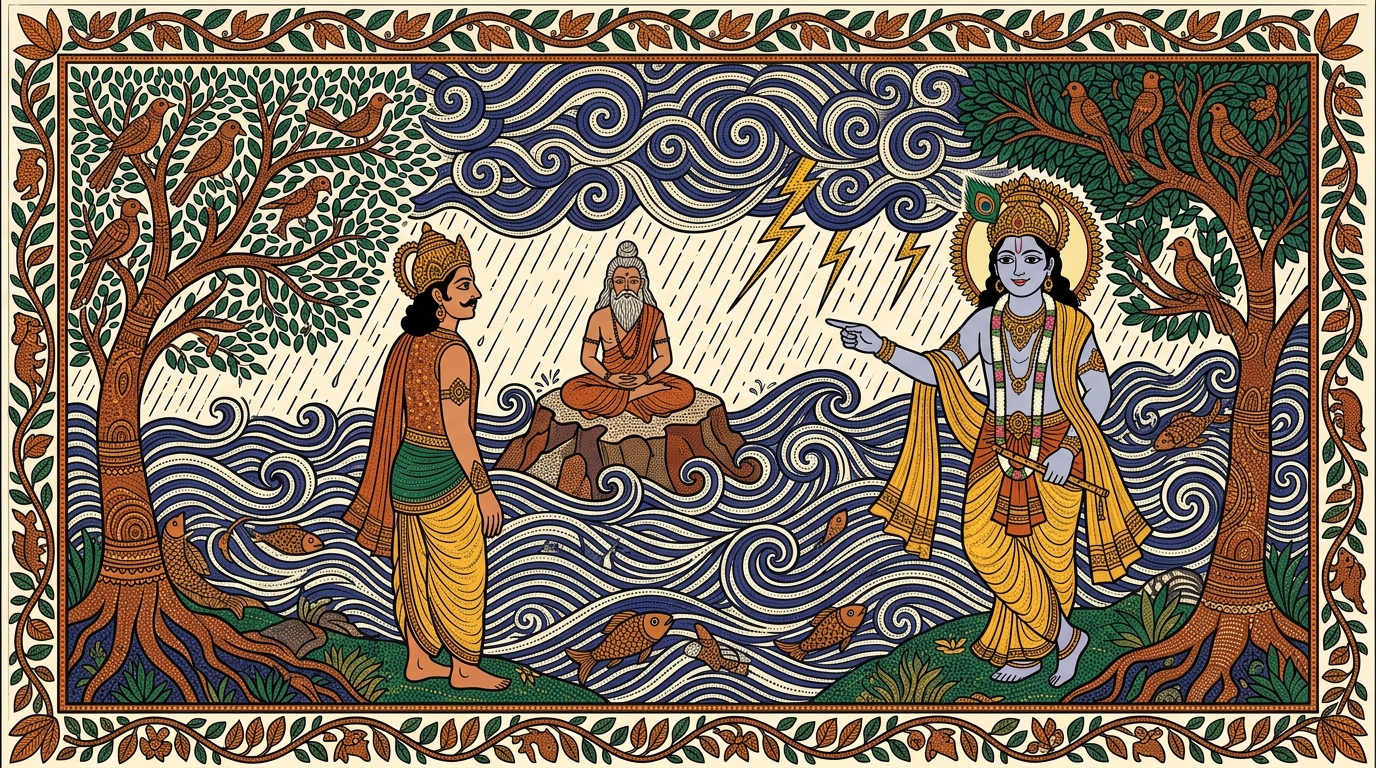
There is an old story told in the foothills of the Himalayas, in
villages where the clouds sit so low you can walk into them.
A sage named Rishabha lived alone on a ridge above the treeline.
His hut was made of stacked stones with a thatch roof that leaked
in three places. He owned a clay pot, a woolen blanket, and a
walking stick carved from deodar wood. That was all.
One autumn, a storm came down from the mountains, the kind of
storm that happens once in a hundred years. The sky turned the
color of iron. Wind screamed through the passes like a living
thing. Rain fell not in drops but in sheets, as though someone
had upturned a lake above the ridge. Lightning split a pine tree
two hundred paces from Rishabha's hut, and the crack of it was so
loud that shepherds in the valley below covered their ears and ran.
A group of travelers, merchants on the road to Badrinath, stumbled
upon Rishabha's hut, drenched and terrified, their mules braying
and pulling at their ropes. They pushed through the low doorway
expecting to find the old man cowering, or praying, or at least
pacing.
He was sitting cross-legged on the floor, eyes open, hands resting
on his knees. The leaks dripped water onto the packed earth around
him, but not on him. His face was still. Not blank — still. The
way the center of a wheel is still while the rim spins.
"Baba," the lead merchant gasped, "are you not afraid?"
Rishabha looked up as though noticing them for the first time.
"Of what?"
"The storm! The lightning! Your roof could collapse!"
"It could," Rishabha agreed. "And then I would sit without a roof."
The merchants stared. One of them, a young man barely twenty,
whispered to his companion: "Is he mad?"
But the oldest merchant, a woman who had traveled the mountain
roads for forty years, shook her head slowly. She had seen this
before, once, long ago, in another sage in another storm. It was
not madness. It was the deepest sanity she knew. This man was not
unmoved because he could not feel. He was unmoved because he knew
what the storm did not know about itself.
It would pass.
The merchants sat with him through the night. The storm raged.
The roof held. By dawn, the sky was pink and clear, and the ridge
smelled of wet pine and new earth. Rishabha offered them water
from his clay pot.
He had not moved once.