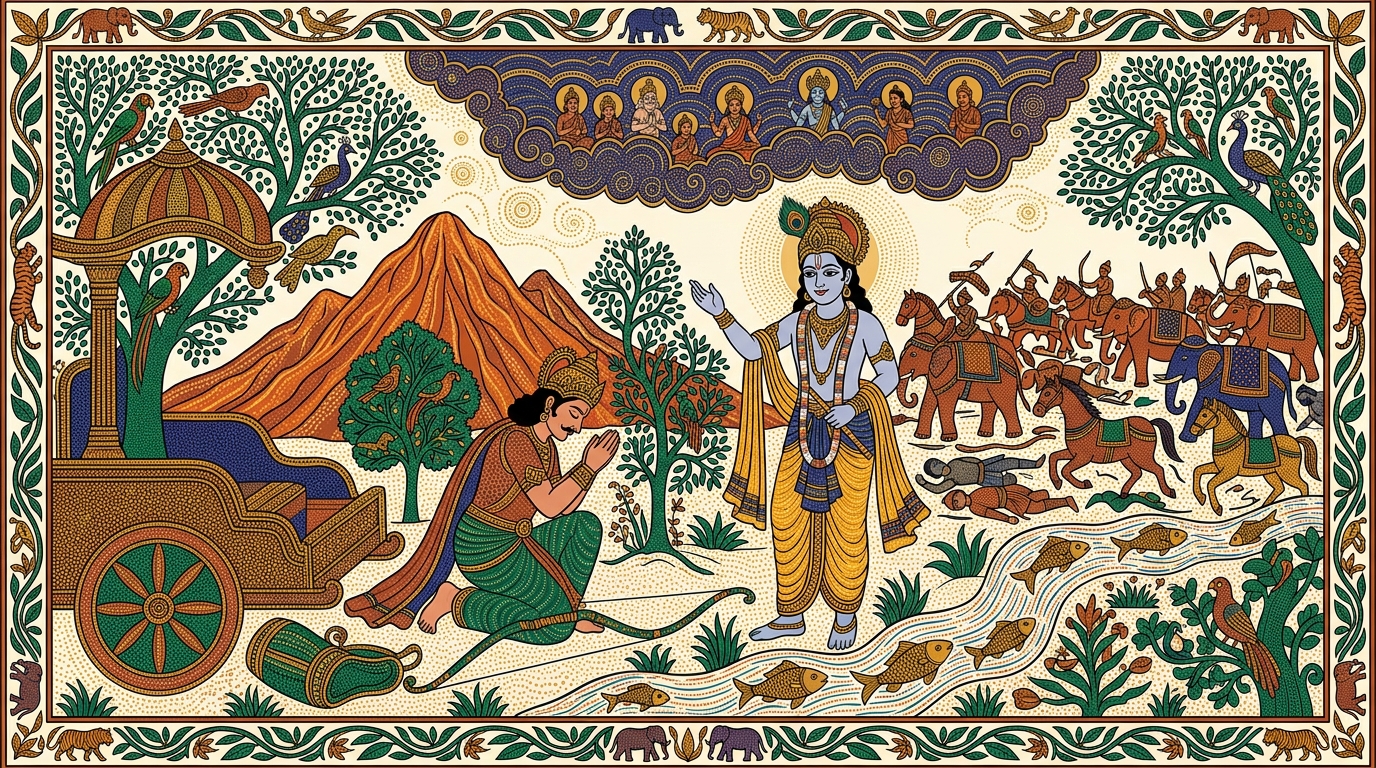
And then Krishna closed the trap.
He had been building toward this moment through five verses: the
honor of a warrior's duty, the rarity of a righteous cause, the
shame of retreat, the mockery of enemies, the silence of
disappointed teachers. Each argument had been a wall, and now
Arjuna stood in a room with no doors except one.
"Listen carefully," Krishna said, and his voice carried the clean
finality of a mathematician writing the last line of a proof.
"There are only two outcomes on this battlefield. You fight and
you fall — in which case, you have given everything for dharma,
and the gates of heaven open for you. Or you fight and you win —
in which case, you rule a kingdom restored to justice, and your
people live in peace."
He spread his hands.
"Slain, you gain heaven. Victorious, you gain the earth. Tell me,
Arjuna — where is the loss? Show me the outcome where fighting
is the wrong choice. I am waiting."
Arjuna opened his mouth. Closed it. Opened it again. No words
came. Because there were no words to find. Krishna had mapped
every possible future, and in every single one, the path led to
something worth having. The only barren path, the only road that
led to nothing but shame and regret and the slow erosion of
everything Arjuna had ever built — was the path of not fighting.
"The only losing move," Krishna said, as if reading the
understanding dawning on Arjuna's face, "is to not play."
And then, for the first time in the entire conversation, Krishna
gave a command. Not a suggestion. Not a philosophical observation.
A command, spoken the way a general speaks to a soldier, the way
a father speaks to a son he loves too much to let him ruin
himself:
"Uttishttha. Stand up."
The word rang across the chariot like a bell struck once and left
to vibrate. Stand up. Arise. Get off the floor of this chariot,
pick up your bow, and be who you are.
The white horses shifted in their harnesses, as if they had been
waiting for exactly this.