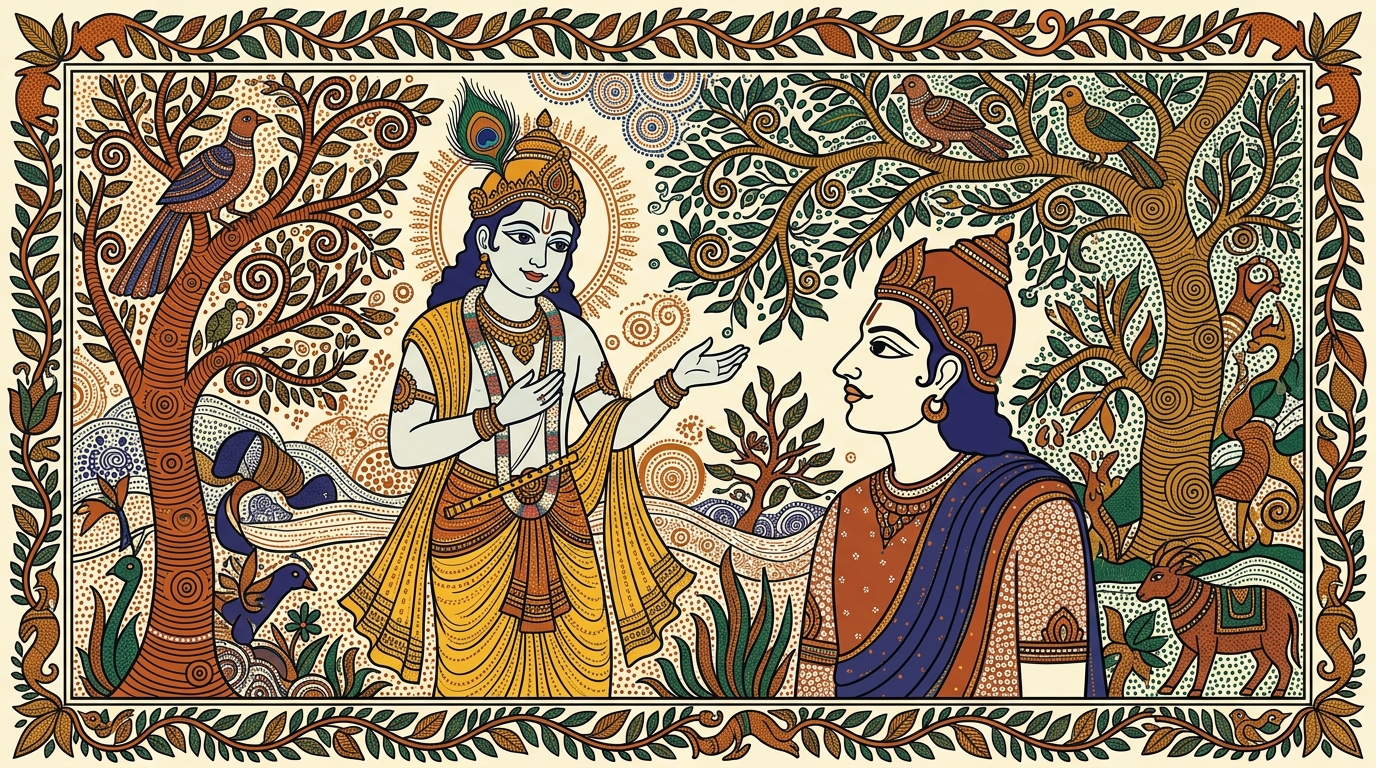
Baa had two paintings on her worktable.
The first was a commission. A dealer from Bhopal had ordered it
for a gallery exhibition, a Gond Tree of Life, thirty inches by
twenty, to be delivered in three weeks. He had specified the
colors (earth tones only), the subject (peacocks, no snakes),
and the price (enough to cover two months of groceries). Baa
worked on it every morning from six to nine, her brush moving in
careful, measured strokes. The painting was good. The lines were
clean, the composition balanced, the peacocks vivid with their
tails fanning like green and blue fire. It was exactly what the
dealer wanted.
The second painting was smaller, barely the size of a school
notebook, and Baa worked on it at odd hours. After dinner, when
the dishes were done. Early in the morning, before the commission
called. Sometimes late at night, when Nandu heard her moving in
the veranda and found her sitting cross-legged on the floor, a
single candle burning beside her, painting by its warm unsteady
light.
This one had no buyer. No specifications. No deadline. It was a
river — not a real river, not the Narmada or the Betwa, but a
river made of fish that were also birds that were also leaves
falling from trees that grew sideways into a sky full of spirals.
It made no sense and it made complete sense. The colors were
wild — saffron next to indigo next to a green so deep it looked
like it had been dug out of the earth.
Nandu watched her paint both. He noticed something.
When Baa worked on the commission, her shoulders were tight. She
checked her reference sketch every few strokes. She paused often,
leaning back, squinting, measuring. She was good at this work
and she did it well and it would sell for a fair price. But her
face, while focused, was not lit.
When she worked on the river painting, she was different. Her
shoulders dropped. Her brush moved faster, then slower, following
some rhythm he could not hear. She hummed — old Gond songs, the
ones her mother had taught her, melodies that had no words Nandu
could catch. Her eyes were soft and bright at the same time, the
way the sky looks just after a storm clears.
"Baa," he said one evening, watching her add a spiral to the
river sky, "which one is better?"
She did not look up. "Which one do you think?"
He pointed to the small one. The river of fish-birds.
"Why?" she asked.
He thought for a long time. "Because this one is alive."
Baa set her brush down and looked at him. "That is because this
one was painted for the joy of painting. The other was painted
for the result." She smiled. "Both are real. But only one
breathes."