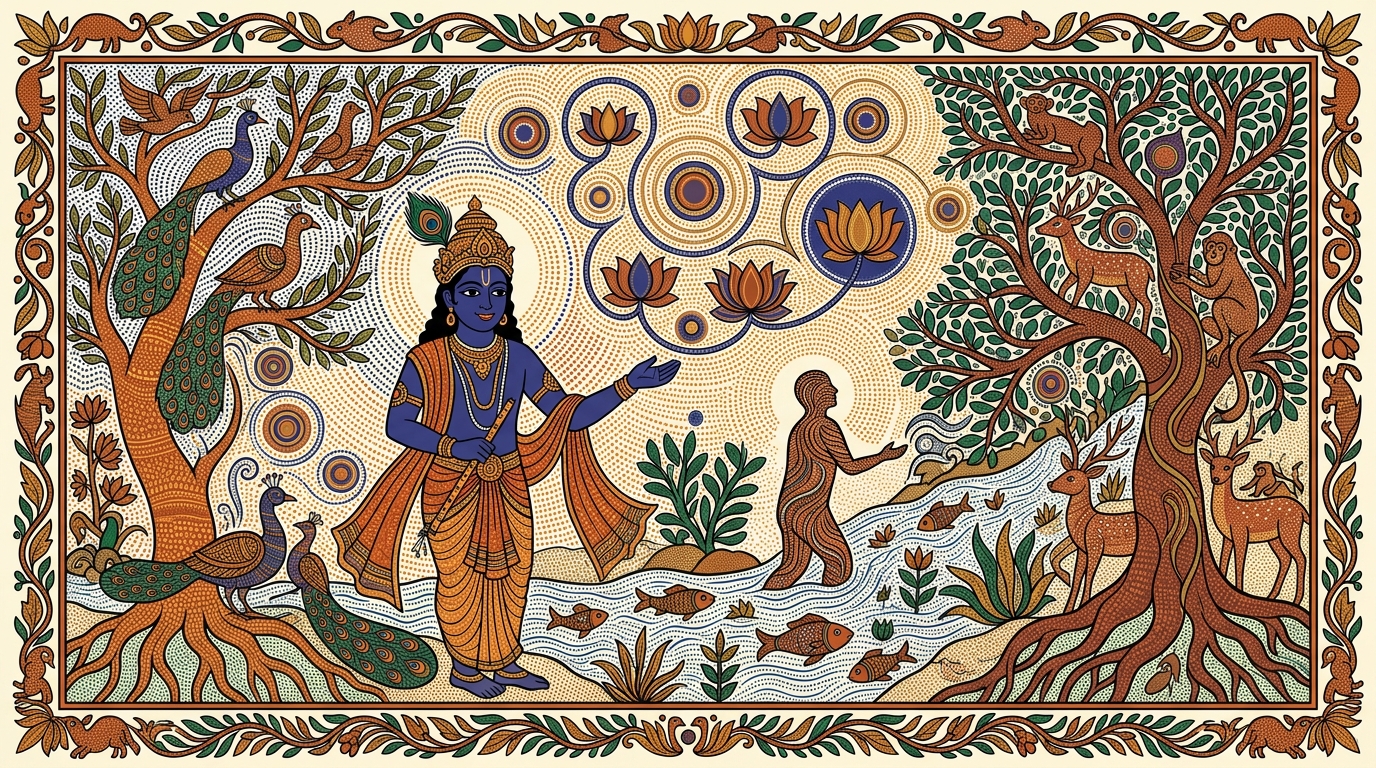
Krishna's voice had gone quiet.
Not quiet the way a person goes quiet when they have run out of words.
Quiet the way a river goes quiet when it reaches the sea — the rushing
is over. It has arrived.
The battlefield seemed very far away. The armies, the chariots, the
elephants with their painted foreheads, the flags snapping in the
wind — all of it was still there. But it had receded, the way the
shore recedes when you wade into deeper water. Arjuna could see it
all, but he was standing somewhere else now — somewhere inside himself
that he had not known existed until this conversation opened the door.
"This is the state of Brahman," Krishna said, his voice almost
indistinguishable from silence. "Not a place. Not a prize. A way of
being. And once you touch it, not merely hear it
described but stand inside it the way you stand inside rain, you
cannot be deluded again."
Arjuna did not speak. For the first time since the chariot had rolled
between the two armies, he did not want to speak. His hands, which
had trembled and dropped his bow, rested on his knees, palms open.
His eyes, which had been flooded with tears, were dry and clear.
Something had changed. Not everything — the war was still coming,
the grief was still there beneath the surface like a river
underground. But the ground above that river was firmer now. Arjuna
could stand on it.
Krishna watched his friend the way a gardener watches a seed that has
just broken the surface of the soil. Not finished. Barely begun. But
the breaking through had happened, and that was the part that
mattered.
The chapter closes here, at the threshold. Krishna has painted the
portrait that Arjuna asked for — the sthitaprajna, the person of
steady wisdom, brushstroke by brushstroke. The person who is content
in the Self. Who is not shattered by sorrow or intoxicated by joy.
Who draws the senses inward like a tortoise. Who does not follow
every passing wind. Who is awake when others sleep, and at peace
when others grasp. Who is like the ocean — vast enough to receive
everything without being disturbed by anything.
It is a portrait, not a manual. Krishna has shown Arjuna the
mountain. He has not yet shown him the path up. That will come.
But for now, in the silence between the end of this teaching and the
beginning of the next, Arjuna sits still. And if you are very quiet
— quieter than the battlefield, quieter than the wind — you can feel
it too. A stillness that is not empty but full. A peace that does not
depend on things going well. A door, standing open, in a room you did
not know your own house contained.