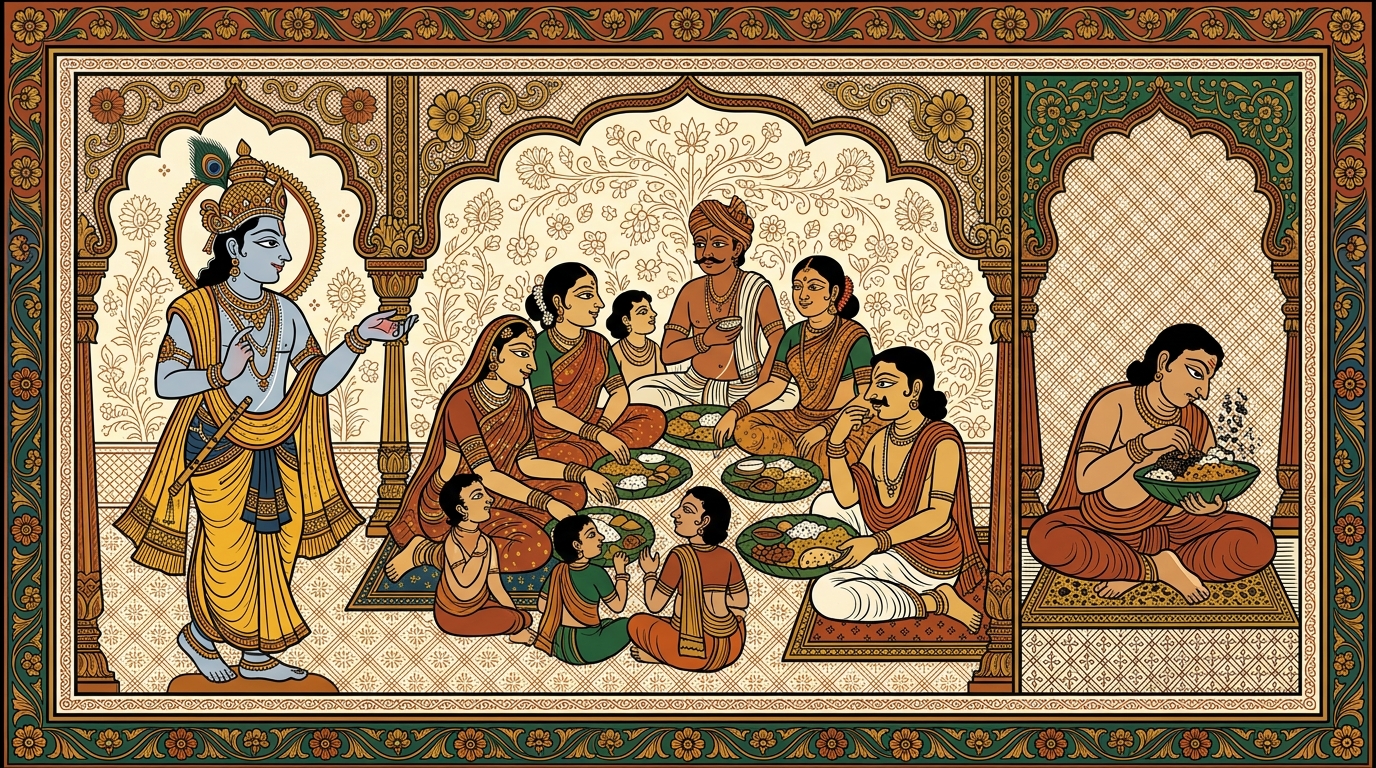
In a clearing beside the Ganga, where the river bent like an elbow
and the banyan trees were so old their roots hung down like curtains,
there stood a small ashram. It had a mud-walled kitchen, a well with
a wooden pulley, and a cook named Bhaskar who woke every morning
before the birds.
Bhaskar was not a priest. He was not a scholar. He couldn't recite
a single verse of the Vedas from memory. But he could do something
that the scholars couldn't — he could feed sixty people from a pot
that looked like it held enough for twenty.
Every morning, he lit the fire before the stars had faded. He ground
spices on the stone slab while the sky turned from black to grey to
the pale pink of a conch shell's inside. By the time the first
students stumbled out of their huts rubbing their eyes, the dal was
simmering and the rice was steaming and the kitchen smelled like a
warm hug.
The students ate first. Then the teachers. Then any traveller who
wandered in from the road — and there were always travellers, because
word of Bhaskar's kitchen had spread as far as Kashi. A merchant with
tired feet. A widow carrying her grandson. A sadhu with nothing but
a walking stick and a smile. Bhaskar fed them all. He never asked
their name or their caste. He simply ladled rice onto a banana leaf
and said, "Eat."
After the travellers came the animals. Bhaskar would scatter grain
for the sparrows, set out a dish of water for the dogs, and leave
rice on the flat stone near the ant trail. The students laughed at
this. "You're feeding ants?" one asked. Bhaskar shrugged. "They're
hungry too."
Only when every student, every teacher, every traveller, every bird,
every dog, and every ant had been fed did Bhaskar sit down with his
own banana leaf. What was left was always the same: a small mound
of rice, a spoonful of dal, a scrape of pickle. Never more. Some
days, barely enough.
But here was the thing the students noticed, year after year: Bhaskar
ate that small meal with more pleasure than a king at a feast. His
eyes closed when he took the first bite. He chewed slowly. He smiled.
When he was done, he washed his leaf, cleaned the pots, and began
preparing for the evening meal.
"Doesn't it bother you?" a young student once asked. "You cook the
whole meal and eat the least."
Bhaskar looked at him with genuine surprise, as if the boy had asked
whether the sky was blue.
"I eat what is left after the offering," he said. "And what is left
after the offering is the sweetest food in the world. You'll
understand when you try it."
The student didn't understand — not that day. But years later, when
he had a kitchen of his own and children of his own, he found himself
serving everyone else first and sitting down last with the smallest
portion. And he understood. The food tasted different. It tasted like
Bhaskar's kitchen. It tasted like freedom.