His name was Pankaj, and he sat in the second row at Aarav's school,
right next to the window so he could stare at the sea during maths.
Pankaj was not a bad person. He smiled easily, laughed at everyone's
jokes, and had a way of making you feel like his best friend for
exactly as long as he needed something from you. That was the
problem. Pankaj needed things from everyone, and he never — not
once, not ever — gave anything back.
It started small. A pencil borrowed and never returned. "I'll bring
it tomorrow," he'd say, and tomorrow would become next week, and
next week would become never. Then it was erasers. Then rulers.
Then Aarav's favourite blue gel pen, the one Dadu had brought from
Bhubaneswar, which vanished into Pankaj's pencil case like a fish
into the sea.
At lunch, Pankaj would appear at your desk with wide, hopeful eyes.
"My mother forgot to pack my tiffin," he'd say, even though everyone
knew his mother packed it every single day — Pankaj just liked
everyone else's food better. He'd eat half of Sanjay's paratha, a
handful of Biku's puffed rice, and two of Aarav's fish cutlets, and
then disappear before anyone could ask for a share of his.
"He's like a one-way street," Lakshmi said one evening when Aarav
complained about the lost gel pen. "Everything goes in. Nothing
comes out."
The strange thing was, Pankaj never seemed to notice what was
happening around him. When the class collected money for Ravi's
family after the storm damaged their house, Pankaj forgot his wallet
three days in a row. When it was his turn to clean the classroom
after the art project, he suddenly had a stomachache. When the
cricket team needed someone to carry the water jug — a boring job,
no glory in it — Pankaj was always somewhere else.
It took about two months. The change was slow, like a tide going
out. Sanjay stopped saving a seat for Pankaj at lunch. Biku
started saying "no" when Pankaj asked for puffed rice — flatly, not
unkindly, but firmly. The cricket team picked everyone before him.
One afternoon, Aarav saw Pankaj sitting alone under the neem tree
in the schoolyard, eating his own tiffin by himself for the first
time anyone could remember.
He didn't look angry. He looked confused. As if the world had
changed its rules overnight and nobody had told him.
Aarav almost walked past. Then he stopped, turned around, and sat
down next to him. They ate in silence for a minute.
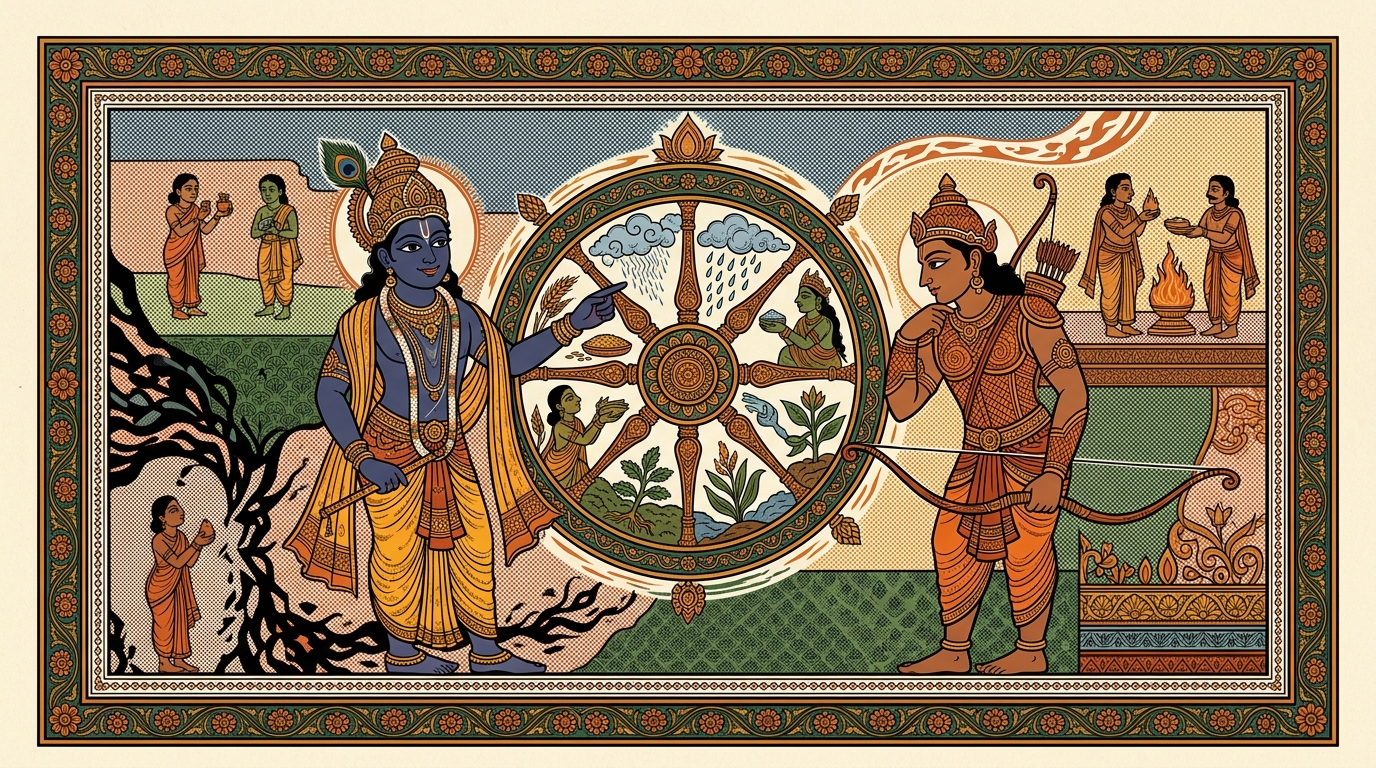
"You know what Dadu says?" Aarav said, not looking at Pankaj. "He
says there's a big wheel — like a chakra — and everyone has to push
it a little. When someone stops pushing, the wheel gets harder for
everyone else. And eventually, the wheel stops turning for that
person too."
Pankaj didn't say anything. But the next day, he brought two tiffin
boxes to school — his own and an extra one his mother had packed
"for whoever wants some." He left it open on the desk. Sanjay took
a piece first, then Biku. By lunch, the box was empty and Pankaj
was grinning, and the wheel — wobbling, rusty, reluctant — began
to turn again.