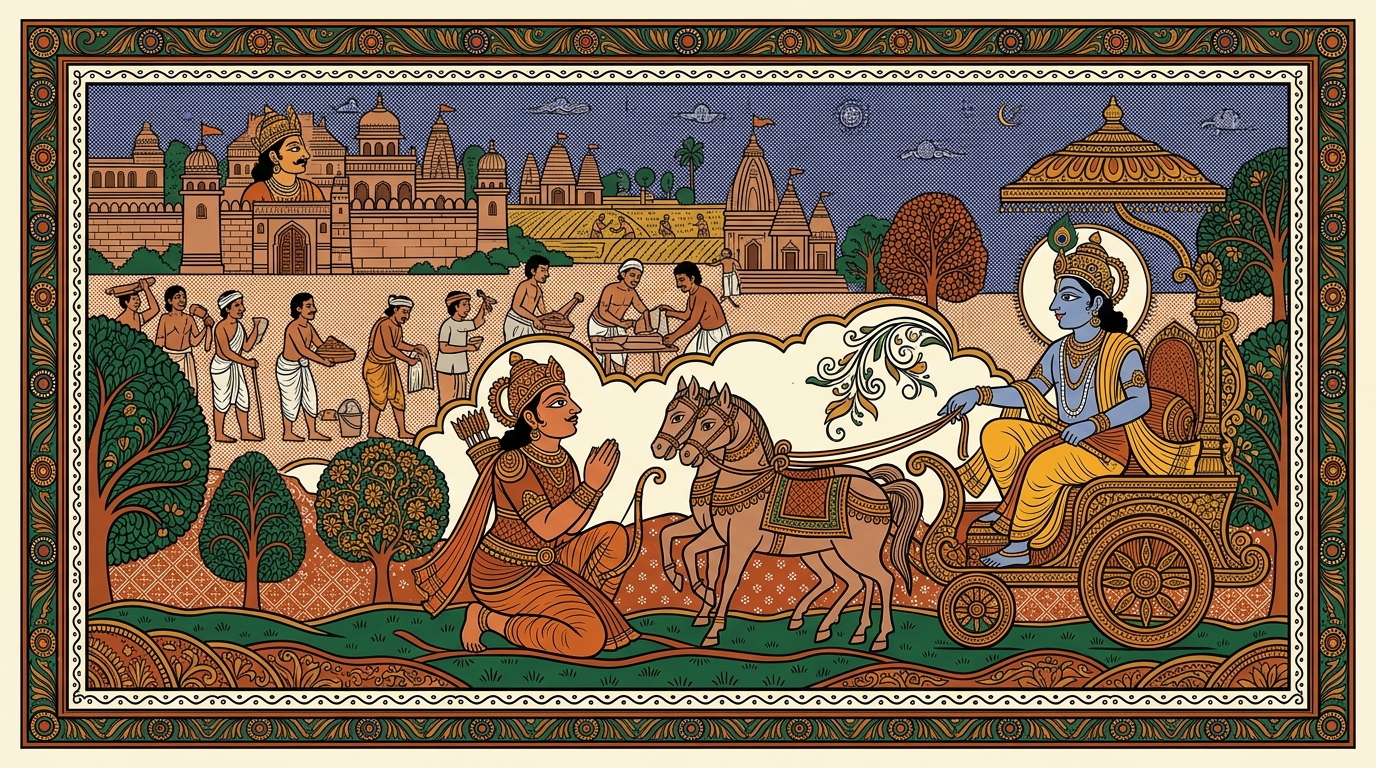
There was once a king named Janaka who ruled the kingdom of Videha.
His palace had a thousand rooms. Its walls were inlaid with gems that
caught the morning light and scattered it in colours across marble
floors. His treasury held gold enough to fill a lake. His army was
vast, his farmlands rich, his people well-fed. By every measure that
the world uses to call a man powerful, Janaka was the most powerful
man alive.
And yet the sages in the forests — the ones who had given up
everything, who slept on bare earth and ate only what fell from
trees — said something strange about him. They said Janaka was the
freest man they had ever met. Freer than them. Freer than any monk
in any cave.
This confused many people. How could a king sitting on a golden
throne be freer than a sage who owned nothing?
One day, a wandering rishi named Shuka came to test this. Shuka was
the son of Vyasa himself, and he had renounced the world so
completely that he wore no clothes, carried no possessions, and
spoke only when necessary. He walked into Janaka's court and sat
down on the polished floor, watching.
Janaka was in the middle of a difficult day. A flood had damaged
villages along the northern river. Farmers needed grain. Soldiers
needed to be sent to help rebuild. Janaka listened to every report,
gave clear orders, checked the granary accounts himself, and
dispatched messengers — all while courtiers argued and advisors
pushed their own plans. He worked without pause until the sun had
moved halfway across the sky.
Then a guard rushed in. "Your Majesty — the east wing of the palace
is on fire!"
The courtiers leapt to their feet. Ministers shouted. Shuka watched
Janaka's face very carefully.
Janaka did not flinch. He turned to the guard and said, calmly,
"Send the water-carriers. Evacuate the servants. Move the horses
from the eastern stables." Then he turned back to the flood reports.
Shuka stood. "Your palace is burning," he said. "Does that not
trouble you?"
Janaka looked at him. "Nothing in that wing is mine," he said. "The
rooms were built by craftsmen who are now old men. The tapestries
were woven by hands that have long since rested. The gold was dug
from the earth, and to the earth it returns. I use these things. I
care for them. But I do not own them. Nothing I have is mine — not
the palace, not the crown, not this body."
Shuka smiled — for the first time in years. He bowed to the king
and walked out of the court without another word. He had found what
he came looking for: a man who lived in the world completely, served
it fully, and was bound by none of it.
That was Janaka's secret. He didn't run from action. He ran toward
it — and stayed free inside.