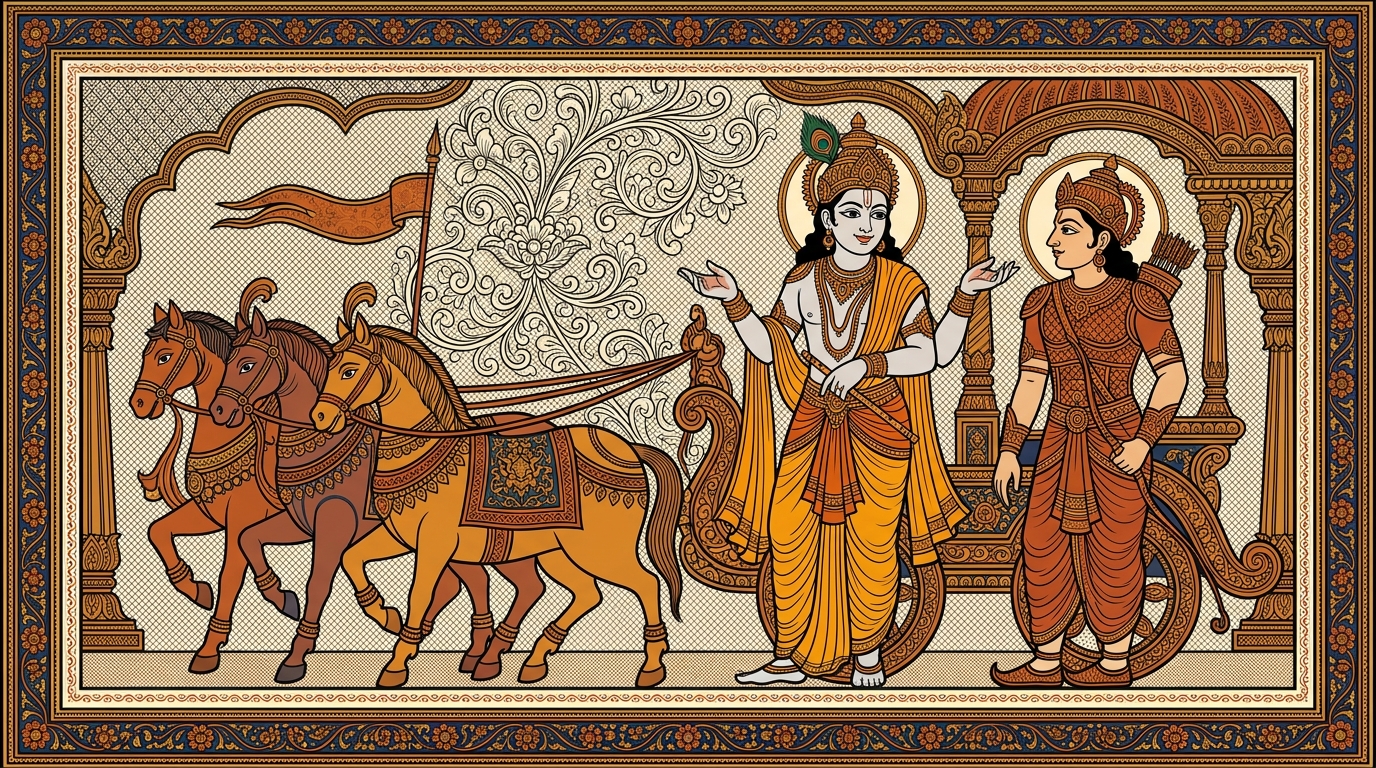
Let us stop the story for a moment and look at the chariot.
There are two people in it. One is Arjuna — the greatest archer
the world has ever seen, a prince whose name makes armies tremble,
a man who once won the hand of a princess by shooting a fish's eye
reflected in water while looking only at the reflection. He stands
at the back of the chariot, tall, armoured, holding the bow called
Gandiva, which was forged by Brahma himself.
And in the front, holding the reins, sits the charioteer.
The charioteer is God.
Think about that. The creator of the sun and the moon. The one who
set the planets spinning, who breathed life into every creature,
who holds the entire universe inside himself the way you hold a
dream inside your sleep. He is sitting on a wooden bench, holding
leather reins, driving four white horses through the mud and dust
of a battlefield.
No one asked him to do this. He could have stood at the centre of
the sky and directed the whole war with a thought. He could have
ended it with a glance. He is Krishna — there is nothing in all
the three worlds that he needs, nothing left for him to gain, no
duty he is bound to perform.
And yet.
That morning, before the sun rose, Krishna had woken early. He
walked to the horse-line in the grey pre-dawn light, his feet bare
on the cold earth. He checked the horses one by one — running his
hands along their legs, inspecting their hooves for stones, feeling
their muscles for stiffness. He combed the tangles from their manes
with his fingers. He filled their water trough himself, lifting the
heavy clay pots without calling a servant.
Then he inspected the chariot. He tested each wheel, spinning it
slowly, listening for the creak that means a spoke is loose. He
oiled the axle. He tightened the leather straps that held the yoke
to the crossbar. He checked the traces — the long lines that
connect the horses to the chariot — making sure no rope was frayed,
no knot was slipping.
A soldier passing by stopped and stared. "My lord," he said,
"there are servants for this."
Krishna smiled without looking up. "There are servants for
everything," he said. "But the horses know my hands."
When Arjuna climbed into the chariot an hour later, everything was
perfect. The reins were supple. The horses were calm. The wheels
turned without a sound. He did not notice any of this — the way
you do not notice the air until the wind stops.
That is what Krishna was teaching, not just with words but with
his life: the highest being in creation had chosen the lowest seat
in the chariot. Not because he had to. Because the world needed
someone to hold the reins, and his hands were willing.