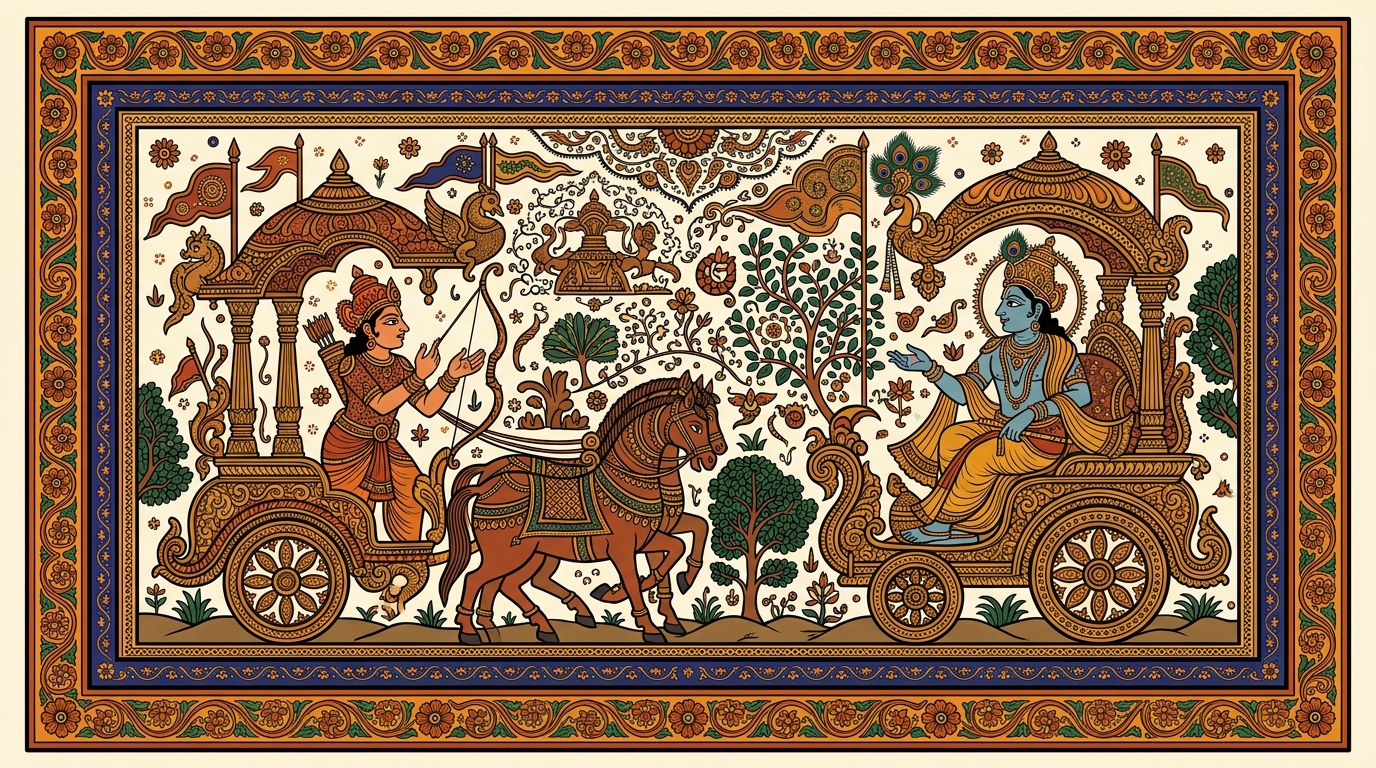
Arjuna had been listening.
Through all of Krishna's teachings — about duty, about nature, about
the gunas that move through everything like currents through water —
Arjuna had sat still in the chariot, his dark eyes fixed on his
friend, his bow resting across his knees. He had not interrupted. He
had not argued. For a warrior known for his fierce pride, this was
itself a kind of surrender.
But now something stirred in him. Not disagreement. Something older
and more uncomfortable: recognition.
He thought of the gambling hall.
He had been there. He had stood beside Yudhishthira as his eldest
brother wagered the kingdom — stake by stake, throw by throw — on a
game of dice he could not win. Arjuna had known it was wrong. Every
fibre of his body had screamed to step forward, to grab the dice, to
say "enough." He was the greatest archer alive. He had faced armies
without flinching.
And yet he had stood there. Silent. Frozen. Watching his brother lose
everything — the treasury, the palace, the land, and then something
so terrible it still woke Arjuna at night, a humiliation his family
could never undo. He had done nothing. Not because he was a coward.
But because something — some invisible force, some pull stronger
than muscle — had held him in place.
That was the question burning inside him now. Not a grand philosophical
puzzle. A personal one.
"Krishna," he said, and his voice was quieter than it had been all
morning. The battlefield receded. The armies blurred. There was only
the space between two men on a chariot and a question that hurt to
ask.
"What is it that makes a person do wrong — even when they know it is
wrong? Even when every part of them is screaming to stop?"
He paused. His hands opened, palms up, as if showing that he carried
no weapon for this particular fight.
"I have felt it, Varshneya. Not in battle. In battle I know what to
do. But in the moments that matter most — when the right path is
clear and the wrong path is easier — something takes hold of me. It
is as if an invisible hand grabs the back of my neck and shoves me
forward. I go where I don't want to go. I do what I don't want to do.
I am yoked to something I cannot see."
His voice cracked, just slightly. Not enough for anyone on the
battlefield to hear. But Krishna heard.
"What is that force?" Arjuna whispered. "What is it that lives
inside a man and fights against his own better nature? Because I need
to know its name before I can fight it. I have defeated Kauravas. I
have defeated demons. I have won boons from Shiva himself. But this
enemy — this one inside me — I do not even know what it is."
The honesty of the question hung in the air between them like the
last note of a bell. It was not the question of a man who thought he
had all the answers. It was the question of a man who had finally
stopped pretending.
And Krishna, who had been waiting — patiently, lovingly, through all
of Arjuna's grief and confusion — looked at his friend and saw that
he was, at last, ready to hear the answer.