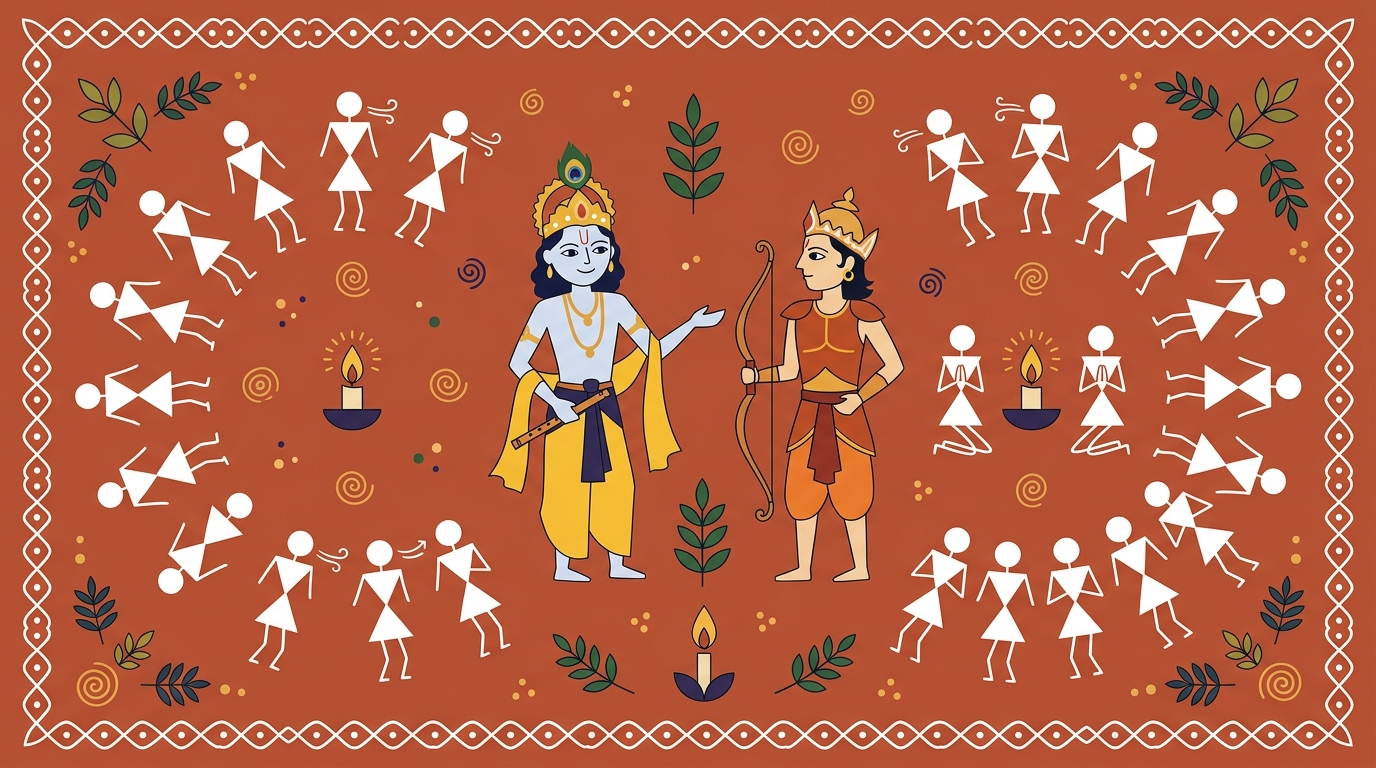
On the chariot, between two waiting armies, Krishna spoke softly, as if
the noise of the field had dropped away and only Arjuna remained.
"Let me tell you of a hermit I once knew," he said. "His name was Suvrata,
and he lived where the river curled around a hill of grey stone. He owned
nothing — a clay bowl, a deerskin, and the morning light. People walked
days to see him, expecting fire-pits and chanting and clouds of fragrant
smoke. They found, instead, a man sitting very still beneath a banyan
tree."
A breeze moved through the chariot's banners. Arjuna leaned in.
"A young traveller once asked him, 'Where is your sacrifice, holy one?
Where is your altar? I see no flames.' Suvrata smiled and said nothing.
He simply breathed. Out — long and unhurried, as though setting something
down. In — slow and grateful, as though receiving a gift. Then, for a
moment, he held the breath gently, the way you cup water in your palms so
it does not spill."
Krishna's voice was as steady as the old hermit's breathing.
"'This,' Suvrata told the traveller, 'is my fire. Each out-breath I pour
into the in-breath. Each in-breath I pour into the out. And sometimes I
hold them both quite still and listen. My altar is here, behind the ribs.
My offering is the only thing that is truly mine to give, the air that
keeps me alive.'"
Arjuna watched the white horses lift and lower their flanks, breathing in
the cool dawn.
"The traveller did not understand at first," Krishna went on. "He had come
looking for spectacle. But he sat down anyway, and he watched the hermit
breathe, and slowly his own breathing grew quiet to match. The river
murmured. The leaves turned. And the boy felt, for the first time in his
restless life, completely still."
Krishna turned to Arjuna.
"You think sacrifice must be grand: gold poured into roaring flames. But
some of the wisest give nothing they can carry, only the breath that
carries them. They make the smallest, plainest act sacred by giving it
their whole attention."
The wind paused. Arjuna realized he was breathing very slowly indeed.