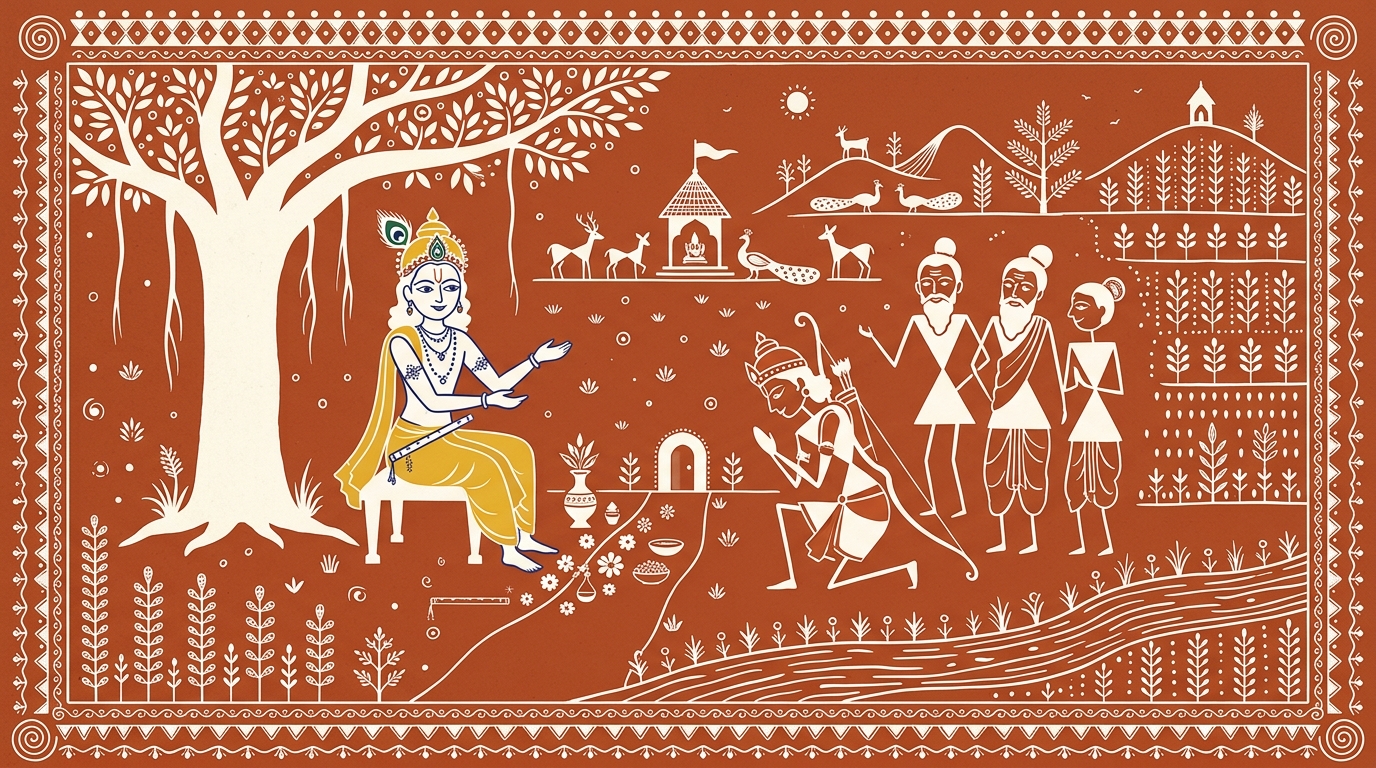
"You ask me where to find such understanding," Krishna said. "Let me tell
you of two boys who once sought the same teacher."
Arjuna, who had himself once been a student under great masters, leaned
forward.
"High in the hills lived a sage named Kaśyapa, who had truly seen the
nature of things. One spring, two boys climbed to his cave on the very
same morning, each hoping to learn from him."
The reins lay still in Krishna's hands.
"The first boy, Darpa, marched up and crossed his arms. 'Teach me,' he
said. 'I am clever already — everyone says so. Tell me your secrets, and be
quick, for I have not got all day.' He did not bow. He did not really want
to understand; he only wanted to add the sage's wisdom to his collection,
like a trophy. And when Kaśyapa spoke, Darpa argued with every sentence,
not to learn but to win. By midday he stamped off, certain the old man knew
nothing."
A breeze stirred the chariot's banner.
"The second boy, Vinaya, came up the path slowly. At the cave's mouth he
bowed low, touching the cool stone with his forehead, for he knew he had
come to receive something precious. He did not pretend to know already. He
asked real questions, not to trap the sage, but because he honestly
wished to understand, and he listened to the whole answer before asking
the next. And he made himself useful: he swept the cave, carried water
from the spring, gathered firewood, never once thinking such tasks beneath
him."
Krishna's eyes were warm.
"Now, Kaśyapa knew the very same truth on both mornings. But to Darpa he
could give nothing, for a closed cup holds no water. To Vinaya he gave
everything, day after day, gladly, because the boy had come humble,
curious, and willing to serve. The wisdom was always there. Only one of
them knew how to receive it."
Krishna turned to Arjuna.
"So when you seek the truth, go to those who have seen it. Bow, not because
you are small, but because what they carry is great. Ask honestly. Lend
your hands to their work. Come like Vinaya, never like Darpa — and the
door of wisdom will open to you of its own accord."
Arjuna thought of his own teachers, and bowed his head, just a little.