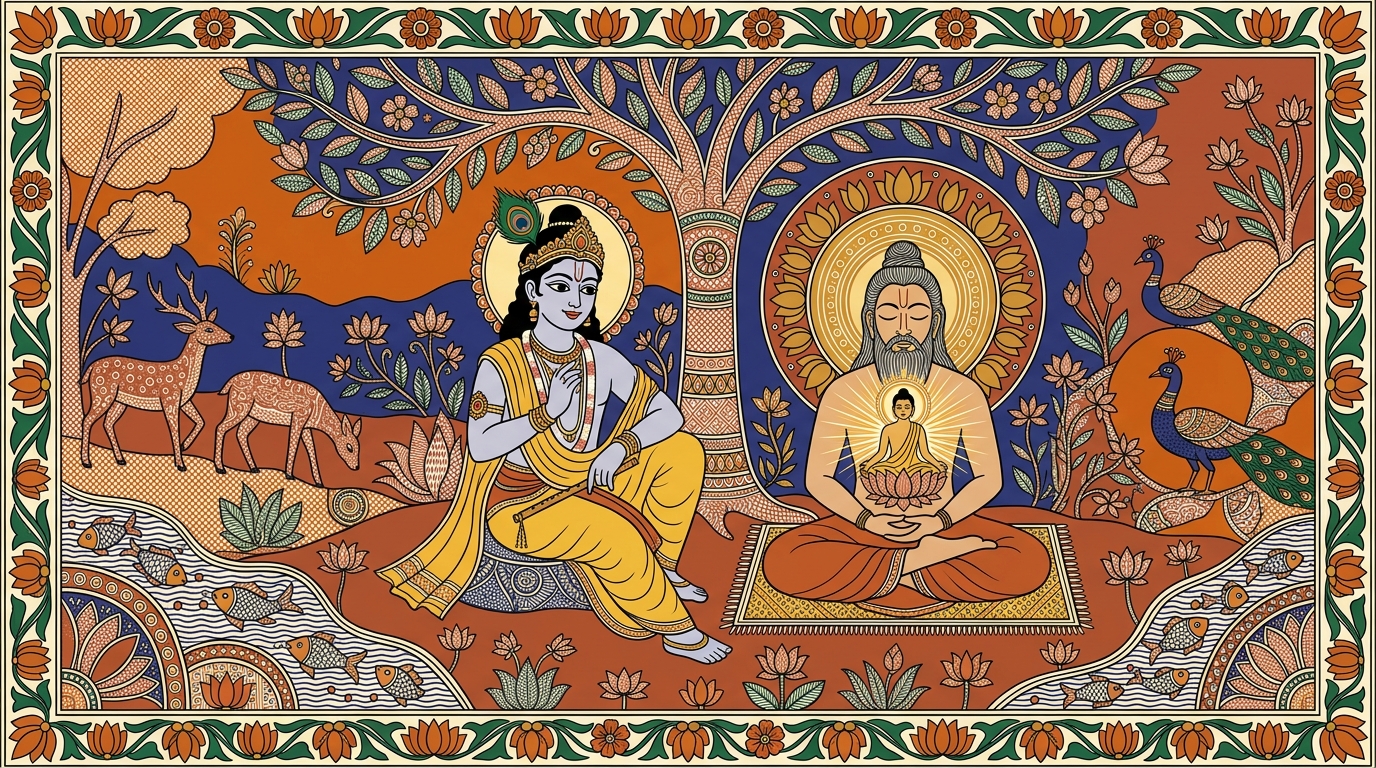
On a hill above the river lived an old rishi named Kanva, and travellers
who passed his hut could never quite figure him out. He owned almost
nothing — a water pot, a worn deerskin, a single shawl. Yet whenever they
looked at him, he seemed to be the happiest man they had ever met.
One day a wealthy merchant climbed the hill to see this curious sage. The
merchant wore rings on every finger and had a caravan of camels waiting
below, loaded with silk and spices. He found Kanva sitting beneath a fig
tree, eyes gently closed, a soft smile on his lips, as if he were
listening to the finest music in the world.
The merchant waited politely until the sage opened his eyes. "Holy one,"
he said, "I have travelled to every great market between the mountains and
the sea. I have gold enough to buy a city. And still, at night, I cannot
sleep: there is always something more I am hungry for. Yet you sit here
with nothing, smiling. What music are you listening to? Where is it
hidden? I will pay any price for it."
Kanva laughed, a warm sound like water over stones. "You cannot buy it,
friend, because it is not far away. For years I sat quietly each morning
until my mind stopped racing, and when at last it went still, I saw it."
"Saw what?" asked the merchant.
"The one who was sitting here all along," said the sage. "The quiet,
happy Self underneath all my thoughts. It was never out at the market. It
was here, the whole time, waiting for my mind to grow calm enough to
notice it." He spread his empty hands. "Once I saw it, I stopped needing
things, because I was already full. That is why I smile. Not because I
have much, but because I have stopped feeling I am missing anything."
The merchant stood a long while. Then, very quietly, he sat down in the
grass beside the old man, closed his eyes, and tried — for the first time
in his restless life — simply to be still.