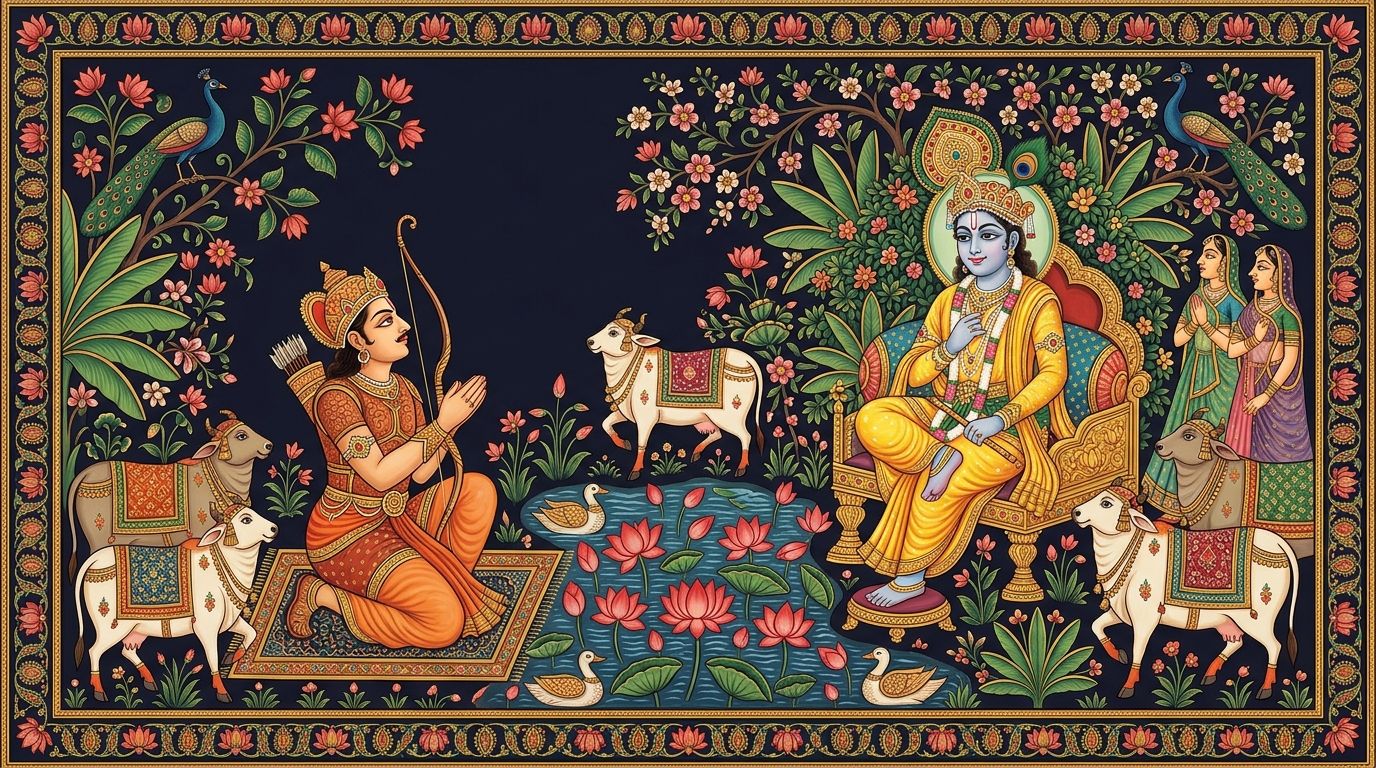
The wind had finally stopped.
All morning it had swept across the battlefield of Kurukshetra, snapping
at the war banners and throwing dust into soldiers' eyes. But now the air
hung still, heavy with the smell of trampled grass and oiled leather. The
horses stood quiet. Even the crows had stopped circling.
Arjuna sat in his chariot, his great bow Gandiva resting across his knees.
His palms were raw from gripping it, and his fingers ached in that deep way
that comes not from fighting but from holding on too tightly to something.
He stared at the reins in Krishna's hands — dark hands, steady hands, hands
that never trembled.
Krishna had just shown him everything. The cosmic form. The universe inside
a body — galaxies spinning in his mouth, rivers of time pouring from his
eyes, every creature that ever lived and every creature that ever would.
Arjuna had seen it, and his mind was still ringing from it, the way a
bronze bell rings long after it has been struck.
But now Krishna sat beside him again, looking ordinary. A charioteer with
a peacock feather in his hair. A friend with a half-smile. And Arjuna
found himself thinking about the old rishis in the forest, the ones his
mother Kunti had told him about when he was small. Those sages didn't
worship a person. They sat with closed eyes and searched for something
they couldn't see, couldn't name, couldn't hold. Something beyond all
form.
"Krishna," Arjuna said, and his voice came out quieter than he expected.
Krishna turned.
"Some people love you like this — face to face, the way I do. They sing
your name, they bring you flowers, they talk to you as if you're sitting
right there. But others close their eyes and reach for something they
can't even describe. Something without shape."
He paused. A single crow called out somewhere behind the army lines.
"Who understands better? Which way is the real way?"
It was the simplest question he had ever asked. Not about war, not about
duty, not about the fate of kingdoms. Just this: when you love something
bigger than yourself, is it better to love what you can see, or to search
for what you cannot?
Krishna's half-smile deepened. Of all the questions Arjuna had asked across
eighteen chapters of doubt and wonder, this one — asked in a tired voice,
on a still battlefield — might have been the most honest.