The dice had been thrown. The game had been lost. And now Draupadi stood
in the middle of the great court of Hastinapura, her heart hammering
against her ribs.
The marble hall was enormous — a hundred pillars holding up a painted
ceiling, oil lamps burning in every niche, the throne of the Kuru kings
gleaming at the far end. It was the grandest room in the kingdom. And
today it was the cruelest.
Duryodhana sat on his throne, smiling. Beside him, his brother Dushasana
had his fist wrapped around the end of Draupadi's sari. "Pull it off,"
Duryodhana said, his voice echoing off the pillars. "She was won in a
fair game."
Draupadi looked around the court. Bhishma, the great-grandfather who
had once bounced her children on his knee, sat silent, staring at
the floor. Drona, the teacher who taught her husbands to fight, looked away. Even Dhritarashtra, the blind king on his cold throne,
said nothing.
She turned to her five husbands, the Pandavas, the greatest warriors
alive. They sat with their heads bowed, bound by the rules of the
gambling game. They could not help her.
Draupadi gripped her sari with both hands. She pulled against Dushasana
with every bit of strength in her arms. But he was bigger, stronger.
The silk slipped through her fingers. She could feel it going.
And then — in the moment when her grip failed — she did something no one
expected.
She let go.
She raised both hands above her head, palms open, and called out one
word: "Krishna!"
Not a prayer. Not a ritual verse. Just a name, spoken from the bottom
of her heart, the way a drowning person calls for help without thinking
about the proper way to ask.
And the sari had no end.
Dushasana pulled and pulled. Yards of silk poured from the cloth like
water from a spring that cannot be emptied. Red, gold, blue, green —
colours Draupadi had never even worn — cascaded onto the marble floor
in great shining heaps. The pile grew to Dushasana's knees, then his
waist. His arms ached. Sweat ran down his face. Still the cloth came.
He finally collapsed, gasping, on a mountain of silk. Draupadi stood
untouched, her sari intact, her hands still raised.
She had not been saved because she was strong. She had been saved because
she stopped trying to hold on alone and let someone greater carry her.
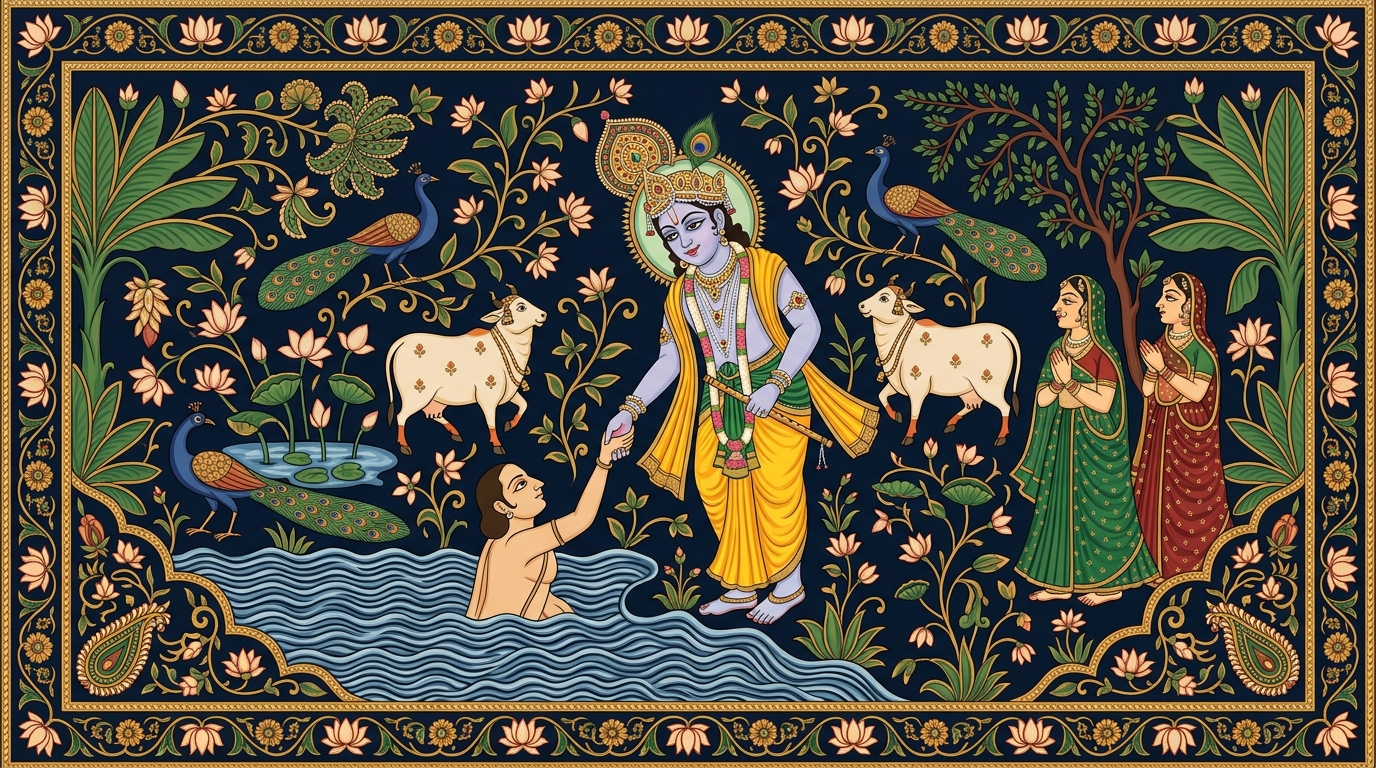
The one who surrenders, Krishna says, is the one who is lifted from the
ocean. Not someday. Not after a long wait. Now. Swiftly. The moment
you let go.