The tide was going out.
Aarav stood ankle-deep in the warm shallows off Puri beach, watching the
sea pull back and leave the wet sand shining like a mirror. In that
mirror he could see himself, a thin boy with knobbly knees, his hair
sticking up, his shadow stretching long behind him in the late afternoon
sun.
He waggled his fingers. The reflection waggled back. He stuck out his
tongue. So did the boy in the sand.
"Dadu," he said, without turning around, "is that me?"
His grandfather was sitting on an upturned fishing boat further up the
beach, mending a net with a wooden needle. He didn't look up. "Is what
you, child?"
"That. In the sand. The reflection." Aarav frowned at it. "It's got my
face. But it's not really me, is it? It's just a picture of me."
Dadu's needle paused.
"And these." Aarav held up his hands and turned them over. "My hands, my
legs, my belly. When I was a baby my body was tiny. Now it's bigger.
One day it'll be old and wrinkly like yours." He grinned. "So my body
keeps changing. If it's always changing... is the body really me? Or is
it just something I'm wearing?"
Now Dadu set down the net.
"And my thoughts," Aarav went on, the questions tumbling out faster now,
the way they did when something had been buzzing in his head all day. "A
minute ago I was thinking about mangoes. Now I'm thinking about this. My
thoughts come and go like the waves — splash, gone, splash, gone. So my
thoughts can't be me either, can they?"
He turned at last to face his grandfather, his feet sinking a little in
the soft sand.
"Dadu — there's a *me* watching all of it. Watching the body change.
Watching the thoughts come and go. Watching this reflection wave back at
me. *That* watcher — the one who's noticing everything — is *that* the
real me?"
For a long moment Dadu said nothing. A gull cried overhead. The sea
hissed in and out.
Then the old man smiled, and it was a slow, surprised, delighted smile.
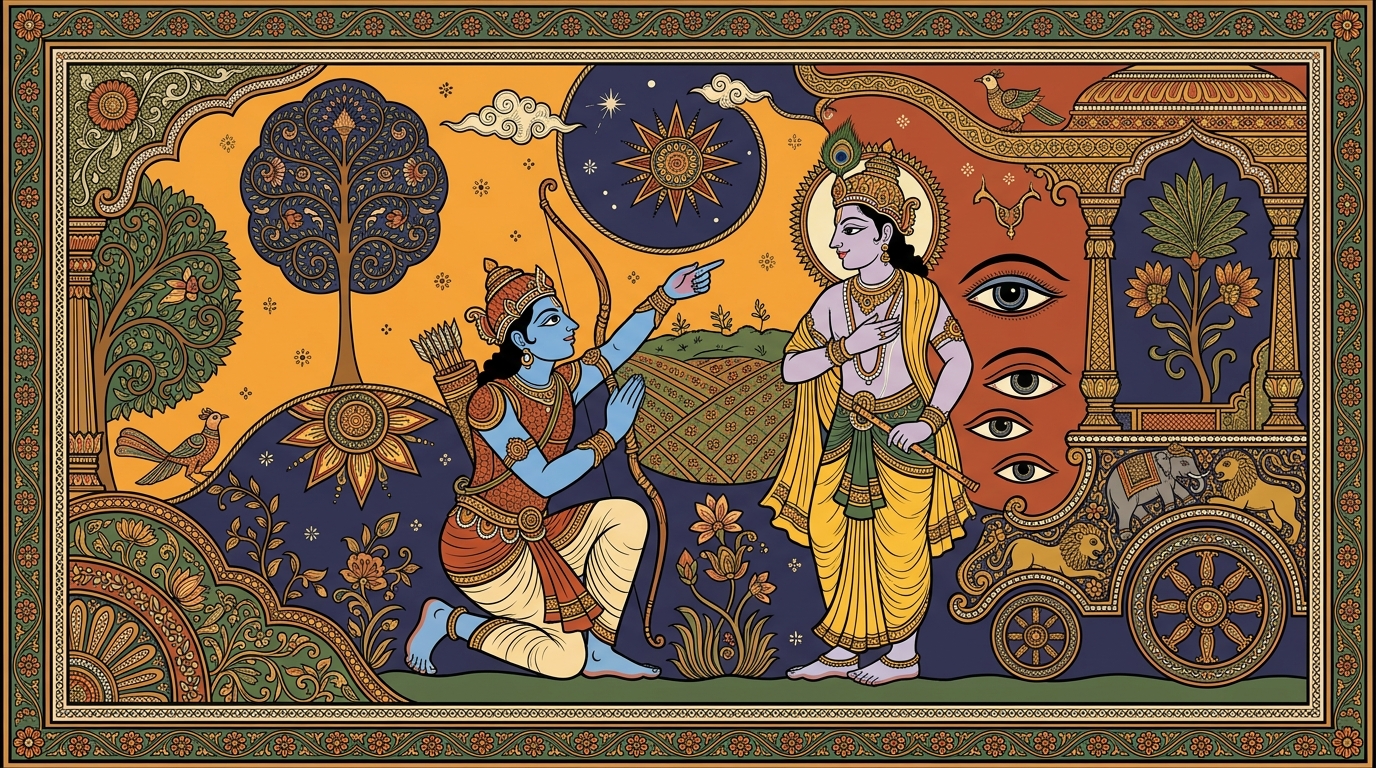
"Aarav," he said softly, "do you know that thousands of years ago, on a
battlefield, a great warrior named Arjuna asked his teacher Krishna the
very same question? He wanted to know which part of us is the changing
field — the body, the world, the thoughts — and which part is the quiet
knower who watches it all. Come. Sit. Let me tell you what Krishna
said."