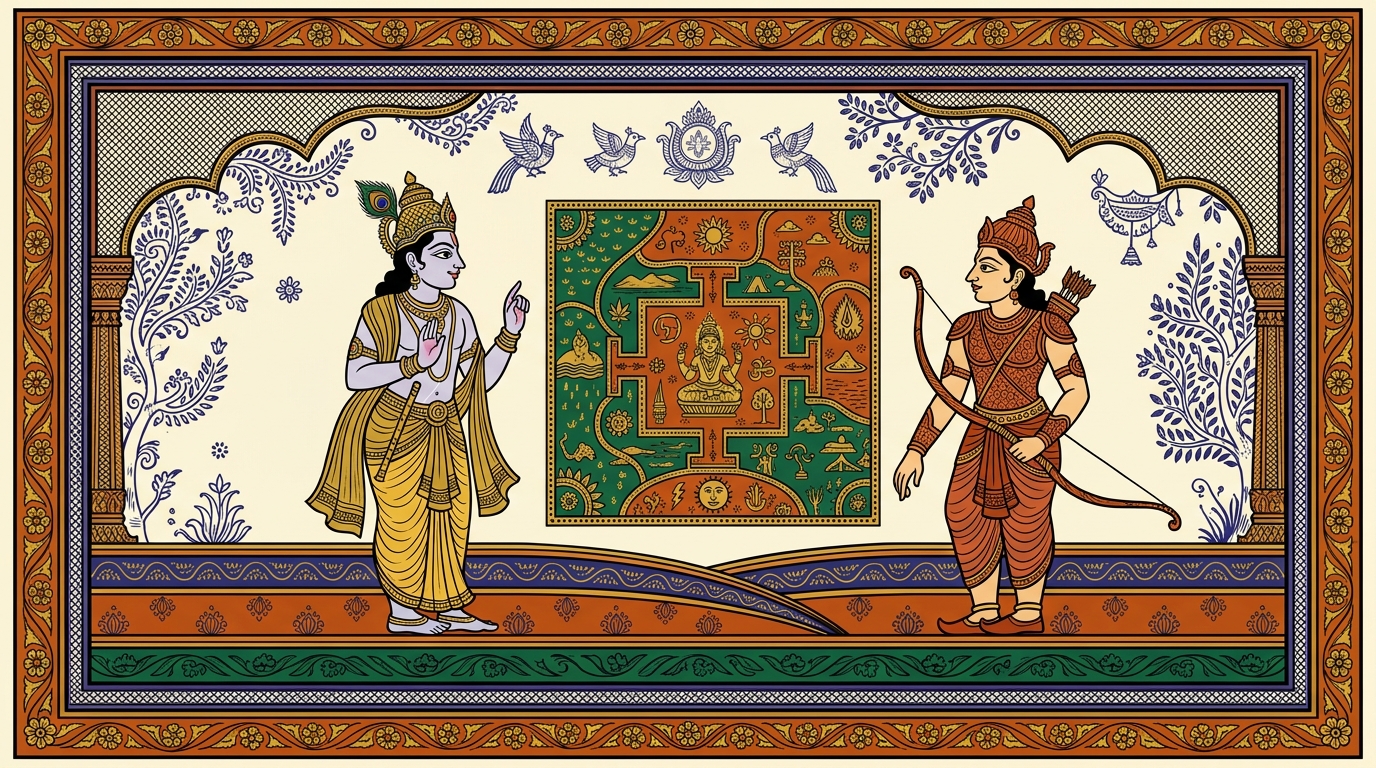
In an ashram deep in the forest, where the morning mist still clung to the
sal trees, a great teacher sat surrounded by students who had walked many
days to reach him. They were tired and eager, and their heads were full of
questions too big to hold.
"Master," said the eldest of them, bowing low, "we have read the long
scriptures. We have heard the endless debates. There are so many words, so
many ideas: the elements, the senses, the mind, the Self, nature, spirit.
Our minds spin. We cannot hold it all." He spread his hands helplessly.
"Is there no simple way to see the whole thing at once?"
The teacher smiled. He picked up a stick and smoothed a patch of earth in
front of him.
"When a traveller sets out on a long journey through unknown country," he
said, "what does he want first? Not every pebble on every path. He wants a
*map* — drawn small, on a single leaf, so he can hold the whole land in
one glance before he takes a single step. Then, when he walks, nothing
surprises him. He already knows the shape of where he is going."
With the stick he drew two simple marks in the dust — one on the left, one
on the right.
"I will give you such a map," he said. "Here is everything that changes —
the body, the senses, the thoughts, the whole busy world. We will call it
the *field*. And here is the one who knows it all, who watches without
changing. We will call him the *knower of the field*. Everything you have
ever struggled to understand fits on one side or the other of this little
line."
The students leaned forward.
"First I will show you *what* the field is made of, what it is like, how it
shifts and changes, and where it springs from. Then I will show you *who*
the knower is, and how vast his quiet power. Listen carefully, and in a few
breaths you will see, in brief, the whole of it."
The eldest student felt something in his chest unknot. After years of
feeling lost in a forest of words, he was finally being handed the map.
This was Krishna's promise to Arjuna too: *Listen, and I will tell you
briefly what the field is and who the knower is.* Before unfolding the
great mystery, he gave the comfort of a clear, short map — so that nothing
that followed would feel like getting lost.