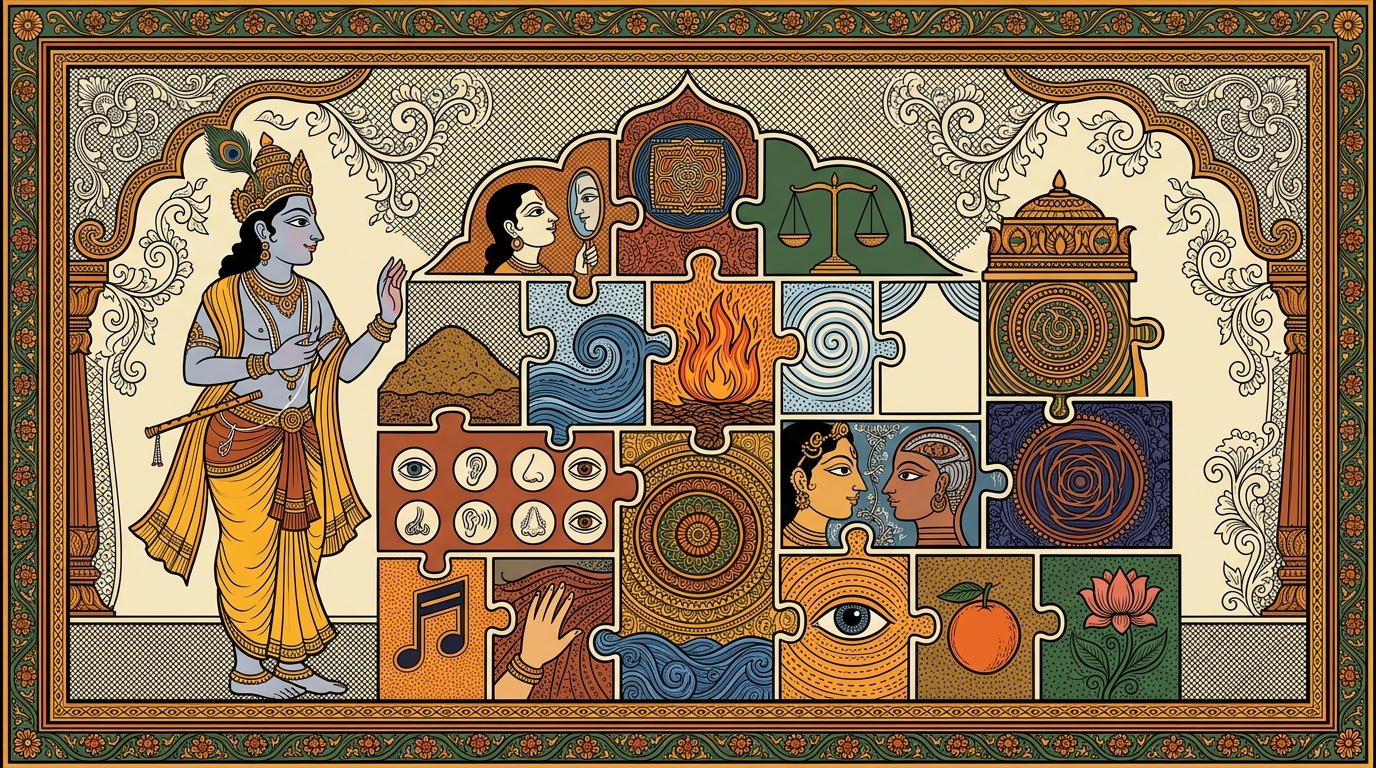
In a hillside cave that caught the first light of dawn, the sage Kapila
sat with a single student — a young seeker who had come to learn how a
living being is put together.
"You wish to know what makes up the field," said Kapila. "The body, the
mind, the whole changing world that the Self looks out upon. Very well.
Let us lay it out, piece by piece, like a builder laying out his materials
before he begins."
He gathered a handful of objects from around the cave floor and set them in
a row on a flat stone.
"First," he said, placing a clod of earth, a drop of water from his pot, a
glowing ember, a puff of breath, and pointing to the empty space above, "the
five great elements — earth, water, fire, air, and space. Everything you
can touch is built from these."
He set down a small mirror. "Next, the ego — the little voice inside that
says *I, me, mine*. It is the puzzle-piece that makes you feel separate
from everything else."
Beside it he placed a clear crystal. "Then the intellect — the part that
weighs, chooses, and decides: *yes, no, this is right, that is wrong.*"
He drew, in the dust, a single closed seed. "And the unmanifest — the
quiet, unseen source out of which all the rest unfolds, the way a whole
tree sleeps inside one seed."
Then he laid out ten small pebbles in two rows of five. "The ten senses —
five for knowing the world: eyes, ears, nose, tongue, skin; and five for
acting in it: hands, feet, voice, and the rest." He added one pebble
between the rows. "And the one mind, the busy messenger that runs between
them all."
Last, he set down five tiny things: a bell, a feather, a flower, a piece
of fruit, a pinch of spice. "And the five things the senses reach for —
sound, touch, sight, taste, and smell."
The student gazed at the strange, beautiful arrangement on the stone.
"All of this," said Kapila, sweeping his hand over it, "is the field. Every
bit of it changes, comes and goes, is born and dies. *Not one piece of it*
is the knower who watches it." He smiled. "Hold the whole field in your
mind at once, and then you will be ready to meet the One who knows it."
This was Krishna's list to Arjuna, exactly: the great elements, the ego,
the intellect, the unmanifest, the ten senses and the mind, and the five
sense-objects — all the puzzle-pieces of the field.