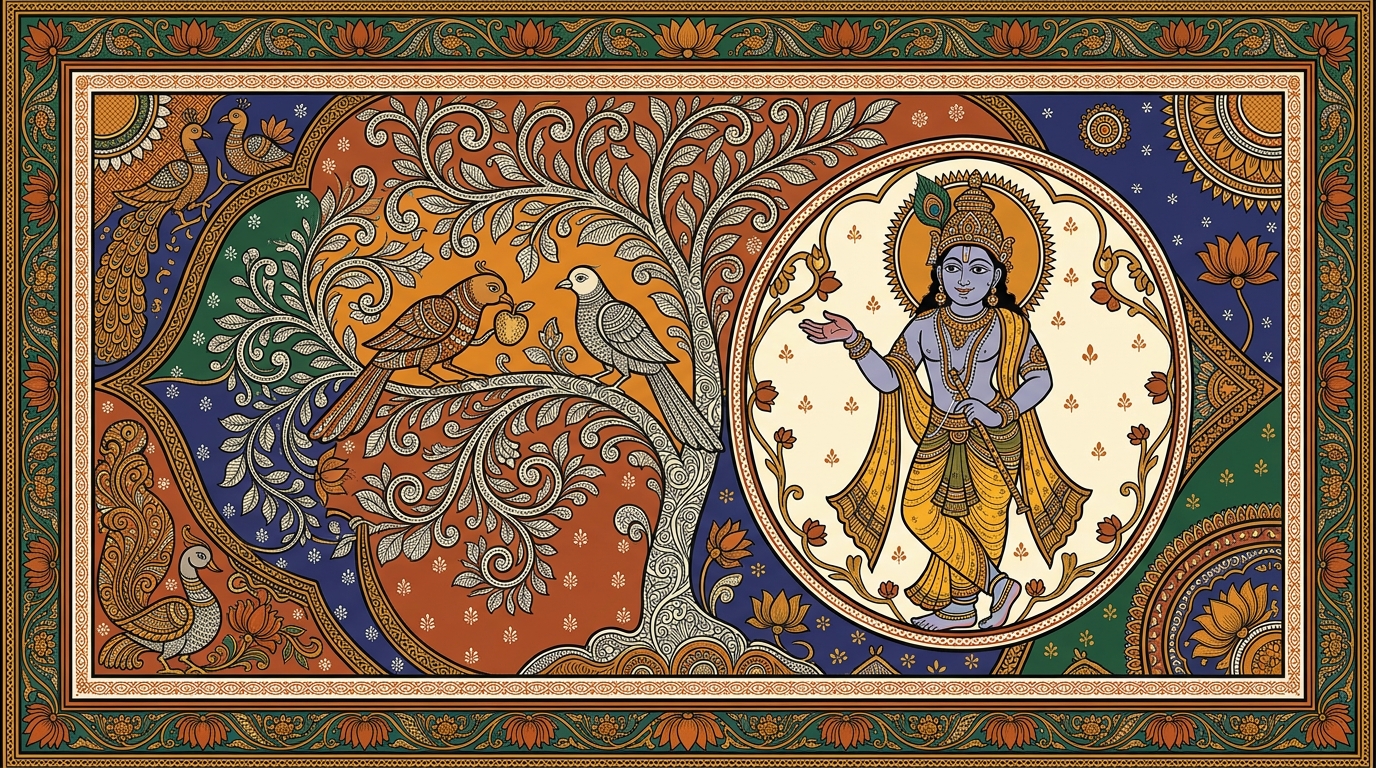
The old rishi Angiras had a way of teaching that his students never
forgot. Instead of long lectures, he would point to a single thing in
the forest and tell its secret.
One golden evening he led the boys to the edge of the ashram, where a
great fig tree spread its branches against the pink sky. "Look up," he
said. "Tell me what you see."
High in the tree sat two birds, side by side on the same branch, both
of them the same gleaming gold. The boys watched.
The first bird hopped and pecked busily at the tree's fruit. It snatched
a sweet ripe fig and chirped with delight. Then it bit a sour one and
shook its head, ruffling its feathers in disgust. It found a bitter
berry and squawked. Sweet, sour, bitter — the little bird bounced from
fruit to fruit, lifted by every sweet one and crushed by every bad one,
its whole mood swinging with each bite.
The second bird did not eat at all. It sat perfectly still, calm and
bright-eyed, simply watching its restless companion. It tasted nothing,
chased nothing, worried over nothing. It only watched — steady as the
branch itself.
"Now," said Angiras softly, "those two birds live in you."
The boys turned to him.
"The first bird is the part of you that runs after the fruits of the
world — the part that is thrilled when things go sweet and miserable
when they go sour. It is always tasting, always wanting, always rising
and falling.
"But there is a second bird in you too. It sits at the very centre,
watching. It is the Self — the witness who sees all your happy days and
sad days without being tossed about by any of them. It allows everything,
holds everything up, tastes the world through you, yet stays calm and
free. The old teachers call it the supreme Self, the great Lord seated
in this very body."
A boy named Hiranya whispered, "Are they really two birds, master?"
Angiras smiled. "Look again."
And as the light faded, the busy bird seemed to grow tired of its
pecking. It turned, hopped closer to the still bird, and gazed at it —
and in that gaze the boys understood. The little bird was not separate
at all. The moment it stopped chasing fruit and looked at the watcher,
it remembered: it had been the watcher all along.