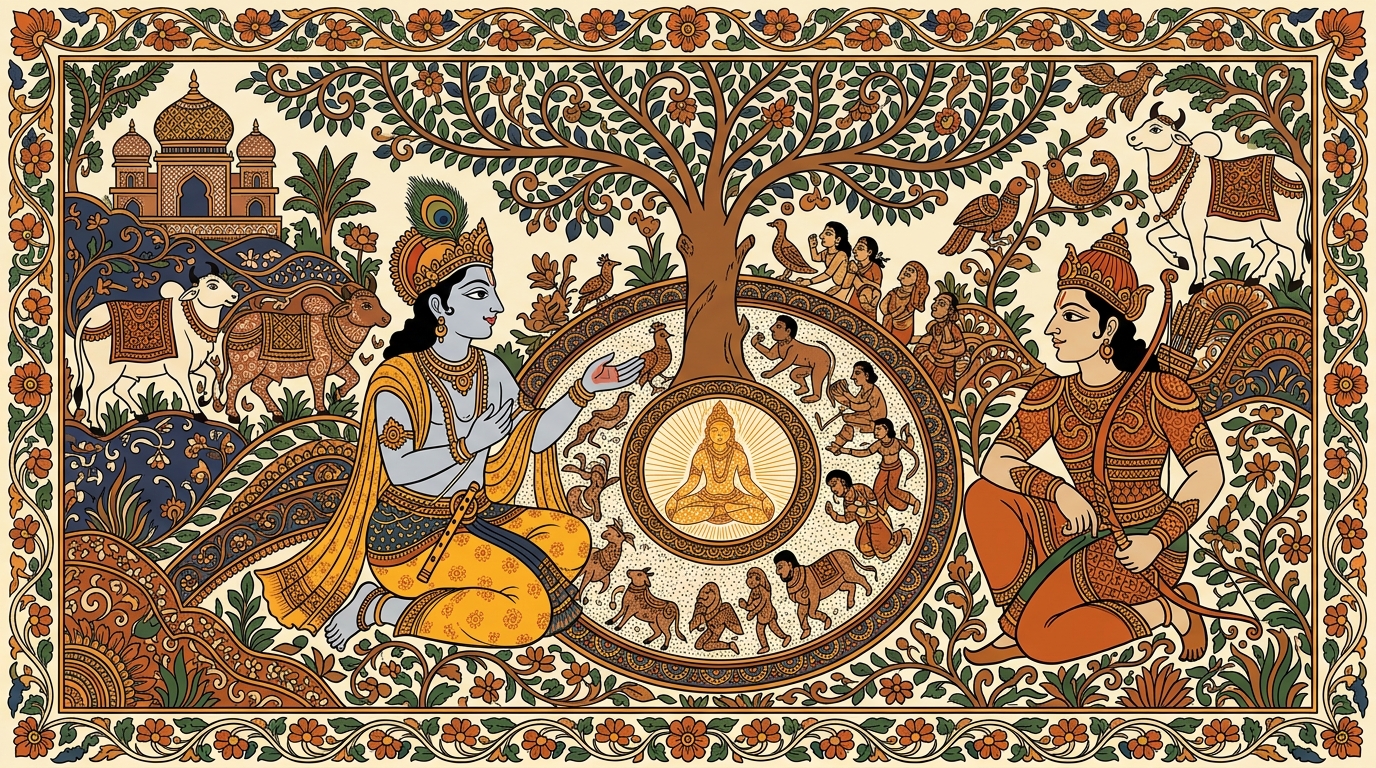
The sun had not yet cleared the eastern hills.
On the plain of Kurukshetra, caught in the grey hour between night
and dawn, everything held its breath. The armies waited in their
formations — a million men, ten thousand horses, war elephants
swaying in the half-light — but for this one suspended moment, the
only movement was Krishna's hand.
He had picked up the leather chariot whip and was drawing in the
dust with its tip.
"Watch," he said.
Arjuna leaned over the chariot rail. In the pale earth between the
wheels, Krishna drew a circle — smooth, deliberate, the size of a
dinner plate. Then he leaned back and waited.
A gust of wind came off the Yamuna, carrying the smell of river mud
and damp grass. It swept across the ground and erased the circle as
if it had never existed. The dust settled. The line was gone.
"That," Krishna said, "is kshara. The perishable. Everything you
see around you — these armies, these horses, the banners snapping
in the wind, the armour on your arms, the breath in your chest. All
of it is a circle drawn in dust. Beautiful. Real. And temporary."
Arjuna looked out across the field. Bhishma's white banner caught
the first ray of sun. Drona's chariot gleamed. Somewhere a conch
shell was being polished, the sound like a whisper of brass. All
of it — kshara. All of it would pass.
Krishna drew a second circle, this time pressing the whip tip deep
into the hard clay beneath the surface dust. The wind came again,
stronger this time, throwing grit against the chariot's wooden
sides. When it passed, the second circle remained — untouched, its
edges clean and sharp.
"And that," Krishna said, "is akshara. The imperishable. There is
something in every creature that the wind cannot erase. It does not
age. It does not break. It stands at the summit of what you are
and simply watches."
Arjuna closed his eyes. He let the sounds of the battlefield
recede — the clank of weapons, the murmur of soldiers, the nervous
stamping of horses. Beneath all of it, deeper than thought, deeper
than memory, he felt something that did not move. Something that
had never moved. It was not warm or cold. It was not loud or quiet.
It was simply there, the way the sky is there behind every cloud.
He opened his eyes. Krishna was watching him with a look that held
no urgency, only patience.
"Two kinds of being," Krishna said softly. "One that the wind takes.
One that remains. Learn to tell the difference, Arjuna. Everything
begins there."