Tara's grandfather made violins. Not the factory kind with machine-cut
edges and spray-on varnish — the handmade kind, carved from maple and
spruce, shaped by chisels and sandpaper and sixty years of knowing
exactly where the wood wanted to bend.
His workshop was a small room behind the house that smelled of wood
shavings, linseed oil, and the faint sweetness of old varnish. Violins
in various stages of completion hung from the ceiling on cotton
strings, turning slowly in the breeze from the window like sleeping
birds. On the wall, written in his careful handwriting, was a list of
names.
"Every violin I finish gets a name," Thatha told Tara. He was bent
over his workbench, drawing a fine-toothed saw across a piece of
spruce. Sawdust fell like gold powder. "This one will be Varsha —
the monsoon. Because I started carving the top plate on the first
day of the rains, and the humidity got into the wood and gave it a
deeper voice than I expected."
"What about that one?" Tara pointed to a dark red violin hanging
near the door.
"Agni. Fire. I varnished her during the hottest week in May, and the
varnish dried too fast — see these tiny crackle lines in the finish?
I thought it was ruined. But when I strung her up and drew the bow
across the strings —" He paused, smiling at the memory. "She had the
brightest, sharpest sound of any violin I have ever made. Like a
spark catching. So I named her Agni."
Tara ran her fingers along the scroll of Agni's neck, feeling the
carved spiral under her fingertips. "Do the names change how they
sound?"
Thatha set down his saw and looked at her. "No. But they change how
I listen. When I pick up Agni, I remember the heat, the crackled
varnish, the surprise of that first note. The name holds the whole
story inside it. And when I play, the story comes through."
He crossed the room and took down another violin, a pale honey-
colored one with a long scratch across its back. "This is Yatra —
the journey. She fell off the back of a bullock cart when I was
carrying her to a concert in Chennai. Slid right out of the case
and bounced along the highway. I thought she was finished."
"But she wasn't?"
"The scratch goes deep. Right through the varnish into the wood.
But the sound?" He plucked a string. A low, warm note filled the
workshop. "The scratch gave the back plate a tiny bit of freedom
to vibrate differently. She sounds more human now. More real."
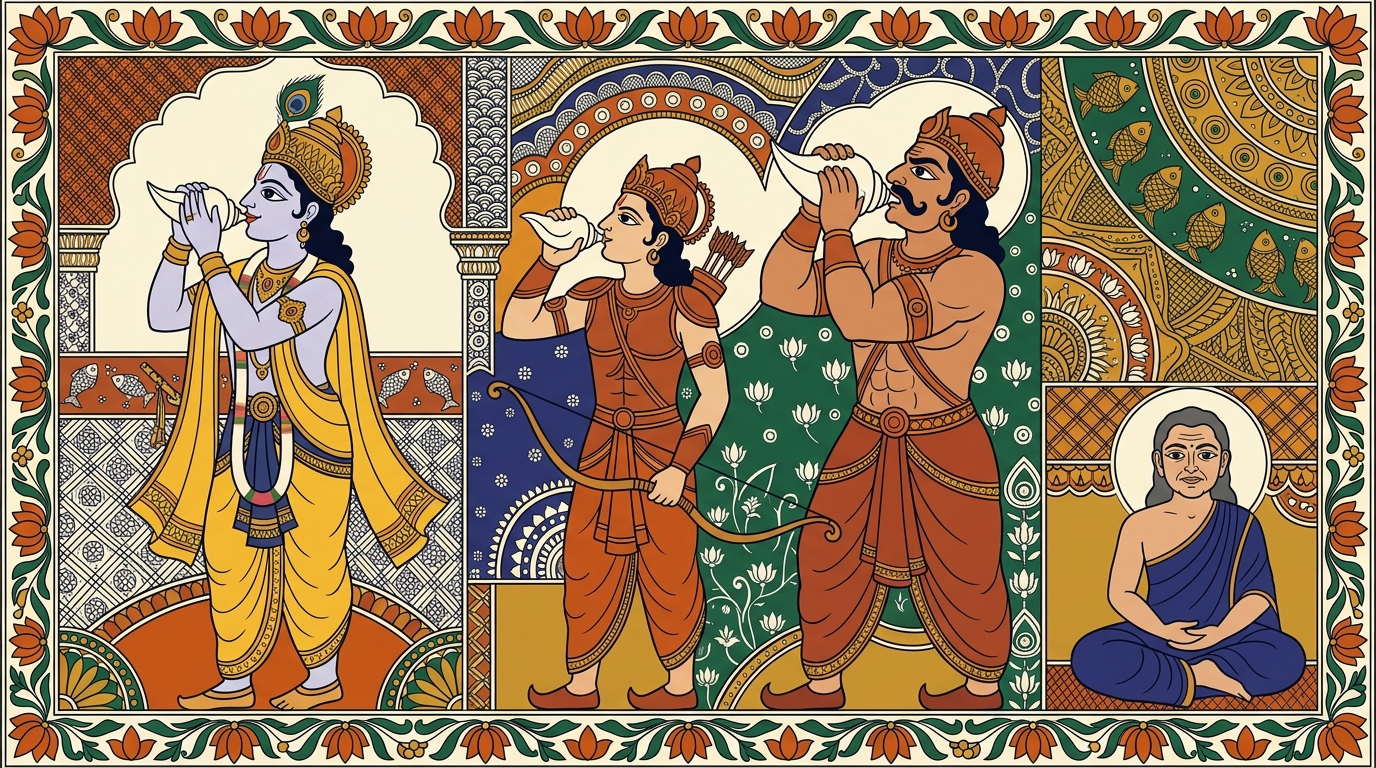
In the Gita, every great warrior's conch has a name. Panchajanya.
Devadatta. Paundra. These are not just labels. They are stories
compressed into a single word. Panchajanya was born from a demon
of the sea. Devadatta was a gift from the gods. Each name carries
a history, a memory, a meaning. And when those conches were blown
on the battlefield, all of that meaning poured out with the sound.