Nobody drops the violin during a concert. That is the one unspoken
rule of the Bangalore Youth Orchestra. You can miss a note. You can
lose your place in the score. You can come in two beats late and
have the conductor glare at you with eyes like hot coals. But you
never, ever drop the instrument.
Maya dropped hers.
It was the winter recital, the big one, the one that parents and
grandparents and newspaper photographers attended. The auditorium at
Chowdiah Memorial Hall was full — six hundred seats, and Maya could
see her mother in the third row, her hands clasped in her lap, her
face shining with the particular pride that only a mother whose child
is about to play Vivaldi can produce.
The orchestra tuned. The conductor raised his baton. Maya lifted her
bow and placed it on the strings, and the first notes of "Winter"
from The Four Seasons rose into the hall — crisp and bright and cold,
like wind through bare branches.
And then, at bar forty-seven, something happened.
Maya's eyes drifted past the music stand and into the audience, and
she saw her father. He was sitting in the last row, near the exit,
half-hidden behind a pillar. He was not supposed to be there. Her
parents had separated eight months ago, and her father had moved to
Chennai. He had not called in three weeks. But there he was, in a
rumpled white shirt, leaning forward with his elbows on his knees,
watching her with an expression she had never seen on his face
before — something raw and broken and full of love.
Her fingers went first. The vibrato she had practiced for hundreds
of hours simply stopped, like a tap turned off. Then her bow arm
began to shake — not the controlled tremolo that Vivaldi calls for,
but an ugly, uncontrollable trembling that travelled from her shoulder
to her wrist to her fingertips. She felt heat spreading across her
skin — her neck, her ears, her cheeks — as if someone had poured
warm water over her. The hairs on her arms stood straight up. And
then, in the silence between movements, her fingers opened and the
violin slipped from her hand and clattered onto the wooden stage.
The sound was enormous in the quiet hall. A collective gasp. The
conductor turned. The first cellist bent down to pick it up.
Maya stood there, burning, trembling, her hands empty, and stared
at her father in the last row. She was not embarrassed. She was not
ashamed. She was feeling something so large that her body simply
could not hold it and play Vivaldi at the same time.
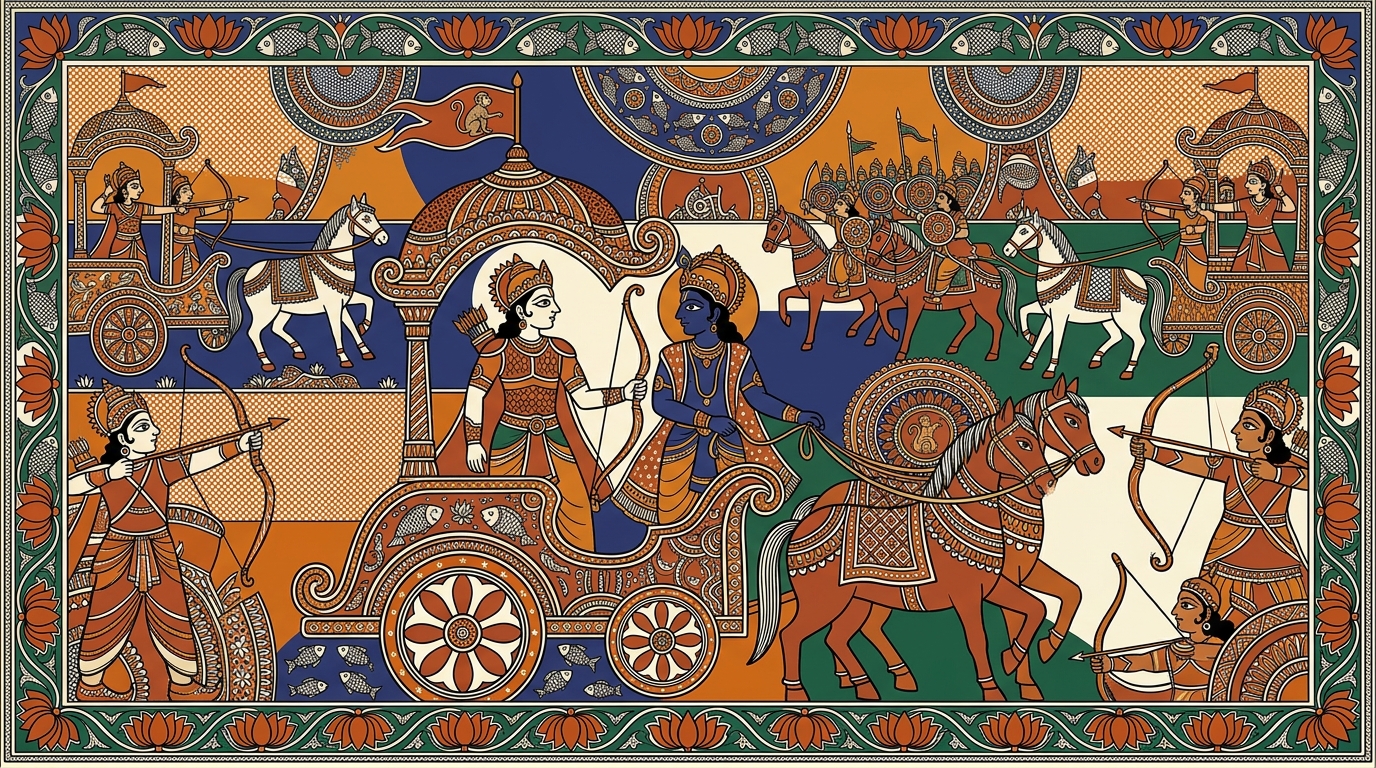
Arjuna's bow Gandiva was not an ordinary weapon. It was a divine
gift from the god of fire, a bow that had never failed him in
battle, an extension of his own arm. When Gandiva slipped from
his grip, it was not because his hand was sweaty or his arm was
tired. It was because the identity he had built — "I am a warrior,
I am the greatest archer, this bow is who I am" — had cracked open,
and what poured through the crack was too much to hold.
Sometimes the things we grip tightest are the first things we drop
when the truth finally hits us.
But here is what happened next. The first cellist placed the violin
gently back on the stage in front of Maya. And after a moment that
felt like a year, Maya bent down and picked it up. Not that evening —
she walked offstage, and the orchestra finished "Winter" without her.
But she did pick it up again, three days later, alone in her room,
and the notes that came out were different than before: deeper,
rougher, more honest. Sometimes what falls from your hands is not
lost. It is only waiting for you to be ready to hold it again.