Everyone said it would be fine.
Dev's friends said it. His older cousin Nikhil said it. Even the
security guard at the construction site, who should have stopped
them, shrugged and looked the other way. "Boys will be boys," he
muttered, turning back to his phone.
The unfinished building was five storeys tall, its concrete skeleton
rising above the empty lot on the edge of town. No walls yet — just
grey pillars and slabs, open on all sides, with rebar poking out of
the top floor like iron fingers reaching for the sky. For months,
the older kids in the neighbourhood had been climbing it after school,
daring each other to go higher, to stand at the edge, to jump from
slab to slab across the gaps where staircases would eventually be.
"Come on," Nikhil said, already three floors up, his voice bouncing
off the bare concrete. "The view from the top is amazing."
Dev put his foot on the first rung of the bamboo scaffolding. His
shoe slipped on the smooth pole, and he grabbed the crossbar to
steady himself. The bamboo was damp from last night's rain and
smelled of mud and rust. He climbed one floor. Two floors. The
ground below shrank. He could see the whole lot now — the piles of
sand and gravel, the cement mixer sleeping under a blue tarpaulin,
the road beyond where an auto puttered past trailing grey exhaust.
On the third floor, he stopped.
Something was wrong. Not with the building. Not with the bamboo. With
him. His mind, which had been calm and even excited on the ground,
was now spinning like a top kicked sideways. Thoughts crashed into
each other: the damp bamboo, the missing railing on the east side,
the gap in the floor where the stairwell would be, the rebar sticking
up like teeth. He could not hold a single thought steady. It was
as if his brain had become a television with someone flipping through
channels too fast.
And then came the feeling. Not a thought, not a reason, not an
argument — just a low, heavy certainty in his gut that said:
something bad is going to happen here.
"Dev! Come on!" Nikhil's voice from above.
"I can't," Dev said. His voice came out thin and strange. "I'm going
down."
"What? Why?"
Dev could not explain. He had no evidence. The building had not
moved. The bamboo had not cracked. Nobody was hurt. But his mind
was showing him pictures he had not asked for — a foot slipping, a
hand grabbing air, the long fall, the sound at the bottom — and he
could not make them stop.
He climbed down. Nikhil called him a coward. His friends laughed.
Two days later, a section of the third-floor scaffolding collapsed
during a rainstorm. Nobody was there. Nobody was hurt. But when Dev
heard the news, his hands went cold, and he sat very still for a
long time.
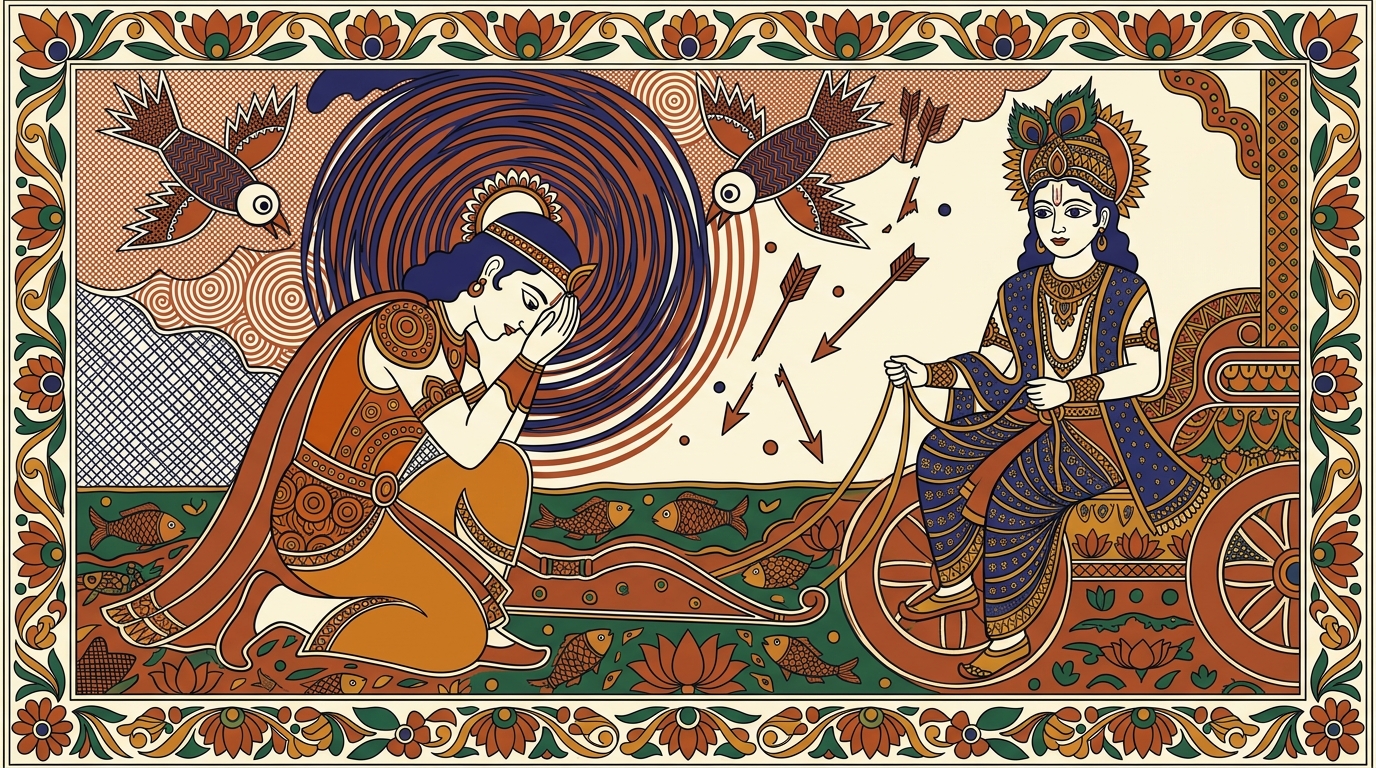
Arjuna says "I see bad omens." The Sanskrit word is "nimittāni" —
signs, signals, warnings. He cannot name them precisely. He cannot
build a logical argument. But every part of him — body, mind, gut —
is screaming that this is wrong. His mind is spinning. He cannot
stand still. He sees destruction everywhere he looks.
There is a kind of knowing that comes before logic. It does not give
you reasons. It gives you a feeling so strong that your body refuses
to move forward. Some people call it intuition. Some call it
conscience. Arjuna, standing in his chariot with his divine bow
hanging useless at his side, called it what it was: "I cannot see
any good in this."
But there is a difference between genuine warning and runaway fear.
Sometimes the body senses real danger — the damp bamboo, the missing
railing — and the gut says stop because stopping is wise. Other
times, the mind invents disasters that will never come, spinning
pictures of catastrophe simply because it is afraid. The hard part
is telling one from the other. Dev's fear turned out to be well-
founded. Arjuna's grief was real, but not every dark picture his mind
painted was prophecy — some of it was the anguish of a man who loved
too deeply to think clearly.
Sometimes the bravest thing a person can do is listen to the voice
inside that says no — even when everyone around them is saying yes.
And sometimes the second-bravest thing is to ask: is this voice
protecting me, or is it only afraid?