Before there was Kurukshetra, there was the dice game. And the dice
game began because Duryodhana visited a palace and could not bear
that it was more beautiful than his own.
The Pandavas had built Indraprastha — a city that shimmered like a
dream, with floors of crystal so clear that visitors mistook them
for water, and pools so still that visitors mistook them for glass.
Duryodhana came as a guest. He slipped on a crystal floor and fell.
Draupadi laughed. Or perhaps she did not, the stories disagree,
but Duryodhana burned with the shame of it, and the burning became
a hunger for everything the Pandavas possessed: their kingdom,
their wealth, their glory.
So he invited Yudhishthira to a game of dice. Not a fair game: the
dice were loaded, rolled by Shakuni, the master of deception. And
Yudhishthira, who should have walked away, sat down to play. He lost
his gold. He lost his kingdom. He lost his brothers, one by one,
staking them like coins. And then, in the grip of something that
was no longer reason but a fever, he staked Draupadi.
The hall went silent. Even Shakuni paused. But the dice rolled, and
Draupadi was lost, and Dushasana dragged her by the hair into the
court where a hundred elders sat and not one of them stood up. Bhishma
sat. Drona sat. Vidura protested but was silenced. The dharma of the
Kuru court, the ancient, sacred obligation to protect the
vulnerable, collapsed in that single hour, and the collapse was not
caused by an enemy. It was caused by greed seated at a game board.
That dice game is the seed from which Kurukshetra grew. Every death
on this battlefield, every arrow and every wound, traces back to a
moment when a king wanted what his cousins had and could not stop
wanting it.
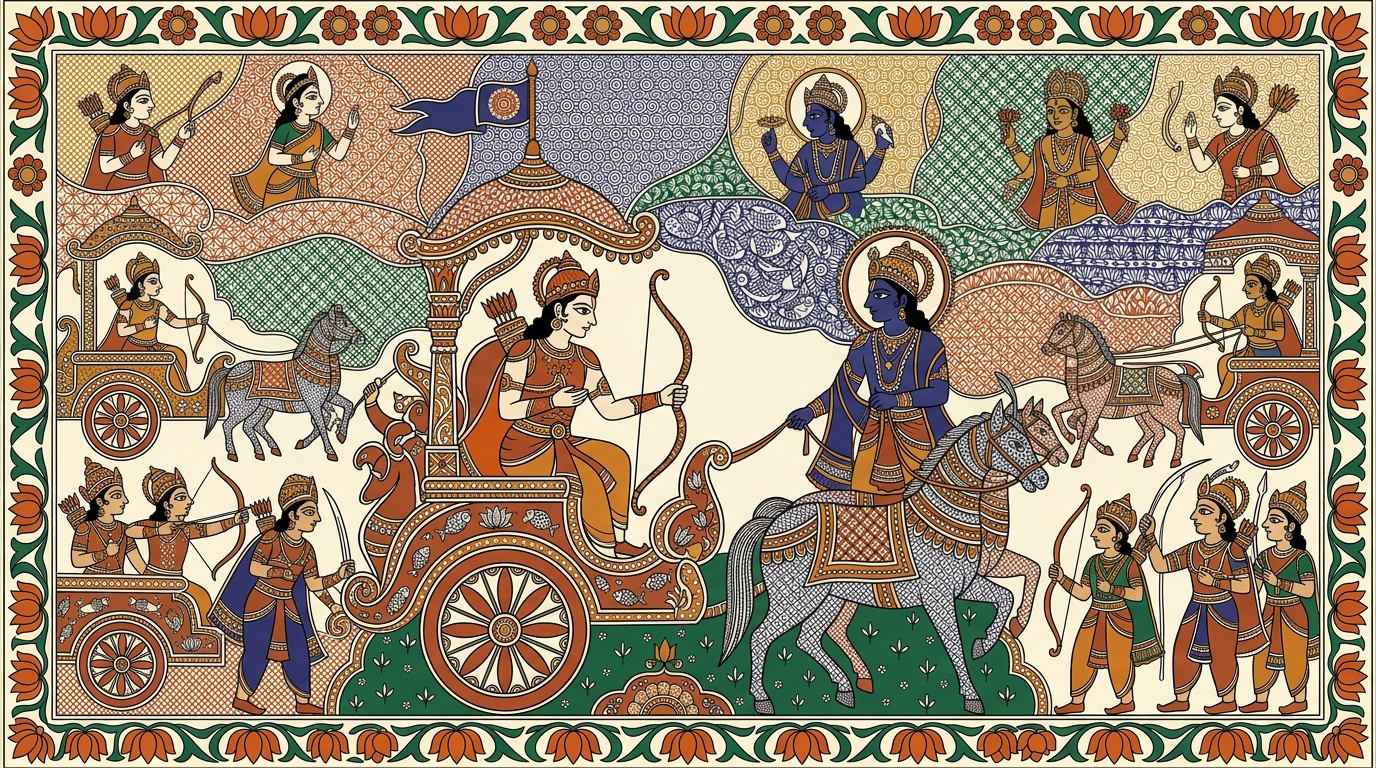
Arjuna knows this. He was there. He stood helpless while Draupadi
was humiliated. He burned for thirteen years in exile because of
those dice. And now, standing in his chariot, he suddenly sees the
full arc of the disaster: "Aho bata!" — Alas! — "What a great sin
we are resolved to commit!" The most devastating word is "we." Not
Duryodhana. We. Because the Pandavas too are here with armies and
weapons and the determination to kill. The greed for a kingdom has
infected everyone, the victims as much as the thieves, and
Arjuna, in this terrible moment of clarity, sees that he is part
of the same sickness he came to cure.
This is the cry that only honesty can produce: the recognition that
you are not standing outside the sin, pointing at it. You are
inside it.