They had been calling him names for three weeks. Raghav did not know
why it started: perhaps because he was new, perhaps because he was
small, perhaps because he carried a tiffin box with hand-drawn
stickers on it that his younger sister had made, which the older boys
found ridiculous. The reason did not matter. What mattered was the
corridor near the science lab where they waited for him every day
after the lunch bell.
Three boys. Vikram, Saurabh, Ajay. Not the biggest boys in school,
but big enough. They would block his path, knock his tiffin box out
of his hands, and say things: about his clothes, his accent, the
stickers, his father's old scooter that dropped him at the gate
every morning trailing blue exhaust. Raghav said nothing. He picked
up his tiffin box, walked around them, and went to class.
His friend Tarun was furious. "Hit them back," Tarun said. "Just
once. They will stop if you hit back."
"I don't want to hit them."
"Then tell a teacher."
"I don't want to do that either."
"Then what are you going to DO?"
Raghav did not have an answer. He only knew that hitting Vikram would
turn him into a boy who hits people, and that was not the boy he
wanted to be. Not because hitting was wrong in some abstract way,
but because once you raise your fist, you cross a line that is very
hard to walk back from. He had seen it happen to his older cousin,
who got into a fight in Class Nine and then another in Class Ten and
by Class Eleven was known as the boy who fought, and the reputation
became a cage.
On the worst day, Vikram pushed him against the wall hard enough to
knock the wind out of him. Raghav slid down to the floor, his back
against the cool tiles, his tiffin box open on the ground, rice
scattered across the corridor. His hands were shaking. His jaw was
tight. He could feel the anger in his arms like an electric current
— the body wanting to strike, the muscles ready, the fists already
clenched.
He opened his hands. Deliberately, finger by finger. He placed his
palms flat on the floor. He looked up at Vikram and said nothing.
Vikram waited for the reaction that did not come. He shifted his
weight. He looked at Saurabh and Ajay, who looked away. The silence
in the corridor stretched until it became uncomfortable, and then
Vikram walked off, muttering something that sounded less like
confidence and more like confusion.
It did not end that day. It took two more weeks. But each time,
Raghav's stillness made the cruelty look smaller, until the boys
grew bored of pushing against something that would not push back.
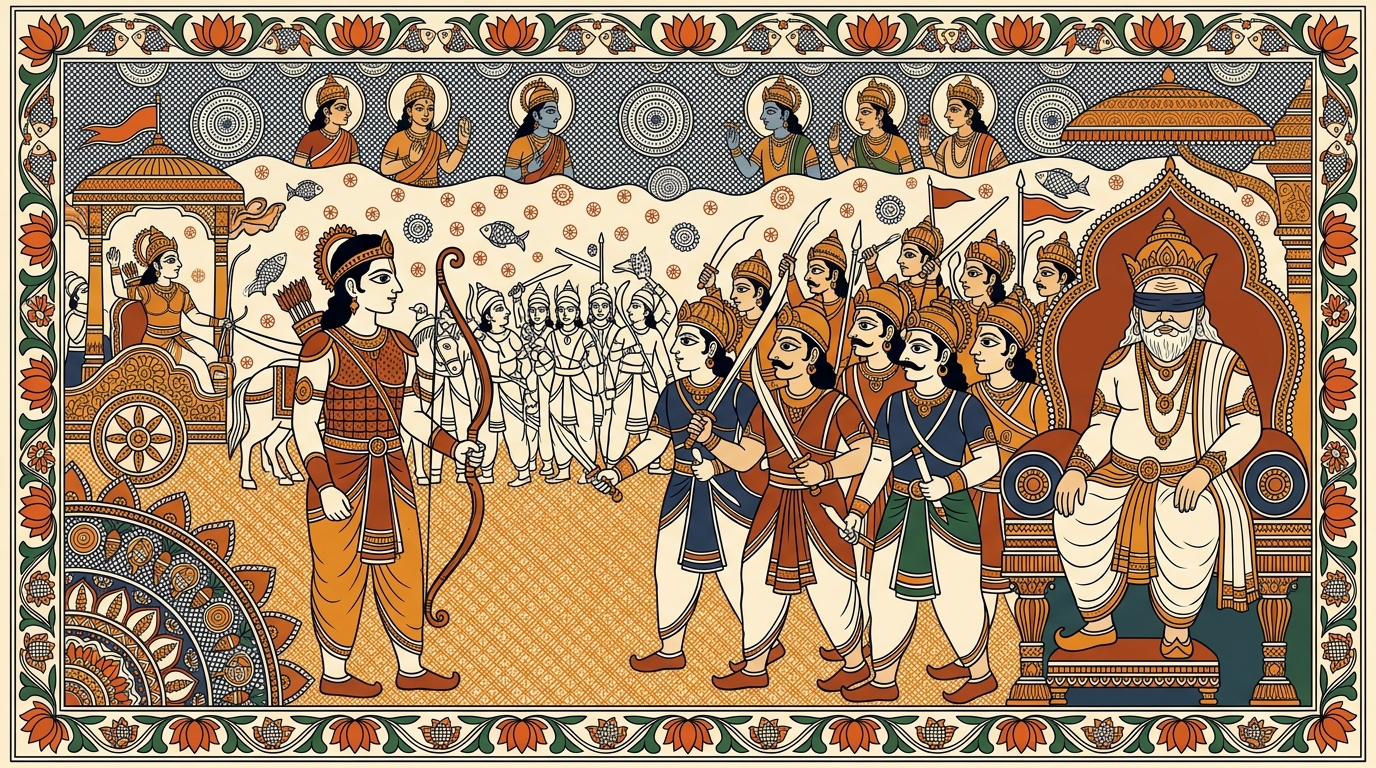
When Arjuna says "let them kill me unarmed and unresisting," he is
not being dramatic. He has reached the place that Raghav reached
on the corridor floor — the understanding that being destroyed is
preferable to becoming a destroyer. It is the most radical statement
in the Bhagavad Gita, made before Krishna has spoken a single word
of wisdom. Centuries later, Gandhi would read this verse and see in
it the seed of ahimsa: the idea that true strength is not the
power to strike, but the courage to absorb the blow.