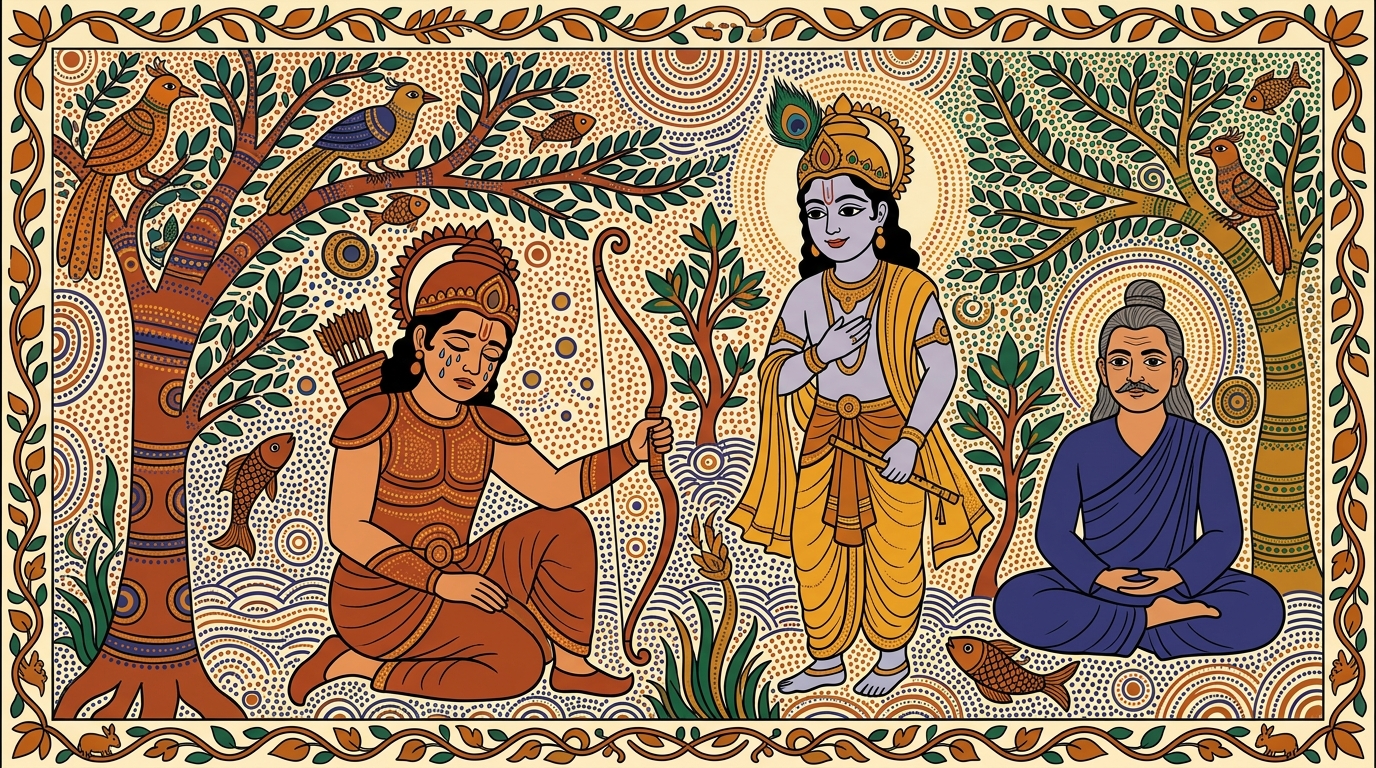
The battlefield had gone quiet in the space between Arjuna's chariot wheels.
Not the real quiet — everywhere beyond them, a million soldiers coughed
and shifted and muttered prayers. Horses stamped. Elephants rumbled low
in their throats. But inside the chariot, inside the small wooden world
where the white horses stood perfectly still, there was a silence like
the bottom of a well.
Arjuna sat crumpled against the railing, his bow Gandiva resting across
his knees where it had fallen. His shoulders shook. Tears ran down his
cheeks and dripped onto his armor, leaving dark spots on the leather
like the first drops of monsoon rain on dry earth. His hands, the same
hands that could split a blade of grass with an arrow from a hundred
paces, hung limp at his sides.
He did not look like the greatest archer in the world. He looked like a
boy who had just realized something terrible and could not un-realize it.
Krishna held the reins and said nothing. Not yet.
He had seen this before, not this exact moment, but this kind of
breaking. He had watched it in the eyes of farmers when the river
flooded and took everything. In the eyes of mothers when the fever
would not leave their children. In the eyes of kings who finally
understood what their decisions had cost. There is a moment when a
person's certainty cracks open like a clay pot dropped on stone, and
everything they thought they knew spills out.
That was where Arjuna was now. Cracked open. Spilling.
Krishna looked at his friend. He noticed how Arjuna's chest heaved
with each breath, how his fingers twitched as though reaching for
something that was no longer there. He noticed the snot and the tears
and the dust caked into the creases of Arjuna's face, and he did not
look away.
That is the first thing this verse tells us. Before Krishna speaks a
single word of wisdom, before any great philosophy begins, he simply
stays. He does not say "stop crying." He does not say "pull yourself
together." He does not walk away embarrassed. He stays in the chariot,
holding the reins steady, and he looks at the mess his friend has
become — really looks — with eyes that are not judging.
Sometimes the most important thing a friend can do is not leave the
room.