Priya's swim coach was a tall woman named Meenakshi Ma'am who had once
swum across the Palk Strait in thirteen hours. She had arms like rope
and a voice that could cut through a crowded pool deck like a whistle.
But the thing Priya feared most was not her voice. It was the silence
before the voice.
Priya had just climbed out of the pool at the state championship
semifinals in Chennai. She had false-started her 200-meter butterfly.
Disqualified. She sat on the wet tiles with her goggles around her
neck and her cap peeled halfway off, dripping chlorine water onto her
knees. She was twelve years old and she was sure her life was over.
Meenakshi Ma'am walked over. She did not sit down. She stood there,
feet apart, arms crossed, her stopwatch hanging from her neck. She
looked at Priya the way a doctor looks at an X-ray.
Then she spoke. Not softly.
"Priya. What is this?"
Three words, and each one landed like a stone dropped in still water.
Not "are you okay." Not "it happens to everyone." What is this.
"You trained for eight months. You swam two hundred butterfly sets in
the dark at five in the morning. You held your breath until you saw
spots. You did all of that — and now you sit on the ground because of
one false start?"
Priya's lip trembled. "But I'm disqualified—"
"From one race. Not from swimming. Not from your life. You have the
relay final in forty minutes. Are you going to sit here and cry, or
are you going to get back in that water?"
It felt harsh. Later, much later, Priya would understand it was the
opposite of harsh. Meenakshi Ma'am was not being cruel. She was
refusing to let Priya become smaller than she was. She was saying:
I have seen what you can do. This, this soggy heap on the tiles,
is not you.
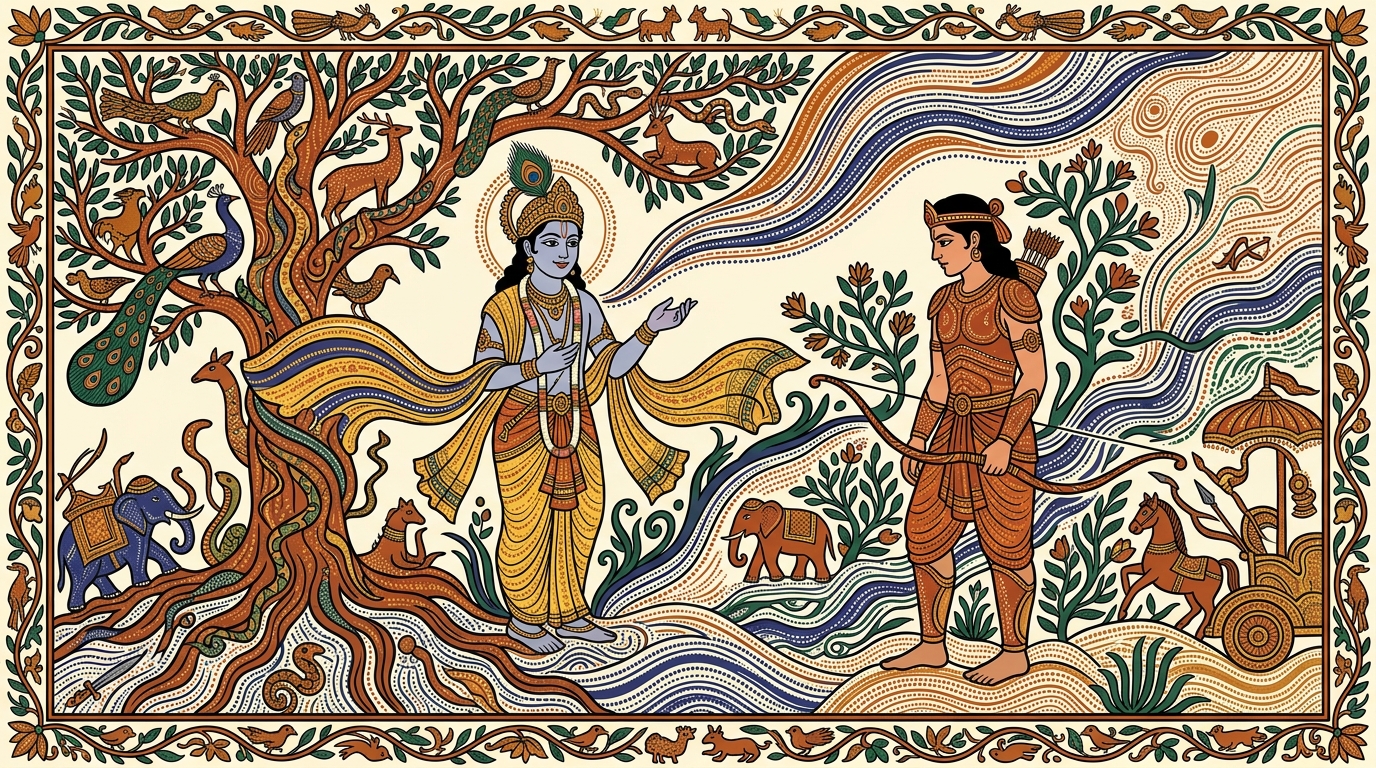
That is exactly what Krishna says to Arjuna in verse 2. His first
words are not comfort. They are shock. "Where has this come from?"
he asks, almost as though he cannot believe what he is seeing.
He uses three stinging words: this is not noble, this will not lead
you upward, this will only bring you shame.
He is not attacking Arjuna. He is attacking the smallness that has
swallowed Arjuna. There is a difference, and only someone who
loves you knows how to make it.