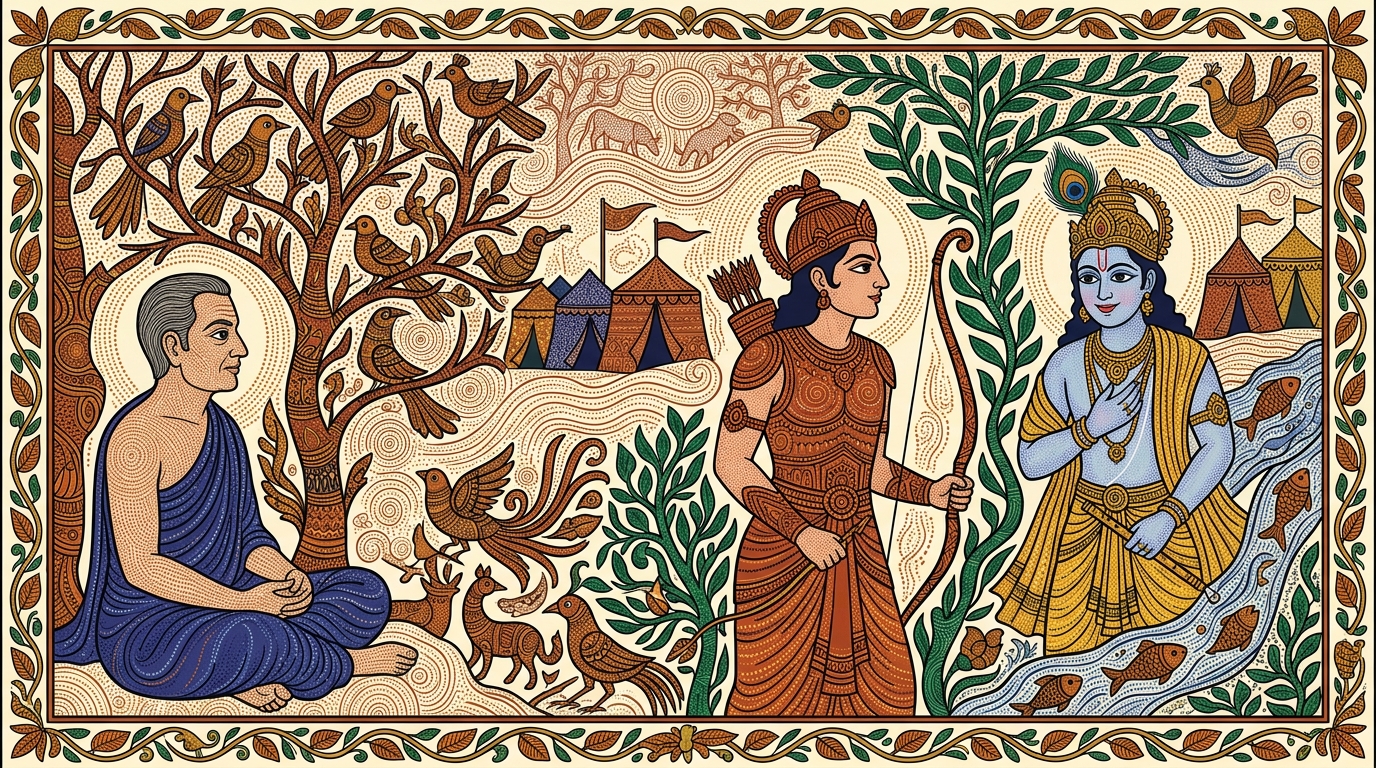
Far away from the battlefield, in the dimly lit palace of Hastinapura,
the blind king Dhritarashtra sat on his throne and gripped its arms
until his knuckles whitened. Beside him, Sanjaya, his minister,
his eyes, spoke in a voice low and steady, like a man describing
a dream he was still inside.
"He has stopped, my king."
Dhritarashtra leaned forward. "Stopped what?"
"Everything. Arjuna said three words, 'I will not fight,' and
then he went silent. He sits in the chariot between the two armies.
His bow lies across his knees. He is not moving."
Sanjaya paused. Through the divine sight that the sage Vyasa had
granted him, he could see every detail on that distant field as
clearly as if he stood in the chariot himself. He could see the
way Gandiva, the great bow that had sung in a hundred battles,
rested limp and unused, its string slack. He could see Arjuna's
hands in his lap, fingers curled like fallen leaves. He could see
the white horses standing still, their ears flicked back, confused
by the silence of the man who always commanded them forward.
And he could see Krishna.
Krishna had not moved either. He held the reins loosely, his back
straight, his face calm. He did not urge. He did not argue. He
simply waited, the way a riverbank waits for the flood to pass.
On the battlefield, a strange hush spread outward from the chariot
like ripples from a stone dropped in water. Soldiers on both sides
noticed it. Conch shells hung at men's lips, unblown. Elephants
shifted their weight. A flag somewhere flapped once and then hung
limp, as though even the wind was holding its breath.
The greatest warrior in the world had just declared that he would
not fight. And in the space where war should have begun, there was
only silence — vast, heavy, and waiting.
It is a strange thing, silence. On a normal day it is just the
absence of noise. But this silence was something more. It was a
held breath. A door about to open. The pause between the question
and the answer that will change everything.
Arjuna did not know it yet, but his silence was not an ending. It
was the space that Krishna needed to begin.