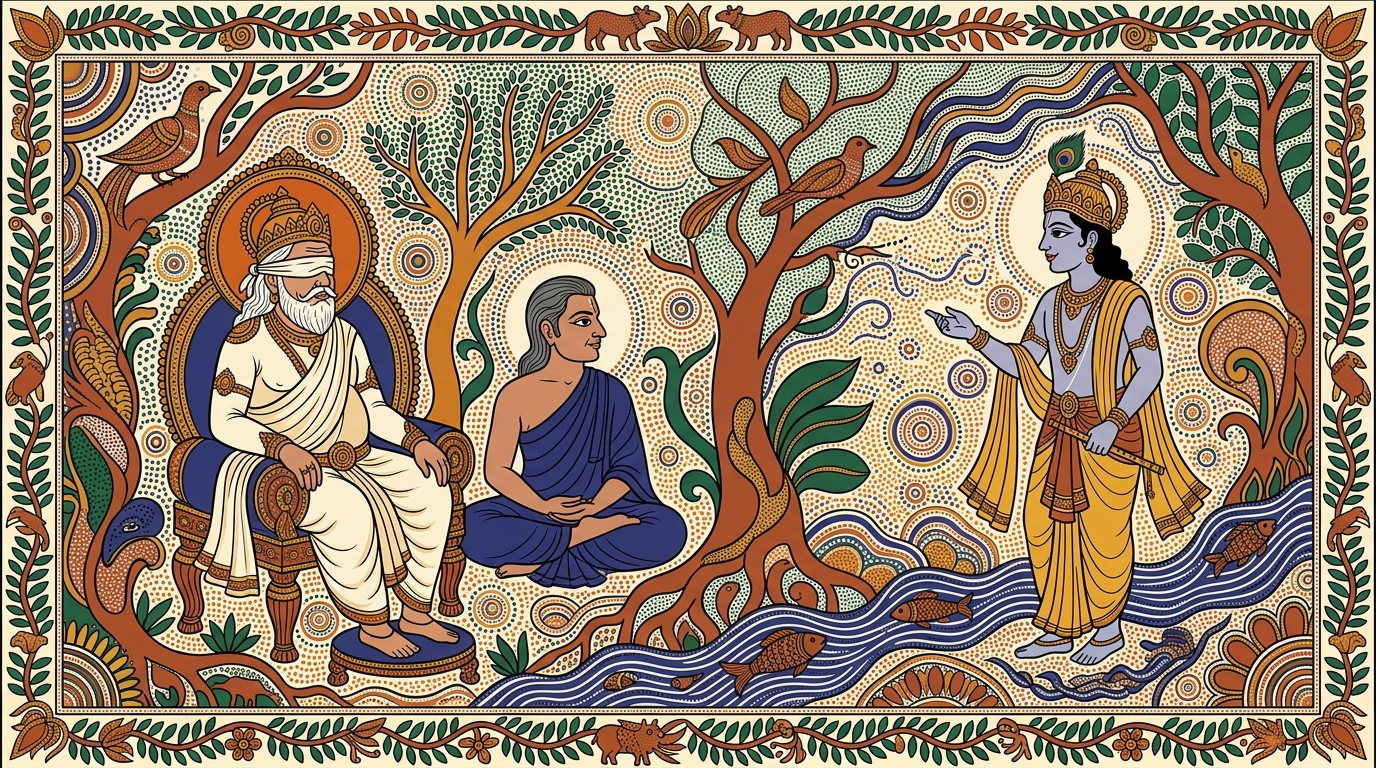
Here is the detail that changes the entire story: Krishna smiled.
Not a grin. Not a laugh. The Sanskrit says "prahasanniva," as if
smiling, almost smiling, the ghost of a smile crossing his lips
like sunlight through a crack in a door. It is the most human
moment in the Gita so far, and it belongs to God.
But what kind of smile?
It was not the smile of someone who finds the situation funny.
Arjuna was in genuine pain: his grief was real, his confusion
was real, and a million men stood ready to die on that field. There
was nothing amusing about it.
It was not the smile of someone who does not care. Krishna had
driven the chariot himself. He had placed himself between the
armies, unarmed, because he loved Arjuna enough to stand beside
him in the worst moment of his life. Indifference does not do that.
So what was it?
Think of a doctor who has seen a thousand fevers. A child is brought
in, burning and crying, and the mother is terrified. The doctor
examines the child, feels the forehead, checks the throat — and
smiles. Not because the fever is not real. But because she knows
the medicine. She has seen this before. She knows what comes next,
even when the mother cannot imagine it.
Or think of a teacher watching a student struggle with a maths
problem. The student's forehead is creased, the pencil is gripped
too tight, the eraser has worn a hole in the paper. And the teacher
smiles, not cruelly, but with a quiet warmth, because she can
see that the student is one step away from understanding. The
struggle is not a sign of failure. It is a sign that learning is
about to happen.
That is Krishna's smile. It says: I see your pain. I know it
feels endless. But I also know something you do not, that this
breaking is not the end of you. It is the beginning.
Between two armies, in the pause before the greatest teaching the
world has ever heard, Krishna looks at his broken friend and
almost smiles. And in that small, quiet curve of his lips lives
a promise: I have the answer. And you are ready to hear it.
The Bhagavad Gita is about to begin.