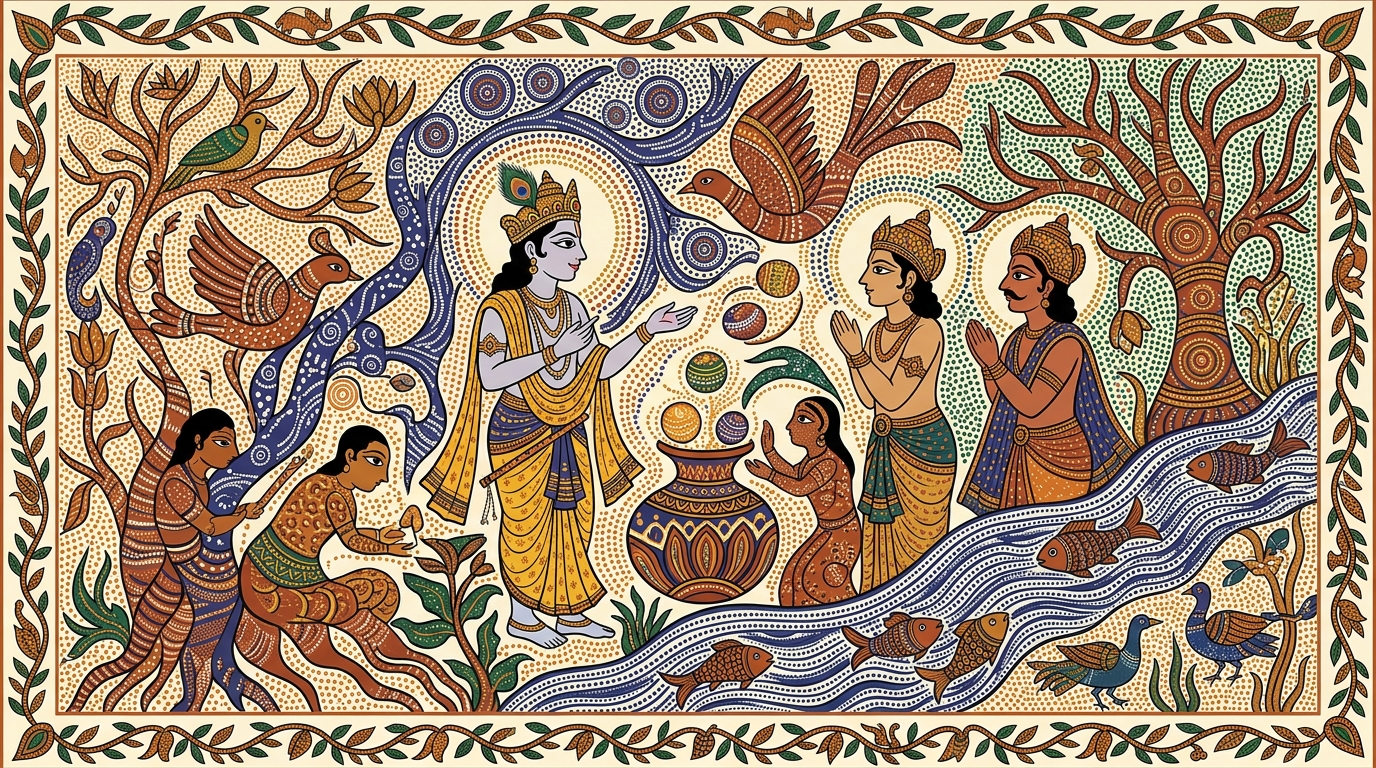
Long before the war at Kurukshetra, in the age when rishis still
wandered the forests and spoke to rivers, there lived a king named
Janashruti.
Janashruti was a generous king. He built rest houses for travelers.
He kept his granaries open to anyone who was hungry. But he was also
a king who worried, and his greatest worry was this: that the things
he loved could be taken from him. His kingdom, his family, his life.
He lay awake at night imagining armies at his gates, imagining
fire, imagining the emptiness of loss.
One day a wandering sage named Raikva came to his court. Raikva was
not impressive to look at, a thin man with matted hair, sitting
under a cart scratching at a rash on his arm. But the birds that
perched on the cart spoke of him in whispers, and even the wind
seemed to pause when he was thinking.
Janashruti brought the sage rich gifts — gold, cattle, a village —
and begged for teaching. Raikva pushed the gifts aside and picked
up a clay water pot from the ground.
"Tell me, king. Is there sky inside this pot?"
Janashruti peered into the pot. "Yes. The pot holds a small space
of sky."
Raikva dropped the pot. It shattered on the stone floor, clay
pieces spinning outward. Water splashed across the king's feet.
"The pot is destroyed," Raikva said. "Is the sky inside it
destroyed?"
Janashruti stared at the broken shards. The space where the pot
had been was still there — the same air, the same sky, unmarked,
unbroken. The pot had given the sky a shape. But it had never
contained the sky. The sky was too vast, too borderless, too
fundamental to be held or broken by a pot.
"You are afraid," Raikva told the king, "that someone can kill the
sky by breaking the pot. That is your error. The body is the pot.
The soul is the sky. When the pot breaks, the sky does not even
notice. It was never inside the pot — the pot was inside it."
Raikva stood, brushed the dust off his knees, and walked away. He
left behind no gold, no scripture, no grand teaching hall. Just a
broken pot and a king kneeling on a wet floor, understanding for
the first time that the thing he feared losing had never been his
to lose.