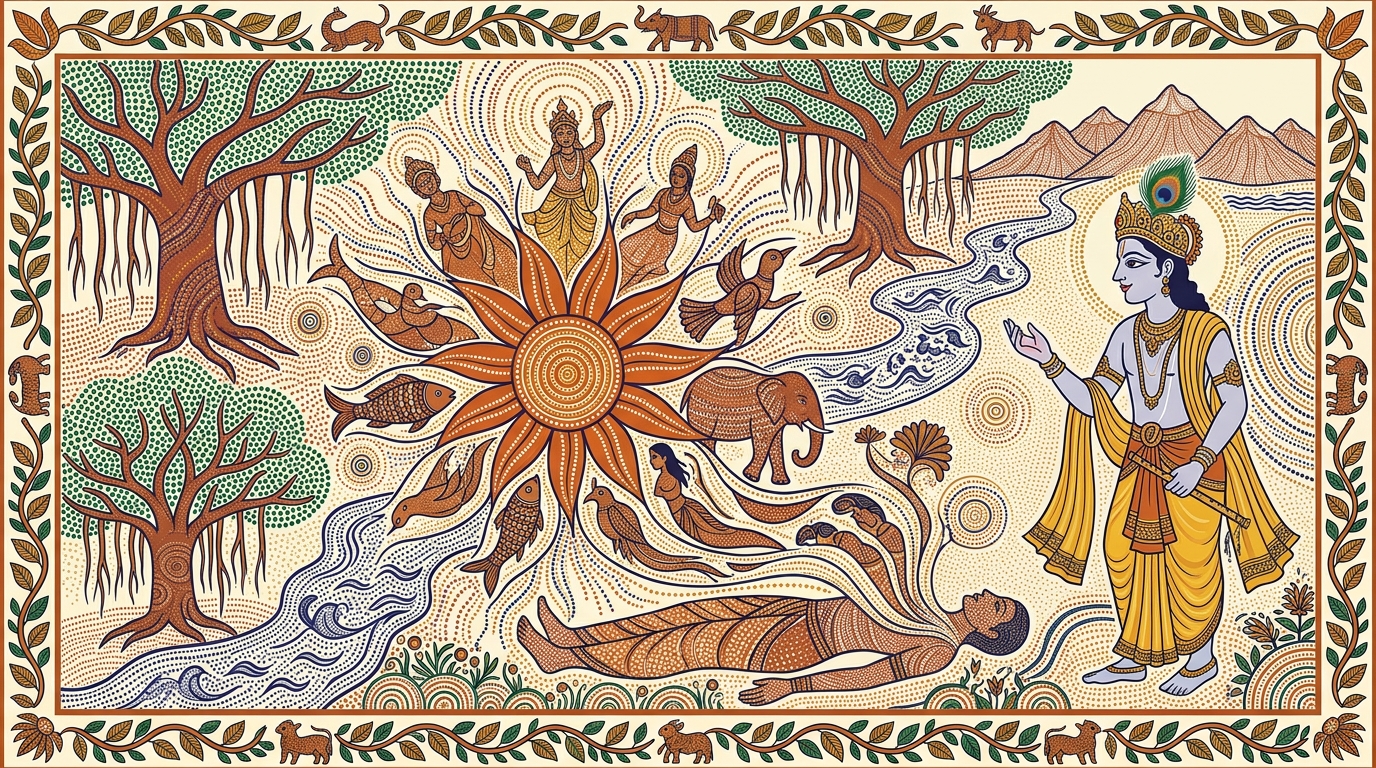
Krishna spoke the words slowly.
Not the way he had spoken the other verses — quick, precise, building
an argument the way a mason builds a wall, one brick at a time.
This was different. Each word came out like a stone dropped into
still water, and the silence between the words was as important as
the words themselves.
Na jāyate.
It is never born.
The chariot seemed to hum. Arjuna did not move. The white horses,
Sainya and Sugriva and the others, stood motionless, their ears
pricked forward as though they too were listening. A hawk that had
been circling above the battlefield suddenly folded its wings and
glided to a stop on a dead tree fifty paces away, as though it
could not fly through the weight of what was being said.
Mriyate vā kadācit.
Nor does it ever die.
The light changed. Later, Arjuna would struggle to describe it —
the way the morning sun, which had been ordinary pale gold, seemed
to concentrate around the chariot, thickening, as though the air
itself had become a lens. The dust motes floating between them
slowed. The distant sounds of the army, the clank of armor, the
murmur of a million men, faded to a whisper. It was as though
Krishna had spoken a word that was older than language, and the
world had recognized it and gone quiet out of respect.
Ajo nityaḥ śāśvato'yaṁ purāṇaḥ.
Unborn. Eternal. Ever-existing. Primeval.
Four words. Each one a door that opened onto a corridor with no
end. Arjuna's mind tried to hold them all at once and could not —
it was like trying to hold the ocean in his hands. Unborn meant
there was no beginning. Eternal meant there was no end. Ever-existing
meant there was no gap, no interruption, no moment of absence.
Primeval meant it was older than old — older than the mountains,
older than the stars, older than the first thought that any mind
had ever thought.
Na hanyate hanyamāne śarīre.
It is not slain when the body is slain.
That was the final stone. It landed and the water closed over it
and the ripples spread outward in all directions — across the
battlefield, across the armies, across time itself. This one verse.
This one truth. Spoken in a chariot between two armies on a morning
that smelled of dust and sweat and horse leather.
The soul does not die.
Arjuna's eyes were wide. His breath had stopped. For a moment — one
impossible, stretched moment — he saw what Krishna saw. Not the
armies, not the bodies, not the banners and the elephants and the
glinting spear-points. He saw light. A field of light that had no
edges, that had always been there, that wore these million bodies
the way a single ocean wears a million waves.
Then the moment passed, and he was Arjuna again, sitting in a
chariot, shaking.
But he was not the same Arjuna. He would never again be the same.