Nandu found the trunk on a rainy afternoon.
He had finally started going into Thatha's room — not comfortably,
not without that squeeze in his chest, but going in. Baa had simply
left the door open, and one day his feet carried him through.
The trunk sat at the foot of Thatha's bed, a heavy wooden thing
with brass clasps turned green with age. Nandu had seen it a
hundred times but never opened it.
He knelt and unlatched the clasps. They opened with a click that
sounded too loud in the quiet room.
Inside, folded neatly in stacks, were Thatha's kurtas.
The white cotton one he wore to the temple, so thin from washing
that you could almost see through it. The dark blue one with the
tiny embroidered collar that he wore on Diwali. The old cream one,
soft as butter, with a chai stain on the pocket that no amount of
scrubbing had ever removed. Nandu lifted it to his face. It smelled
like Thatha: sandalwood soap and old cotton and that faint
sweetness.
His throat closed.
Baa appeared in the doorway. She did not come in. She leaned against
the frame and watched Nandu hold the kurta to his face, his
shoulders trembling, his breath coming in small, sharp gasps.
She let him cry. She did not say "it's okay" or "be strong."
She waited until the worst of it had passed, until he lowered the
kurta and sat there with it pooled in his lap, eyes red, nose
running.
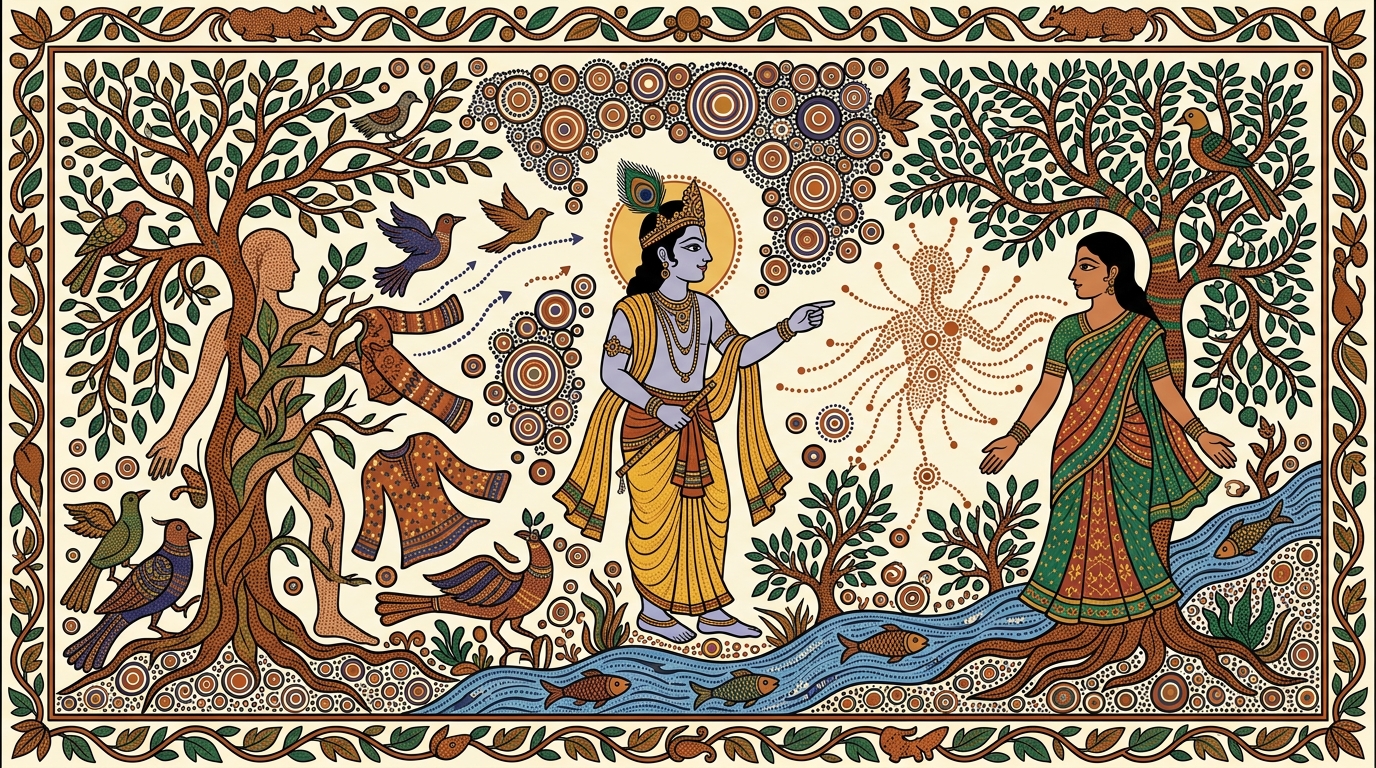
Then she said, very gently: "He changed his clothes. That's all."
Nandu looked up.
"When your shirt gets too small or too torn, you take it off and
put on a new one. You don't cry for the old shirt. It was just
something you wore for a while."
She sat beside him on the floor and touched the cream kurta in
his lap.
"This was his shirt. His body was also his shirt, a bigger, more
beautiful shirt, one that held his laugh and his walk and the way
he tilted his head when he was listening to you. But it was still
just a shirt. It got old. It wore through. And so he took it off."
"And put on a new one?" Nandu whispered.
"And put on a new one." Baa's voice was steady, but her eyes were
bright. "Somewhere, right now, there is a new shirt. And the one
who wore this one" — she pressed the kurta gently — "is wearing
that one. He did not end, Nandu. He changed."
Nandu folded the cream kurta and placed it back in the trunk. He
closed the clasps. Then he leaned against Baa's shoulder, and they
sat together while the rain drummed on the neem tree outside, and
for the first time since the funeral, the room did not feel empty.
It felt like a wardrobe whose owner had simply stepped out.