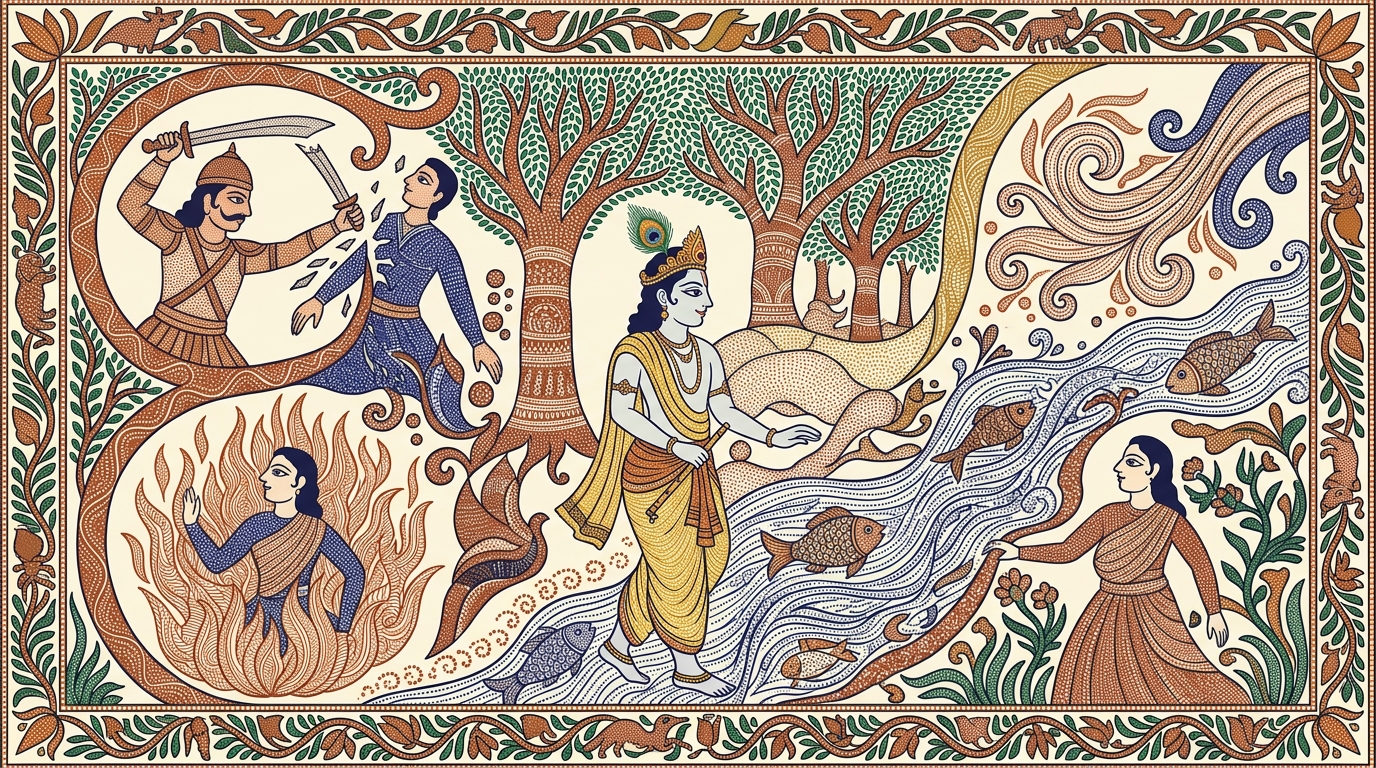
Krishna raised his hand and pointed east, toward the rising sun.
"Consider the sword," he said.
Arjuna looked at the army of the Kauravas. He could see, even from
this distance, the glint of a hundred thousand blades — swords and
spears and the curved edges of battle-axes catching the morning
light. Every one of them forged for a single purpose: to cut.
"A sword can cut flesh," Krishna said. "It can split armor. It can
fell a tree and divide a river. But take the sharpest sword ever
forged — the one Bhishma carries, the one that has tasted the blood
of a thousand warriors — and try to cut the soul. What happens?"
He paused, as though genuinely curious about the answer.
"Nothing. The blade passes through emptiness. You cannot cut what
has no edge to cut, no surface to meet the steel."
He pointed south, where the morning cookfires of the army sent
columns of grey smoke into the air.
"Consider fire. Fire can consume a forest. It can melt iron. It can
turn a palace to ash in a single night. But hold the soul over a
flame. What burns?" He shook his head. "Nothing. Fire needs
something to grip: wood, cloth, oil. The soul offers it nothing.
The flame flickers and goes out, and the soul has not grown even
warm."
He pointed west, toward the distant gleam of the Sarasvati river.
"Consider water. Water can dissolve salt. It can wear away
mountains, grain by grain, over a million years. It can flood a
city and leave nothing standing. But pour the ocean over the soul.
Does it dissolve? Does it soften? Does even a single drop cling to
it?" A slow shake of his head. "Water cannot wet what has no
surface to be wet."
He pointed north, where the wind was coming from — a dry, hard
wind that pressed against the banners and made the elephants shift
their weight.
"And wind. Wind can uproot trees. It can scatter armies. It can
strip the skin from a man's face in a desert storm. But the soul?"
Krishna smiled, a small, quiet smile that held the patience of
someone who has explained the same truth across a thousand ages.
"Wind cannot dry what was never moist. It cannot scatter what has
no parts. It blows through the soul the way it blows through the
sky — without resistance, without effect, without the soul even
noticing."
He lowered his hand.
"Four elements," he said. "Earth's sharpest blade, fire's fiercest
heat, water's deepest flood, wind's wildest gale. Each one vast.
Each one powerful. And each one — entirely, completely, hopelessly
— helpless against what you truly are."