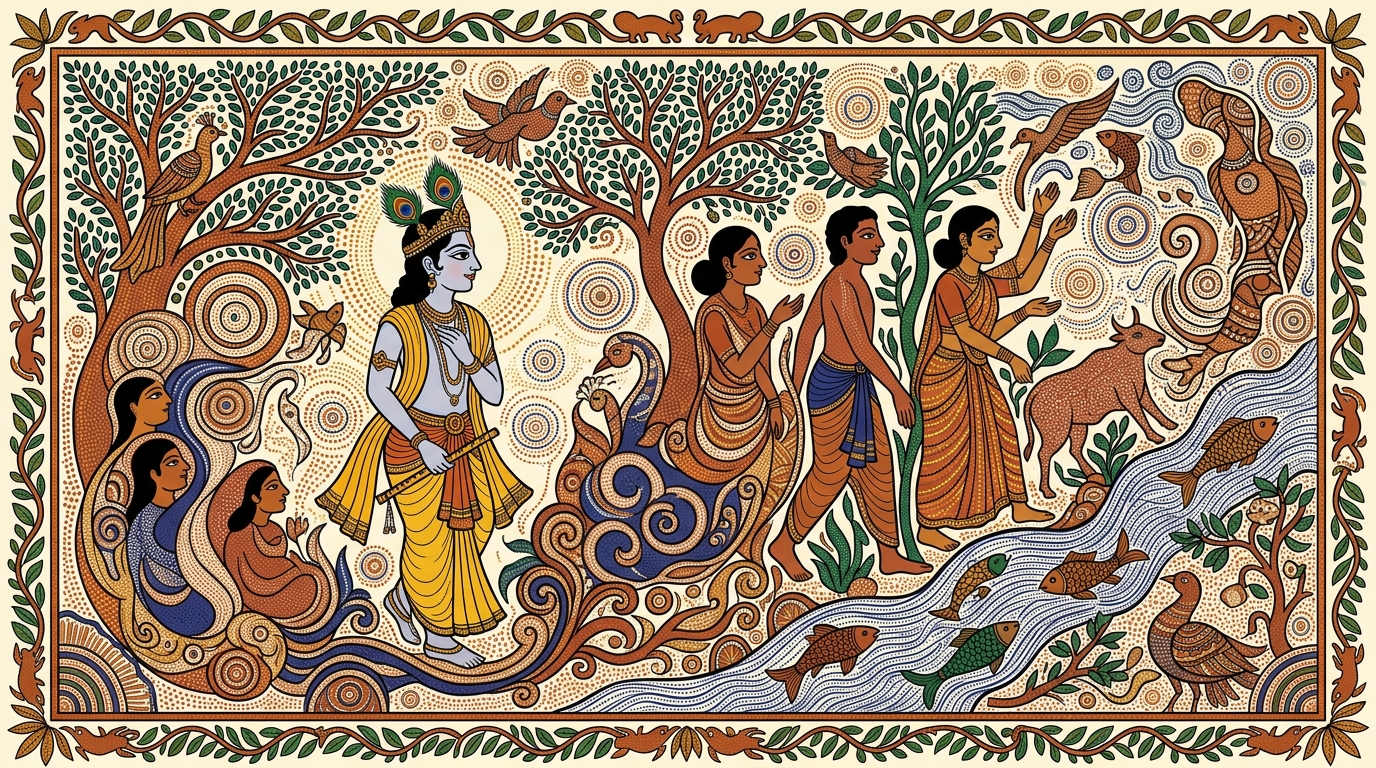
Krishna swept his hand across the plain of Kurukshetra, palm open,
as though wiping condensation from a window.
"Where were they," he asked, "a hundred years ago?"
Arjuna followed the gesture. His eyes moved across the front ranks
of the Kaurava army — Duryodhana in his golden armor, Dushasana
with his whip coiled at his hip, row after row of soldiers with
their spears planted in the earth like a forest of iron saplings.
A hundred years ago. None of them had existed. Not one. The field
itself had been here — the same dry grass, the same flat horizon
shimmering in the heat — but it had been empty of these particular
lives. They had been nowhere. Unmanifest. Like colors inside a
seed that has not yet sprouted, like music inside a flute that no
one is playing.
"And a hundred years from now?" Krishna continued.
Arjuna's throat tightened. He knew the answer. A hundred years from
now, this field would be empty again. The grass would grow over
whatever scars the battle left. Farmers would plow the soil and
find rusted arrowheads and wonder briefly who had fought here.
Every man he was looking at — every face he loved, every face he
feared — would be gone.
"You see?" Krishna said softly. "The visible part is the middle.
It is the smallest part. Before birth, we are invisible. After
death, invisible again. This life, this brief flash of being
seen, of being here, of standing in the sun, is a single
paragraph in a story that has no beginning and no end."
He paused and let the silence do its work. A hawk circled high
above the field, riding a thermal, patient as a thought.
"You are grieving for the paragraph, Arjuna. You are weeping
because the paragraph will end. But the story goes on. It was
going on before the paragraph started, and it will go on after.
What is there to mourn in that?"
The hawk tilted its wings and slid eastward, vanishing into the
white haze where sky met earth.