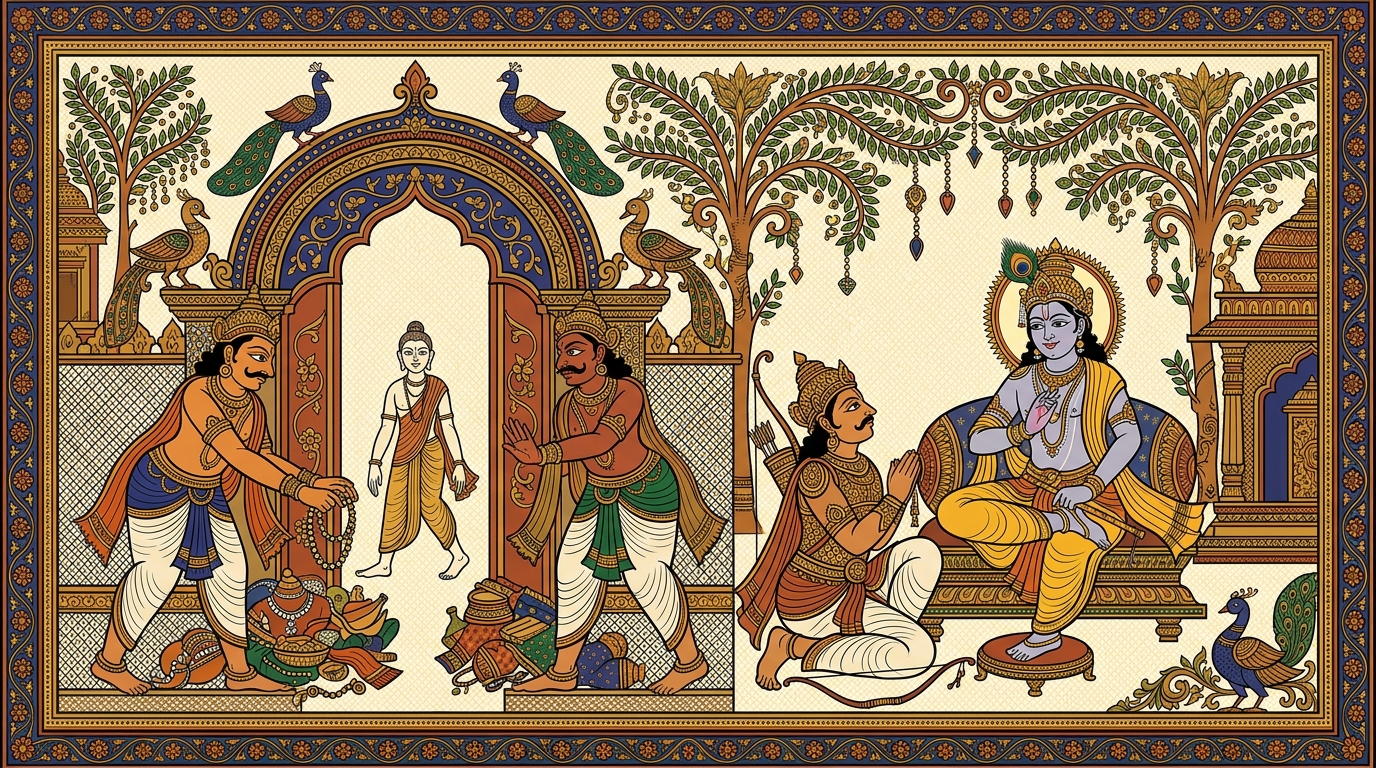
Krishna's voice dropped low, as if he were sharing a secret that the
wind itself should not overhear.
"Listen carefully, Arjuna. There is something you need to understand
about your own senses — your eyes, your ears, your tongue, your
skin, your nose. Every one of them is a doorway. And at every
doorway, two guards are posted."
Arjuna leaned closer. The battlefield noise faded to a murmur.
"The first guard is called Raga," Krishna said. "He is charming. He
wears bright clothes and carries a honeycomb. When your eyes see
something beautiful — a jewelled sword, a golden chariot, the smile
of someone you admire — Raga whispers: 'More. You want more of this.
Hold on to it. Never let it go.' He makes pleasant things feel
necessary. He turns enjoyment into craving."
"And the second guard?" Arjuna asked.
"The second is Dvesha. He is darker, quieter, and just as dangerous.
He carries a shield. When your ears hear harsh words, when your tongue
tastes bitter food, when your skin feels the cold — Dvesha whispers:
'Push it away. Hate it. Run from it. Destroy the thing that makes
you uncomfortable.' He turns discomfort into hatred."
Arjuna thought about this. He knew both guards. He had felt Raga's
pull — the way his hand lingered on the Gandiva bow, the pride that
swelled when crowds cheered his name. And he knew Dvesha's push —
the flash of anger when someone insulted him, the urge to look away
from things that were ugly or painful.
"These two stand at every doorway of your senses," Krishna continued.
"Every single one. They are not evil — they are part of how you are
built. But they are not your friends. They are paripanthinau — bandits
on the road, thieves who wait at the crossroads to rob travellers."
"What do they steal?" Arjuna asked.
"Your freedom. Raga chains you to the things you desire. Dvesha
chains you to the things you flee. Either way, you are chained. The
man who must have the golden chariot is no freer than the man who
must avoid all pain. Both are prisoners."
Arjuna looked at the armies spread before him. Grandfathers. Teachers.
Cousins. Raga whispered that he loved them, that he could not bear to
lose them. Dvesha whispered that Duryodhana had wronged him, that
hatred was justified.
"How does the warrior walk between them?" Arjuna asked.
Krishna smiled — not the easy smile of someone who thinks the answer
is simple, but the deeper smile of someone who knows the question
matters more than the answer.
"You notice them," he said. "That is the first step. When Raga pulls,
you see it: 'Ah, there is desire.' When Dvesha pushes, you see it:
'Ah, there is aversion.' You do not obey either one. You do not
crush them — remember, repression accomplishes nothing. You simply
see them, bow to neither, and walk through the doorway on your own
terms."
The wind picked up again across Kurukshetra. Arjuna sat straighter
in the chariot, and for the first time that day, he looked at the
battlefield without Raga or Dvesha telling him what to feel. He
looked with his own eyes.
It was still terrible. But it was clear.