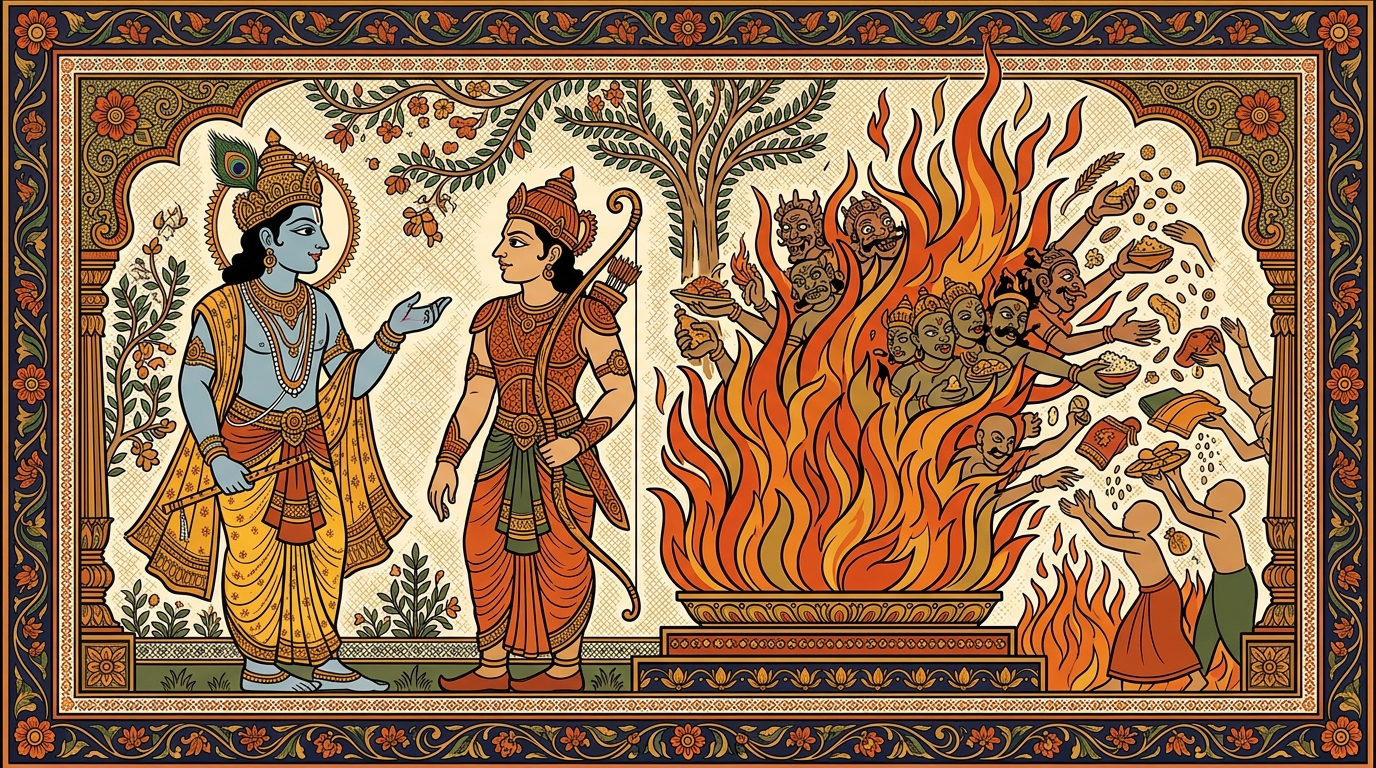
In the forest of Naimisha, where the trees grew so tall their tops
vanished into mist, there lived a young student named Uttanka. He
had come to the hermitage of Veda Vyasa three years ago, and had
been the most devoted student in the ashram — first to wake, last
to sleep, the one who carried water without complaint.
One evening, Uttanka was given the task of tending the sacred fire.
A simple job. Keep the flames steady. Feed it a stick when it
dimmed, and wait.
He sat before the fire pit and watched the flames — orange and
gold, with thin blue roots where the wood turned to ash. He added
a stick. The fire brightened. He added another. Its warmth felt
good against the evening chill.
A thought came to him: what if he made it bigger?
Two more sticks. The flames climbed to his chest height, crackling
and spitting sparks. A thick branch. Then another. The fire roared,
throwing wild orange light across the courtyard, making shadows
leap like frightened deer.
Uttanka fed it faster. A bundle of kindling. A log. The flames
were above his head now, and still the fire was not satisfied.
The woodpile meant to last seven days was half-gone in an hour.
"Uttanka."
The voice came from behind him — calm, unhurried. Vyasa stood at
the edge of the courtyard, his white hair lit amber by the blaze.
"What are you doing?"
"I — I was feeding the fire, Guruji."
"And is it satisfied?"
Uttanka looked at the flames — still reaching, still hungry. He
looked at the woodpile. Nearly gone. His hands were blistered.
And the fire wanted more.
"No," he whispered.
Vyasa sat beside his student. He did not scold. He simply watched
the fire, the way a doctor watches a fever — with understanding,
not fear.
"This is desire, child. It does not want to be satisfied. That is
not its nature. A fire's nature is to burn. You can pour a river
into it and it will hiss and spit and, the moment the water stops,
spring back to life. Desire is the same. It does not want to be
full. It wants to consume."
A log collapsed in a shower of sparks.
"So what do I do?" Uttanka asked.
"You do not fight fire with more wood," said Vyasa. "You learn to
sit near it without feeding it. You let it burn down to embers.
And there, in the embers — steady, warm, quiet — you find something
the blaze could never give you."
"What?"
"Light without destruction."
Uttanka sat with those words as the fire slowly shrank. By midnight
it was a bed of glowing coals, warm enough to sit beside but no
longer wild enough to burn. And in that quiet warmth, for the
first time, he understood.