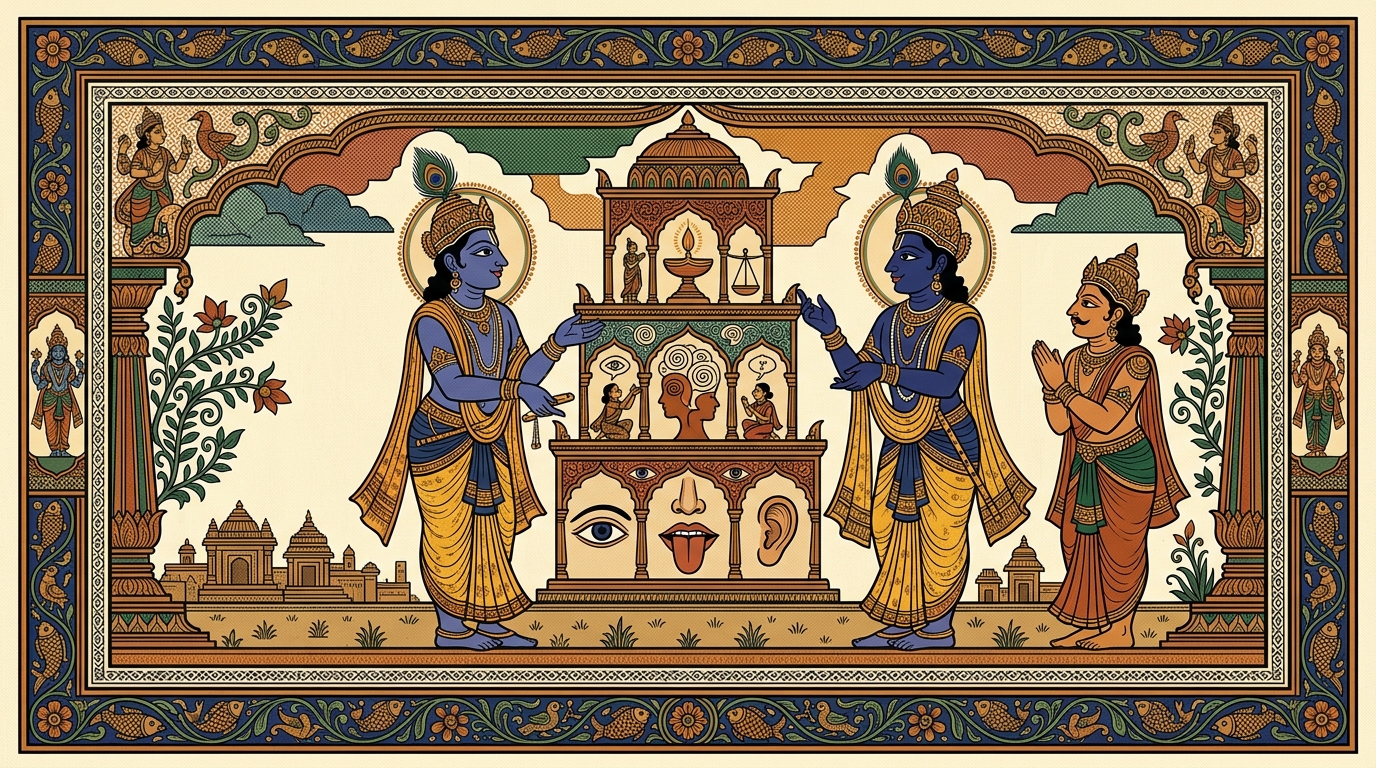
Krishna leaned forward in the chariot, and when he spoke next, his
words carried the precision of a commander describing an enemy's
position.
"Imagine a fortress," he said. "A great stone fortress on a hill,
with three gates — an outer gate, a middle gate, and an inner gate.
Inside the fortress, at its very centre, sits a lamp. This lamp is
your knowledge, Arjuna — the clear, quiet light that tells you what
is true."
Arjuna listened. Around them the armies waited, a million men
breathing the same dust-thick air, but in the chariot there was
only Krishna's voice and the soft clink of harness metal.
"The outer gate is the senses. Your eyes, ears, tongue. They face
the world and let everything in. The senses are loyal guards, but
easily dazzled. A sweet taste makes them forget their post. And
when the senses are dazzled, desire walks through the outer gate
without a challenge."
He held up two fingers. "The middle gate is the mind. It does not
just see and hear — it imagines, it remembers, it dreams. Desire
does not need real things to trick the mind. It only needs to
whisper a memory: 'Remember how good that tasted?' And the mind
opens the gate and says, 'Yes, come in.'"
He held up three fingers. "The inner gate is the intellect — your
buddhi, the part of you that decides. A strong buddhi can look at
desire and say, 'I see you. You are not what I need.' But if
desire has already passed the senses and the mind, it arrives
wearing a disguise. It doesn't say, 'I am greed.' It says, 'I am
reasonable. I deserve this.' And the intellect, tired from
fighting, lets it through."
Arjuna was quiet for a long time.
"So the lamp goes out," he said.
"No," said Krishna. "The lamp never goes out. But the fortress
fills with smoke, and the light cannot be seen. The soul is still
there, still shining. But the person cannot find it. They stumble
through their own fortress, following the voice of desire because
it is the only voice loud enough to hear in the dark."
"How do I guard all three gates at once?"
Krishna smiled — the fierce, steady smile of a teacher who has
been waiting for exactly this question.
"You don't guard all three at once. You start with the outer
gate. The senses. Master those first, and the battle is half-won
before it reaches the mind."