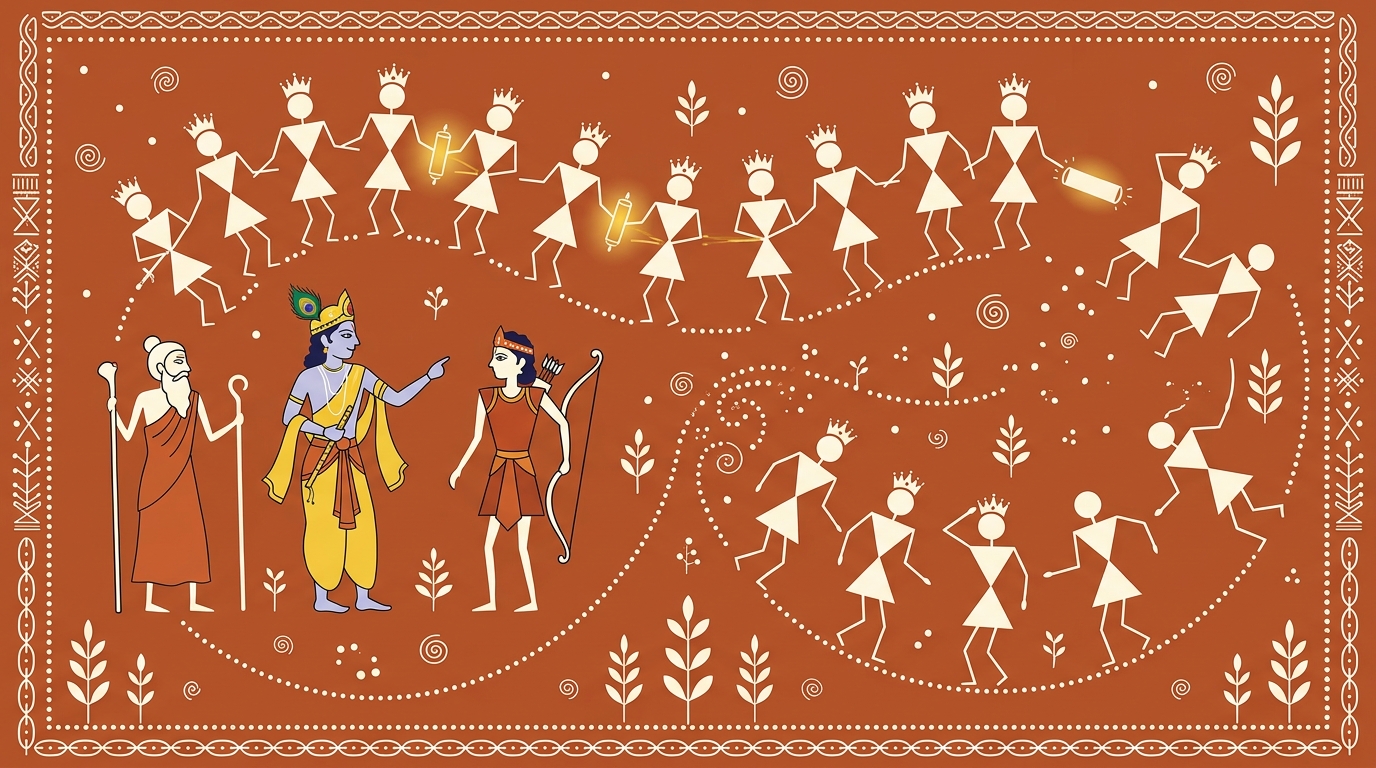
Krishna kept his eyes on the brightening field, but his voice had grown
quieter, the way a voice does when it remembers something sad.
"For a long time," he said, "the kings knew. They were not only kings
who fought well or built tall palaces; they were seers too, men and
women whose minds were as steady as a deep lake. They held this teaching
carefully and handed it on, father to child, ruler to ruler, like a song
sung perfectly down the years."
Arjuna tilted his head. "What happened to it?"
"Time happened," Krishna said. "Imagine a song so beautiful that
everyone in a village knows it. The grandmother teaches it to the
mother, the mother hums it over the cradle, the child grows up and
teaches it to her own children. For a hundred years the song is alive in
every house."
He paused. The horses shifted their weight.
"But then comes a year when the harvest fails, and people are too tired
to sing. And the next year there is a quarrel, and folk stop visiting
one another's homes. A grandmother dies before she finishes teaching the
last verse. A child grows up busy and forgets the tune. Slowly — not all
at once, but slowly — the song goes quiet. Until one day there is a
village full of people, and not a single one of them remembers how it
goes."
Arjuna felt a strange ache, as if he himself had lost something he could
not name.
"That is what happened to this yoga," Krishna said. "The unbroken chain
broke. Generation by generation, the teaching grew faint, until the
world had nearly forgotten that such a path of peace had ever existed at
all."
The conch shells were silent now. Even the great armies seemed, in that
moment, to be holding their breath.
"So you see," Krishna said, turning at last to look at his friend,
"this is not an ordinary morning. A song the world had forgotten is
about to be sung again — and you, of all people, are the one who is here
to hear it."
Arjuna swallowed. Suddenly the weight in his chest felt less like dread,
and more like being trusted with something precious.