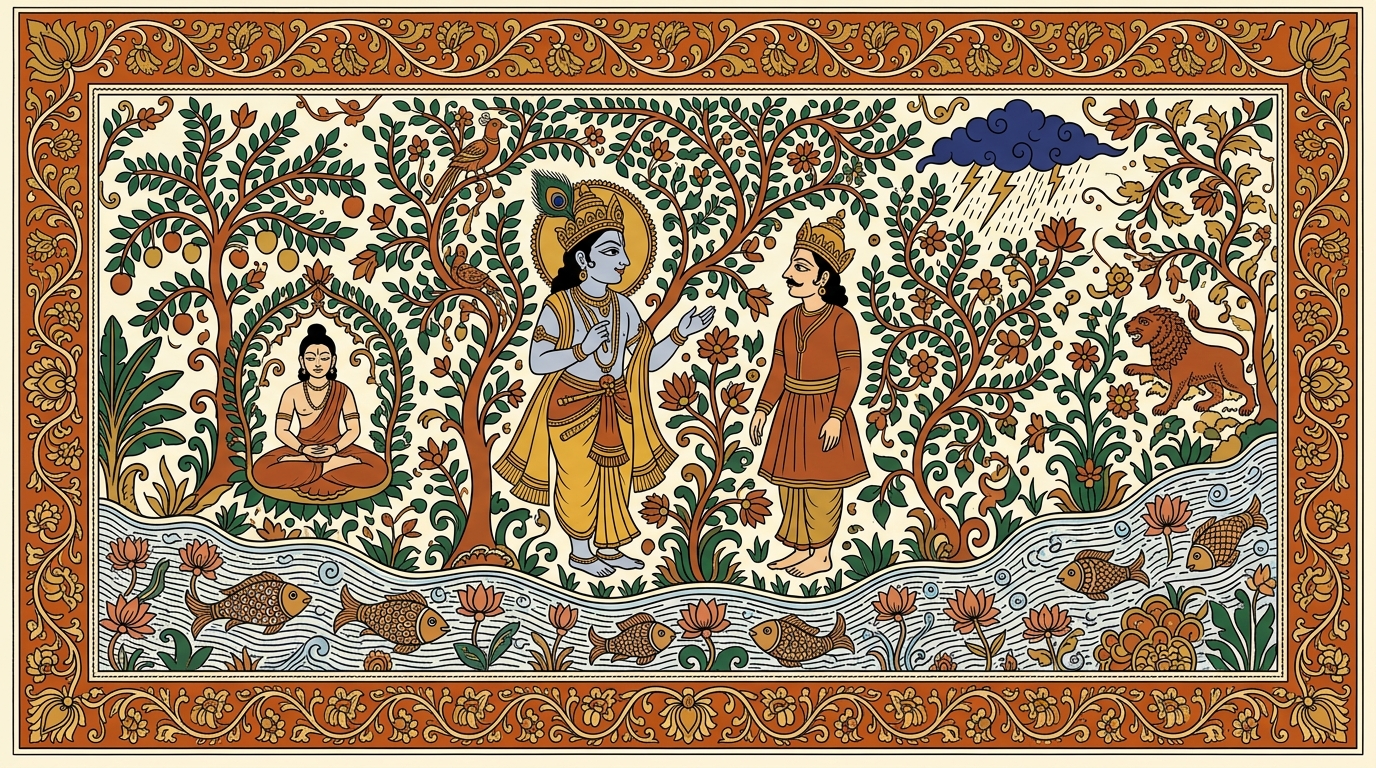
On the river that bordered the war-plain there worked a boatman named
Tunga, and the village children loved to ride with him because nothing
ever rattled him.
One spring the river was kind. Trade was busy, coins filled Tunga's
pouch, and a wealthy traveller, delighted by the smooth crossing, pressed
a gold ring into his hand. The children expected Tunga to whoop and dance.
He only thanked the man, tucked the ring away, and pushed off for the next
crossing, humming the same low tune as always.
"Aren't you happy?" asked a girl named Ila.
"I am pleased," Tunga said. "But the river gave it, and the river can take
it. Why let my heart fly up so high it has far to fall?"
Later that summer the river turned cruel. A storm smashed his boat against
the rocks, and he lost nearly everything. The children crept down to the
bank, afraid they would find him weeping. Instead they found Tunga calmly
lashing new planks together, humming the same low tune.
"Aren't you sad?" Ila whispered.
"I am sorry for the boat," he said. "But I am not drowning, and you are
here, and the river is still the river. If I did not leap up when it gave,
why should I fall down when it takes?"
Ila sat with him a long while, watching his steady hands, and felt
something settle in her own chest like a stone finding the bottom of a
pond.
In a chariot far upriver, Krishna was describing exactly such a heart to
Arjuna. "The one who does not get giddy when good things come, and does
not collapse when hard things come — clear, unconfused, knowing the Self
within — that one already lives in the great calm. Pleasant and unpleasant
are only the river's moods."
Tunga fitted the last plank, tested it with his weight, and pushed his
mended boat back into the current. The water rocked him.
He did not rock back.