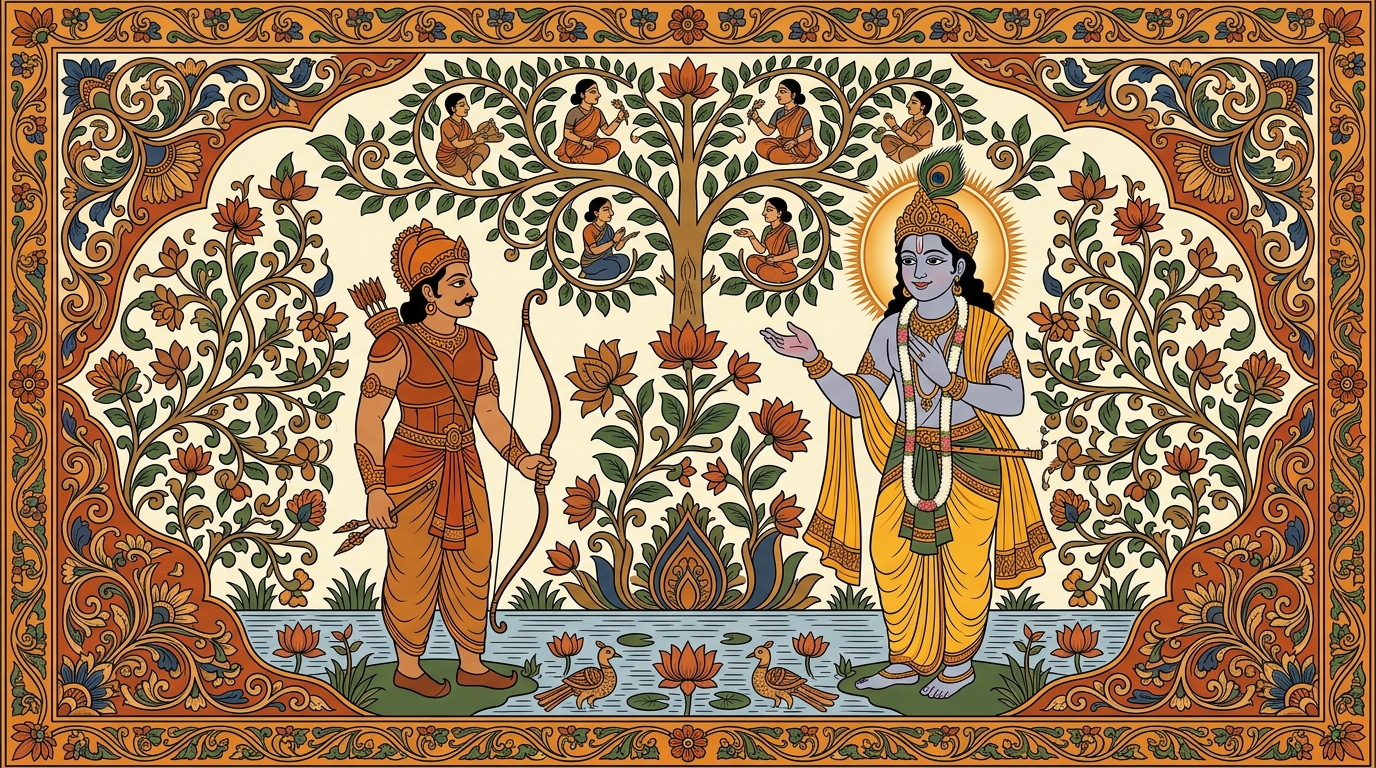
The Yoga of Letting Go
कर्मसंन्यासयोग
Arjuna asks Krishna a great question — is it better to stop doing things or to keep doing them? Krishna smiles and says both paths lead to happiness, but doing good work with a cheerful heart is easier and better. A wise person stays calm and peaceful like a still lake, even in the middle of a busy life.
✶ Art Style: Kalamkari from Andhra Pradesh Learn more
Kalamkari literally means "pen-work" — kalam (pen) and kari (work). This ancient art from Andhra Pradesh uses a bamboo or date palm stick sharpened into a pen, dipped in natural dyes made from plants and minerals. Artists draw intricate outlines of gods, flowers, and the famous Tree of Life motif, then fill them with earthy colors. The Srikalahasti school focuses on freehand temple hangings, while the Machilipatnam school uses hand-carved blocks for printing on fabric. The result looks like a beautiful, detailed textile come to life.
Signature Elements
- • Fine pen-drawn outlines with natural dye fills
- • Elaborate scrolling vine and floral borders
- • Tree of Life motif
- • Textile-like patterning throughout
Did you know?
Making Kalamkari fabric involves 23 steps — including soaking the cloth in buffalo milk and myrobalan solution! The entire process can take weeks, and the natural dyes mean no two pieces ever look exactly the same.
संन्यासं कर्मणां कृष्ण पुनर्योगं च शंससि। यच्छ्रेय एतयोरेकं तन्मे ब्रूहि सुनिश्चितम्॥
ArjunaArjuna is still puzzled. He says to Krishna: "First You praise giving up action altogether, and then You praise yoga — doing your work in a calm, selfless way. These sound like two different paths. Please choose for me, clearly and for certain, the one path that is better."
संन्यासः कर्मयोगश्च निःश्रेयसकरावुभौ। तयोस्तु कर्मसंन्यासात्कर्मयोगो विशिष्यते॥
KrishnaKrishna answers gently: "Both paths lead to the highest happiness: walking away from action, and doing your work without grasping at rewards. But of the two, doing your work in this calm, selfless way is the better one." He chooses, but he does not throw the other path away.
ज्ञेयः स नित्यसंन्यासी यो न द्वेष्टि न काङ्क्षति। निर्द्वन्द्वो हि महाबाहो सुखं बन्धात्प्रमुच्यते॥
KrishnaKrishna explains: "The real renouncer is not always the one who runs away. It is the one who neither hates what comes nor desperately wants what he doesn't have. Mighty Arjuna, a person who is free of those tugging opposites — liking and disliking — is easily set free from every kind of bondage."
सांख्ययोगौ पृथग्बालाः प्रवदन्ति न पण्डिताः। एकमप्यास्थितः सम्यगुभयोर्विन्दते फलम्॥
KrishnaKrishna says: "Only childish, unwise people think that the path of knowledge and the path of action are two completely separate things, leading to different places. The wise know better. Whoever follows even one of these paths properly, all the way, gains the reward of both."
यत्सांख्यैः प्राप्यते स्थानं तद्योगैरपि गम्यते। एकं सांख्यं च योगं च यः पश्यति स पश्यति॥
KrishnaKrishna continues: "The very same goal that quiet thinkers reach by knowledge, busy workers reach by acting selflessly. Knowledge and action arrive at the same place. Whoever sees that these two are really one, that person truly sees how things are."
संन्यासस्तु महाबाहो दुःखमाप्तुमयोगतः। योगयुक्तो मुनिर्ब्रह्म नचिरेणाधिगच्छति॥
KrishnaKrishna says: "Mighty Arjuna, simply giving up action is hard to do well if you haven't first learned to act calmly and selflessly. But the sage who works in that steady, unselfish way reaches Brahman — the great, boundless peace — before very long." Doing your work the right way prepares you for the deeper stillness.
योगयुक्तो विशुद्धात्मा विजितात्मा जितेन्द्रियः। सर्वभूतात्मभूतात्मा कुर्वन्नपि न लिप्यते॥
KrishnaKrishna describes the calm worker: "Someone who is steady in selfless action, with a clear pure mind, who is master of himself and his senses, who feels every living being as part of his own self — that person acts all day long and yet nothing sticks to him." He stays clean and free even in the middle of work.
नैव किञ्चित्करोमीति युक्तो मन्येत तत्त्ववित्। पश्यञ्शृण्वन्स्पृशञ्जिघ्रन्नश्नन्गच्छन्स्वपञ्श्वसन्॥
KrishnaKrishna shares a secret of the wise: the one who truly understands how things work thinks quietly, "I am not really the one doing anything at all" — even while seeing, hearing, touching, smelling, eating, walking, sleeping, and breathing. He knows it is his eyes, ears, hands, and senses doing their natural work, not his deepest self.
प्रलपन्विसृजन्गृह्णन्नुन्मिषन्निमिषन्नपि। इन्द्रियाणीन्द्रियार्थेषु वर्तन्त इति धारयन्॥
KrishnaKrishna explains how a wise person feels even while doing many things. While talking, releasing, grasping, opening and closing the eyes, the wise one quietly knows: "It is only the senses moving among their objects." The eyes see, the ears hear, the hands hold — but the calm one inside is not pulled along by any of it.
ब्रह्मण्याधाय कर्माणि सङ्गं त्यक्त्वा करोति यः। लिप्यते न स पापेन पद्मपत्रमिवाम्भसा॥
KrishnaKrishna gives one of his most beautiful pictures. A person who offers all their actions to Brahman, the vast Whole, and lets go of clinging to results, is never stained by wrongdoing. They stay clean and free in the middle of all their work — just as a lotus leaf sits on a pond yet never gets wet.
कायेन मनसा बुद्ध्या केवलैरिन्द्रियैरपि। योगिनः कर्म कुर्वन्ति सङ्गं त्यक्त्वात्मशुद्धये॥
KrishnaKrishna says that yogis work with their body, their mind, their understanding, and even just their senses — but they let go of clinging to what they will get from it. They do their work for one quiet reason: to make their own heart clean and clear. Their actions become a way of washing the self.
युक्तः कर्मफलं त्यक्त्वा शान्तिमाप्नोति नैष्ठिकीम्। अयुक्तः कामकारेण फले सक्तो निबध्यते॥
KrishnaKrishna shows two people side by side. The steady one gives up grasping at what their work will get them, and so they find a peace that lasts and does not wobble. The restless one, pulled along by wanting, clings to the prize at the end, and that very clinging ties them up like a knot. Letting go of the fruit is what sets you free.
सर्वकर्माणि मनसा संन्यस्यास्ते सुखं वशी। नवद्वारे पुरे देही नैव कुर्वन्न कारयन्॥
KrishnaKrishna calls the body a city with nine gates: two eyes, two ears, two nostrils, a mouth, and the two lower openings. The true self who lives inside this little city can set aside all actions in the mind and simply rest there, happy and self-controlled, neither doing anything nor making anything happen. The body works, but the dweller within stays calm and at home.
न कर्तृत्वं न कर्माणि लोकस्य सृजति प्रभुः। न कर्मफलसंयोगं स्वभावस्तु प्रवर्तते॥
KrishnaKrishna explains something surprising. The great Lord does not create the feeling of "I am the doer" in people, nor does He make their actions, nor does He tie deeds to their rewards. It is each person's own nature, moving on its own, that sets all of this in motion. We are not puppets pushed by some outside hand. Our own inborn ways carry us forward.
नादत्ते कस्यचित्पापं न चैव सुकृतं विभुः। अज्ञानेनावृतं ज्ञानं तेन मुह्यन्ति जन्तवः॥
KrishnaKrishna says the all-pervading Lord does not take on anyone's wrongdoing or anyone's good deeds. So why do people feel lost and confused? Because their inner knowing is covered over by not-knowing, the way a cloud hides the sun. The wisdom is already there inside every creature. It is only veiled, and that veil is what muddles us.
ज्ञानेन तु तदज्ञानं येषां नाशितमात्मनः। तेषामादित्यवज्ज्ञानं प्रकाशयति तत्परम्॥
KrishnaKrishna says that when true knowledge clears away a person's ignorance, that knowledge shines like the sun. Just as the sun lights up everything it touches, this inner knowing reveals the highest truth: the one Self that lives quietly inside every being.
तद्बुद्धयस्तदात्मानस्तन्निष्ठास्तत्परायणाः। गच्छन्त्यपुनरावृत्तिं ज्ञाननिर्धूतकल्मषाः॥
KrishnaKrishna describes people whose minds, hearts, and whole lives are settled on the highest truth, with that truth as their one goal. Because knowledge has washed away every stain in them, they reach a peace they never fall back out of. Their seeing has become so steady that they cannot lose it again.
विद्याविनयसम्पन्ने ब्राह्मणे गवि हस्तिनि। शुनि चैव श्वपाके च पण्डिताः समदर्शिनः॥
KrishnaKrishna says that the truly wise see the same shining Self in everyone and everything: in a gentle, learned person, in a cow, in an elephant, in a dog, and in someone the world has pushed to its edges. They do not love one and look down on another. They see the one light living equally in every body, no matter how different the bodies look from the outside.
इहैव तैर्जितः सर्गो येषां साम्ये स्थितं मनः। निर्दोषं हि समं ब्रह्म तस्माद्ब्रह्मणि ते स्थिताः॥
KrishnaKrishna says that people whose minds rest in this equal vision have already won, right here in this life: they have risen above the endless tumble of the changing world. Because the one vast Self, Brahman, is flawless and the same everywhere, those who see that sameness are already living inside it. Their peace does not wait for some far-off day. It is theirs now.
न प्रहृष्येत्प्रियं प्राप्य नोद्विजेत्प्राप्य चाप्रियम्। स्थिरबुद्धिरसम्मूढो ब्रह्मविद्ब्रह्मणि स्थितः॥
KrishnaKrishna says that a person of steady mind does not leap up wild with joy when something nice happens, and does not crumble when something unpleasant comes. Clear-headed and unconfused, knowing the one Self within, such a person already lives in that calm vastness. Good news and bad news come and go, but their quiet does not tip over.
बाह्यस्पर्शेष्वसक्तात्मा विन्दत्यात्मनि यत्सुखम्। स ब्रह्मयोगयुक्तात्मा सुखमक्षयमश्नुते॥
KrishnaKrishna says that a person who is not glued to the pleasures chased outside discovers a happiness waiting inside themselves. Joined in quiet union with the one Self, that person enjoys a happiness that never wears out. Outer treats always run low; this inner one keeps on giving.
ये हि संस्पर्शजा भोगा दुःखयोनय एव ते। आद्यन्तवन्तः कौन्तेय न तेषु रमते बुधः॥
KrishnaKrishna gently warns Arjuna that the pleasures born when our senses touch exciting things are actually little wombs of pain: they always carry a hidden ache inside them. Every one of them has a beginning and an end, so the joy never stays. Knowing this, a wise person does not pin their heart on them.
शक्नोतीहैव यः सोढुं प्राक्शरीरविमोक्षणात्। कामक्रोधोद्भवं वेगं स युक्तः स सुखी नरः॥
KrishnaKrishna says: the person who, while still alive in this body, can stand firm against the sudden rush of desire and anger, that person is steady, and that person is happy. Desire and anger come like a wave that tries to knock us over. The one who keeps their feet, again and again, has found a quiet kind of joy.
योऽन्तःसुखोऽन्तरारामस्तथान्तर्ज्योतिरेव यः। स योगी ब्रह्मनिर्वाणं ब्रह्मभूतोऽधिगच्छति॥
KrishnaKrishna describes the person whose happiness comes from inside, who delights and rests within, and who carries a light within. That person no longer needs the world to hand them joy from outside. Settled and at one with the vast, endless truth, they reach a deep and unshakable peace.
लभन्ते ब्रह्मनिर्वाणमृषयः क्षीणकल्मषाः। छिन्नद्वैधा यतात्मानः सर्वभूतहिते रताः॥
KrishnaKrishna says the sages who reach this deep peace are the ones whose faults have worn away, whose doubts have been cut clean through, who have learned to hold themselves steady, and who take real delight in the good of every living thing. Their kindness reaches every being everywhere, not only a few.
कामक्रोधवियुक्तानां यतीनां यतचेतसाम्। अभितो ब्रह्मनिर्वाणं वर्तते विदितात्मनाम्॥
KrishnaKrishna says that for those who have let go of desire and anger, who have disciplined themselves and steadied their minds, and who have come to know their own true Self, the deep peace of Brahman is all around them, close on every side. They do not have to travel far to find it; it surrounds them already.
स्पर्शान्कृत्वा बहिर्बाह्यांश्चक्षुश्चैवान्तरे भ्रुवोः। प्राणापानौ समौ कृत्वा नासाभ्यन्तरचारिणौ॥
KrishnaKrishna now describes how to sit quietly. Let go of the things tugging at the senses from outside, and rest the gaze softly between the eyebrows. Make the breath going out and the breath coming in slow and even as they pass through the nose. This is how the body grows still so the mind can settle.
यतेन्द्रियमनोबुद्धिर्मुनिर्मोक्षपरायणः। विगतेच्छाभयक्रोधो यः सदा मुक्त एव सः॥
KrishnaKrishna continues: the sage who holds the senses, mind, and thinking steady, who keeps their heart set on freedom, and who has let go of desire, fear, and anger, that person is already free, always and forever. Once those three things no longer rule you, no chain can hold you.
भोक्तारं यज्ञतपसां सर्वलोकमहेश्वरम्। सुहृदं सर्वभूतानां ज्ञात्वा मां शान्तिमृच्छति॥
KrishnaKrishna gives the last word of the chapter. He says: whoever knows me as the one who lovingly receives every offering and every act of effort, as the great Lord of all the worlds, and as the warm-hearted friend of every single living being, that person comes to rest in peace. To know that the heart of all things wishes you well is itself the deepest peace. And that friend is the very Self living at your own centre.