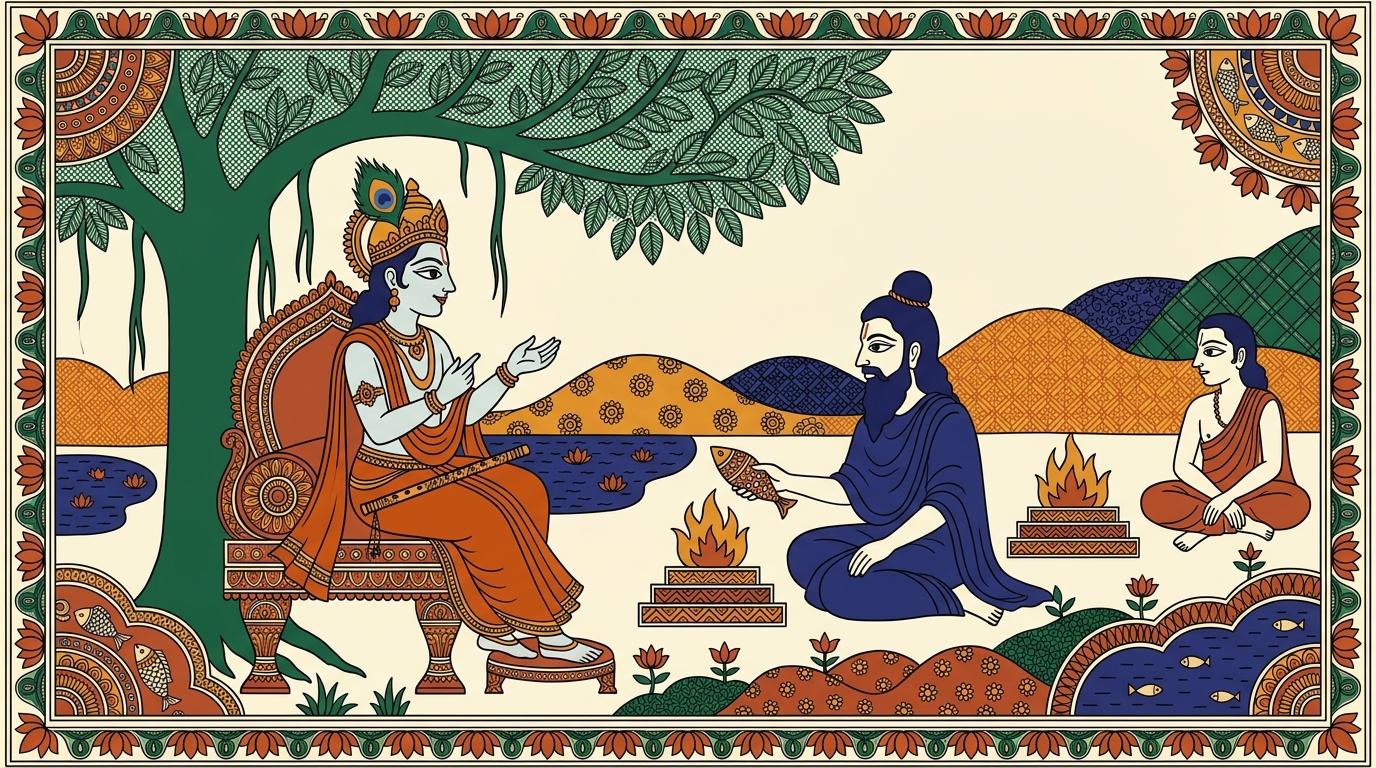
The horses stood still in the cold light, and Krishna spoke as if he were
setting two paintings side by side for Arjuna to study.
"Let me show you two kings," he said, "so you understand what renunciation
means. Both believed they had given up the world. Only one of them
was free."
Arjuna leaned forward on the chariot rail.
"The first king grew weary of his crown. So one morning he walked out of his
palace, left the throne to whoever wanted it, and went to live in the forest.
He wore bark instead of silk. He ate roots. He lit no fire and did no work.
'Now I have given up everything,' he told himself. But sit beside him at
dusk, Arjuna, and you would hear him muttering. 'Is my brother ruining the
kingdom? Are the people speaking my name? Did I leave too soon — or too
late?' His body sat under a tree, but his mind paced the marble halls he had
left behind. He had walked away from the work, yet carried all its worry
into the trees. He was a renunciate in costume only."
Krishna let that picture settle.
"Now the second king. He kept his crown. Every dawn he sat in the hall of
judgement and heard the people's troubles. He led armies when he had to. He
collected taxes, mended roads, settled quarrels. His hands were never idle.
Yet ask him at night, 'Was today a victory or a defeat?' and he would only
smile. 'I did what was mine to do,' he would say. 'The fruit is not in my
keeping.' He did not lie awake counting his rewards, because he had never
been working for them. He held the kingdom the way you hold water in an open
palm — fully, but without clutching."
Krishna turned to Arjuna.
"Tell me — which of the two had really renounced? Not the one who fled the
work and kept the worry. The one who kept the work and let go of the worry.
That is the renunciate. That is the yogi. Lighting no fire and sitting idle
makes no one free. Doing your duty without grasping at its fruit — that is
the whole secret."