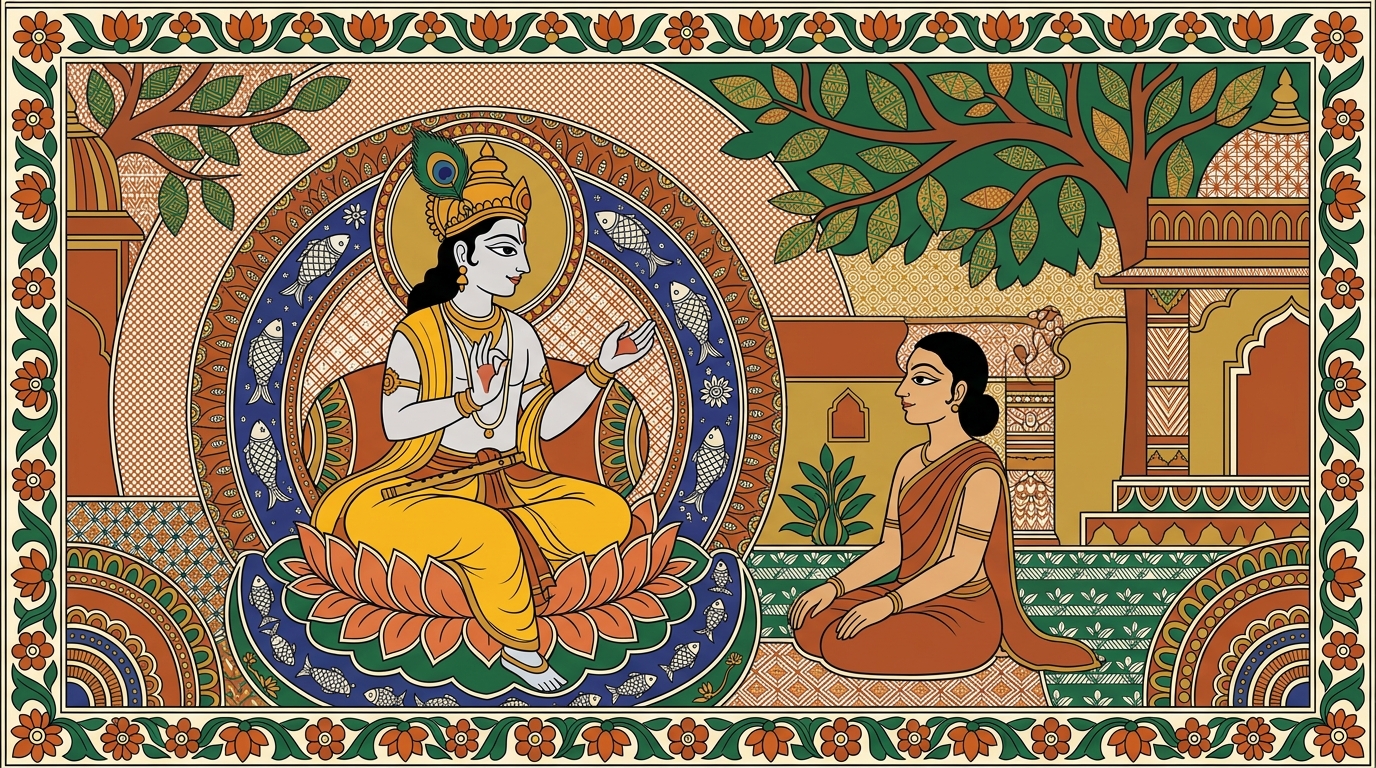
It was the hour before sunrise in the old gurukul, when the sky was the
colour of a pearl and the birds had only just begun. A young student
named Aruni rose without a sound, washed at the well, and walked to the
smooth flat stone beneath the banyan where he sat each morning.
He had taken the vow of the brahmachari — to live simply, to study with
a clean heart, to keep his energy gathered rather than scattered after
every wanting. The vow was not a chain on him. It was more like the banks
of a river: because his days had clear, steady banks, the whole stream of
his life could run deep and strong toward one sea.
He settled onto the stone, body straight, eyes soft. First he let his
heart grow quiet. The little frights of a boy — fear of failing, fear of
the dark wood, fear of what the older students thought — he set them down
one by one, like setting down stones he had been carrying without noticing.
*There is nothing here to fear,* he told himself, *for the Self I seek
fears nothing and lacks nothing.* His breathing slowed. A great calm
spread through him.
Then, with his mind gathered and held, he turned his whole attention
inward and upward — toward the Supreme, the boundless Self that his
teacher said dwelt in his own heart and in all things alike. He did not
picture a faraway god in the sky. He simply let everything else fall away
until that one shining presence was all he leaned toward, his highest aim,
nearer to him than his own breath.
The first ray of sun slipped through the banyan leaves and touched his
still face. He did not stir. Serene, unafraid, his life kept clean and
simple, his heart fixed on the One — Aruni sat as a lamp sits, quietly
burning, holding nothing back.
His teacher, passing by, did not disturb him. "That," the old man thought,
"is what it looks like to truly sit."