Ravi could not stop fidgeting. He scratched his elbow, then his ankle.
He slumped, then twisted to peek at Moti, then tipped sideways to see who
was walking past the gate. His head bobbed about like a sparrow's, looking
everywhere at once.
"How am I supposed to be calm inside," he complained, "when my body keeps
doing this?"
Nani set down her brush and beckoned him over to the wall, where her
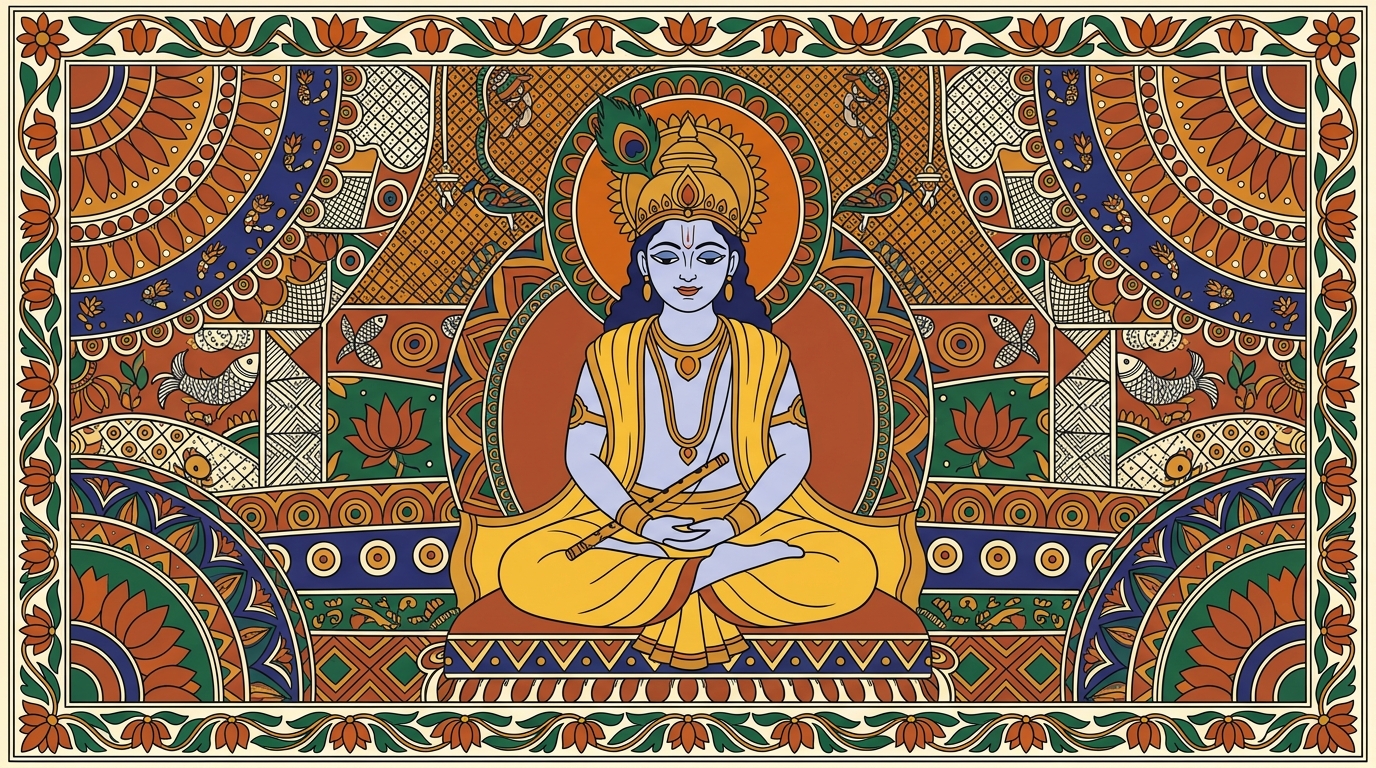
newest Madhubani painting was drying. It showed a row of figures — a
musician, a dancer, a sage — and Ravi noticed, for the first time, how
they were drawn. Every one of them sat or stood perfectly straight, spine
like a young bamboo, head balanced level on the neck, eyes calm and
forward.
"Look how the old painters drew people who were at peace," Nani said.
"Never crumpled, never craning their necks to gawk. Body, neck, and head
in one straight line, like a string held gently taut. The straightness is
not stiffness. See how soft their faces are? It is *steadiness*."
She helped him settle on his mat. "Stack yourself up gently," she said.
"Bones over bones, like a careful tower. Now let your eyes go soft — don't
squeeze them shut, just lower them, as if you were looking toward the tip
of your own nose. When the eyes stop running off in every direction, the
mind stops running after them."
Ravi tried it. He sat tall, neck long, chin level. He let his gaze drop
softly downward and stopped hunting for things to look at. To his
surprise, the urge to fidget began to fade. With his body settled like
one of the painted figures, there was suddenly nothing to twist toward,
nothing to peek at.
"Oh," he whispered, eyes half-closed. "It's quieter already."
"That is the body teaching the mind," Nani said softly. "A steady seat,
a straight back, and eyes that stop wandering. Even the great sages began
right there."